

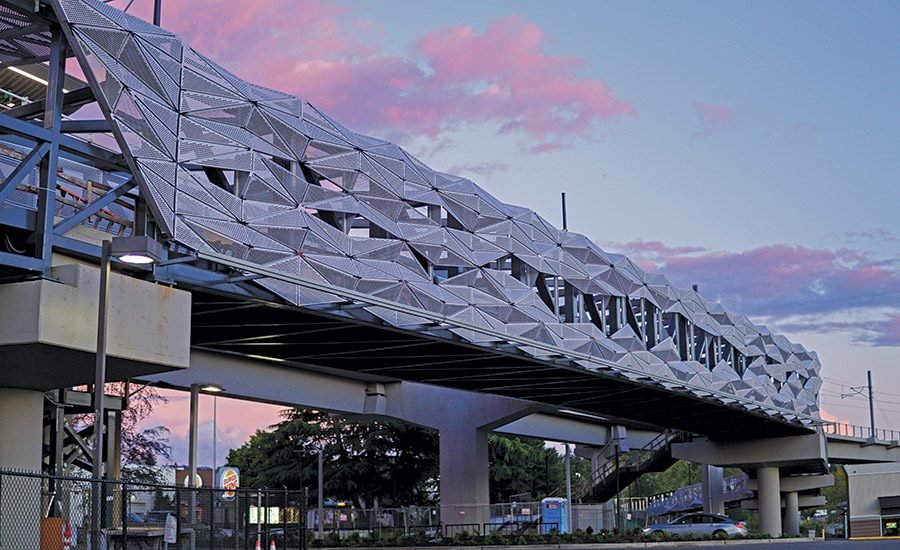
NE 8th Street Eastrail Crossing
Bellevue, Wash.
BEST PROJECT, HIGHWAY/BRIDGE, and Merit Award, Safety
Presented by Granite Construction Co.
owner King County
Leading design company KPFF Consulting Engineers
General Contractor Granite Construction Co.
As part of the larger Eastrail program that converts 42 miles of former railroad tracks into a multi-use trail, this $18.2 million project serves as a vital link in King County’s shift toward sustainable, transit-oriented transportation.
The scope included a 550-foot-long, six-span steel truss bridge over NE 8th Street, allowing multimodal commuters to safely bypass one of downtown Bellevue’s most dangerous streets.
Ramps on either side double the length of the bridge, while stairs connect directly to the lower level of the light rail station and the RapidRide B line bus stop. The bridge incorporates historical and cultural elements that honor the local contributions of Japanese Americans, including a 121-foot mural, intricate steel display walls and origami-style aluminum cladding.
Maneuvering within a dense urban corridor presented major challenges for the project team. The project team led weekly planning meetings for three months to ensure the bridge could be safely raised during an overnight closure. All approach sections were also assembled on site.

Photo by Elizabeth Novy
The 170-foot center bridge was assembled and stored in a narrow area between the concrete Sound Transit guide piers, approach spans, and adjacent properties.
During the night shutdown, the team used specialized motors to navigate extremely tight horizontal and vertical clearances, safely transporting the section from assembly site to assembly site. The main bay was then successfully lifted using two hydraulic cranes.
During construction, the team navigated more than $1.6 million in owner-requested design changes while managing schedule and budget challenges. Solutions were worked out collaboratively.
During 48,000 hours of work, the project team recorded zero lost or recordable time incidents thanks to comprehensive safety protocols and offline construction strategies. To minimize the risk of falls and protect the traveling public while crews worked above live traffic, the team built and mounted the main light at ground level and away from traffic before transporting and mounting it into place. This approach dramatically reduced exposure to fall hazards and traffic-related risks.
