

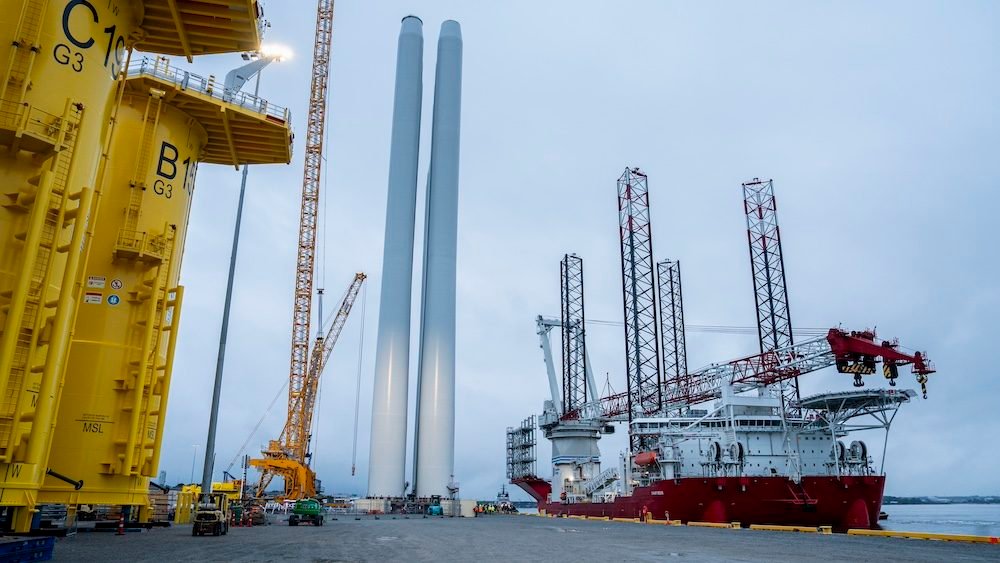

On Dec. 22, the White House ordered an immediate pause in federal ocean leases for five large offshore wind projects under construction on the US East Coast, citing national security concerns linked to classified assessments, the US Department of the Interior said.
In a statement the same day, Interior said the pause applies to Vineyard Wind 1 off the coast of Massachusetts and that it is partially operational; Empire Wind 1 and Sunrise Wind, both underway off New York; Revolution Wind almost finished between Rhode Island and Connecticut; and Coastal Virginia Offshore Wind, in Virginia Beach and due for completion next year. All have received federal approvals.
The action follows a Dec. 10 decision by Federal District Court Judge Patti Saris in Boston to vacate an indefinite halt by federal agencies to permitting onshore and offshore wind energy projects imposed in a Jan. 20 executive order by President Donald Trump. The ruling came in a lawsuit by 17 states led by New York and Massachusetts, along with the District of Columbia, against the order that put federal project approvals on hold pending a new review.
“The administration has had several legal setbacks … responding petulantly by ‘throwing their toys out of the pram,'” offshore wind industry analyst Philip Totaro, managing director of consultancy IntelStor, told ENR.
“All projects subject to the construction pause already underwent a national security review when they were permitted.” he added. “There are now more than 80 GW of offshore wind projects operating in the world, and while some had legitimate radar interference issues, they were dealt with during the permitting process.”
RELATED
Federal Court in Boston rejects Trump’s blanket freeze on wind energy approvals
Federal research has long recognized that wind turbines can create radar “clutter,” but Energy Department studies also note that mitigation technologies and operational adjustments can reduce those effects.
Interior Secretary Doug Burgum said the action is intended to allow for further review of “emerging national security risks,” including potential radar interference from large offshore wind facilities and evolving adversary technologies, despite the fact that the U.S. Department of Defense vetted the projects as part of its federal approvals. Interior said it will work with the defense agency, tenants and state partners to assess whether mitigation measures are feasible.
go “It needs every electron”
“The Virginia offshore wind project is essential to American national security and to meeting the dramatically growing energy needs of Virginia, the fastest growing in America. [that] is driven by the need to provide reliable power to many of America’s most important war installations, the world’s largest warship manufacturer and the largest concentration of data centers on the planet, as well as the forefront of the AI revolution,” Jeremy Slayton, a spokesman for owner Dominion Energy, told ENR.
“Stop [it] over any period of time will threaten the grid reliability of some of the country’s most important civilian, artificial intelligence and civilian assets,” he continued. “It will also lead to energy inflation and threaten thousands of jobs. CVOW is owned by the United States and benefits all of our customers in Virginia [who] they pay for the project after a careful review … by Virginia state regulators in 2022.” Outgoing Republican Gov. Glenn Youngkin was also supportive.
Slayton added that “Virginia needs all the electrons we can get as our electricity demand doubles. This will power the data centers that will win the AI race, support our warfighters and build the nuclear warships needed to maintain our maritime supremacy. Virginia’s grid needs the addition of electrons, not the rest.”
He said the owner and the project team “are ready to do whatever it takes to get those vital electrons flowing as quickly as possible.” Still, he declined to confirm whether the utility or the state is considering immediate legal action.
The decision also drew immediate criticism from environmental and clean energy advocates. The Conservation Law Foundation noted that the action revives arguments previously rejected by the courts and warned that it could expose the federal government to legal challenges.
Ted Kelly, director and senior adviser for U.S. clean energy at the Environmental Defense Fund, said the administration was “recklessly blocking the creation of clean, affordable energy for millions of Americans, just as the nation’s need for electricity is increasing,” according to the Associated Press.
RELATED
UPDATED: Connecticut, RI governors fight back against nearly completed wind project ordered by Trump
While no joint statement has yet been issued on this development, several state governors’ offices have reiterated concerns that abrupt federal actions could undermine regulatory certainty for long-standing infrastructure projects.
The Democratic governors of Massachusetts, Rhode Island, Connecticut, New York and New Jersey said in public statements earlier this year that halting or reversing approved offshore wind projects threatens billions of dollars in private investment, port redevelopment and thousands of maritime and union construction jobs tied to the region’s clean energy supply chain.
Interior did not immediately release project-specific stop-work orders or detail how the lease pause will affect offshore construction schedules, maritime operations or supply chain contracts. Developers and state agencies said they were reviewing the announcement and awaiting formal direction from federal regulators.
“There are legal precedents for disobeying government orders that are issued in bad faith. Developers should feel comfortable challenging these stop orders because the consequences of challenging them actually pale in comparison to the billions they stand to lose if they stop construction,” Totaro said.
“Projects could literally run out of budget and never finish construction, and the government knows that. It’s their strategy,” he added. “The fact is that this is a deliberate order issued in bad faith and the developers have grounds to show why they should be allowed to challenge the order. They could also seek compensation from the government for intentionally interfering with the project development process.”
According to Totaro, “Equinor, in particular, already had an agreement in May to continue construction. The fact that the Trump administration reneged on that agreement is evidence of bad faith.”
ENR will continue to follow this story as Interior and project developers issue project-level guidance and as states assess potential legal and economic impacts.
