

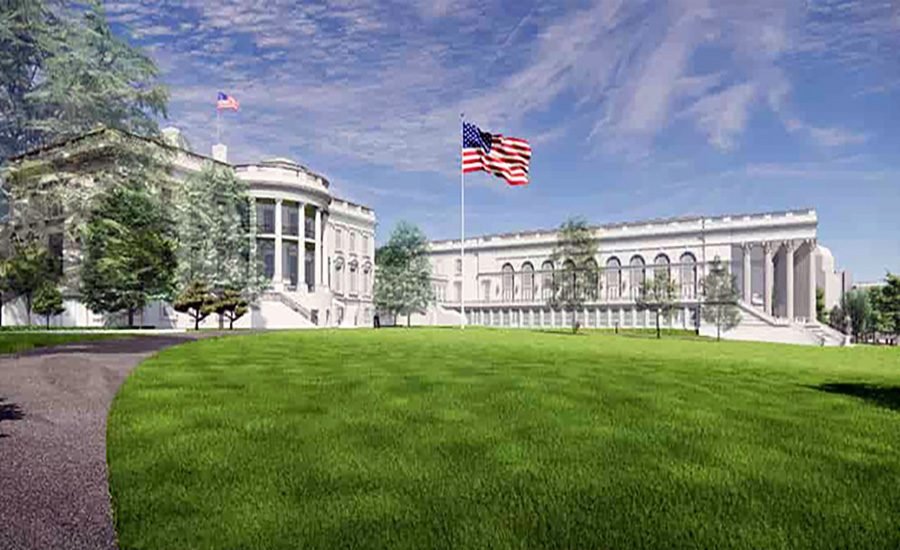
Federal planners reviewing the proposed modernization of the White House’s East Wing delayed a decision on President Donald Trump’s new ballroom until April after nearly two hours of public testimony at a March 5 meeting of the National Capital Planning Commission.
NCPC staff recommended approval of the final plans for the site and building, arguing that the public will see little change in the main views of the White House because pedestrian sight lines will mostly be blocked by existing landscaping. However, commissioners decided to postpone the decision until their April meeting after hearing lengthy testimony from preservation groups, architects and private citizens.
See the project — in 3-D

The New York Times, in its March 5 online edition, offers a dynamic 3D presentation of the White House Ballroom project that readers can access without a firewall.
Representation courtesy of NPCP
The project program is not modest. Staff describe a roughly 22,000-square-foot ballroom designed to seat about 1,000 guests, within about 89,000 square feet on two visible floors above ground, along with support facilities, including a commercial kitchen, a suite of offices for the First Lady and a replacement movie theater.
The delay comes against two pressures surrounding the proposal: a public comment log that exceeds 30,000 submissions, most opposing the project, and an active federal lawsuit. U.S. District Judge Richard J. Leon recently denied the National Trust for Historic Preservation’s request for a preliminary injunction, but signaled that the dispute could return quickly if the plaintiffs reframe their challenge to directly question presidential statutory authority.
The design has already cleared a federal design review hurdle. The US Commission of Fine Arts approved the concept and final plans at its February 19 meeting.
Building Intelligence in the Federal Register
The submission identifies Shalom Baranes Associates Architects as the project architect and includes detailed engineering and construction documentation that rarely appears in early-stage federal planning filings.
In a Feb. 5 memo sent to NCPC, Joshua Fisher, assistant to the president and director of the White House Office of Administration, lays out the administration’s engineering case for a full rebuild rather than a modification.
Looking for quick answers on construction and engineering topics?
Try Ask ENR, our new intelligent AI search tool.
Ask ENR →

Architectural elevation drawings submitted to the National Capital Planning Commission for the modernization of the East Wing of the White House show the facade of the proposed State Ballroom, including a revised portico design that eliminates the triangular pediment.
Representation courtesy of NCPC
The White House says that bringing the old East Wing and colonnade up to modern structural and safety requirements would have required stripping the buildings “down to the structural shell and walls,” and then inserting additional structural support throughout in ways that would permanently alter the designs and finishes.
Fisher linked the rebuilding decision to state-specific issues, citing chronic water intrusion and substructure leaks, mold contamination and life safety deficiencies, including egress and compartmentalization issues that, he wrote, created an “unacceptable risk to occupants.”
It is the most direct articulation in the federal planning record to date of why the project team argues that the existing east wing could not be modernized without fundamental structural intervention.
NCPC staff also noted that the design has evolved since the commission’s Jan. 8 briefing. Among the changes was the removal of a triangular pediment on the south facade, which staff say reduces the perceived height and simplifies the roofline.
RELATED
US Commission of Fine Arts approves Trump ballroom design, next stop is NCPC vote
Even with the recommended approval, staff flagged a remaining design pressure point, saying the south portico’s dense column spacing could create what the report described as a “heavy, dark facade” and calling for more refinement.
The same filing describes a workplace protection plan: heavy equipment kept “at a safe distance” from the executive mansion, selective removal of hands closer to the mansion, stabilization to prevent collapse and vibration, and monitoring of crack movement to confirm ongoing work does not harm the mansion or nearby structures. ENR has previously reported on the project’s monitoring and limited monitoring regime.
The National Environmental Policy Act (NEPA) filing now includes a key interface detail that engineers and general contractors will immediately notice: Limited portions of the east facade of the previously removed Executive Mansion will be reinstalled to align the two levels. The NEPA decision file also determines the footprint and duration of staging.
It describes a temporary construction zone through the summer of 2028 that would close Madison Place NW between H Street NW and E Street NW and restrict portions of Pennsylvania Avenue, which run about 260 feet east and 350 feet west from the Madison Place centerline.
The presentation envisages a heavy load logistics. ENR previously reported that a crane and other heavy equipment have been moved to the site in anticipation of the federal review process moving forward.
Baranes, the project’s architect, defended the size of the ballroom during the meeting, telling commissioners that the massive floor plate reflects the unique security and operational requirements of presidential events. The space must accommodate not only 1,000 seated guests, but also camera platforms, security circulation corridors, staging areas and ceremonial elements such as military color guards.
“These events require layers of circulation and security that simply don’t exist in a typical hotel ballroom,” Baranes told commissioners.
The NEPA file also describes previously unreported selective landscape salvage work, including the removal of commemorative southern magnolias due to the new footprint, the careful removal and reinstallation of the east garden, the storage and relief of brick pavers, the dismantling and preservation of the fountain and statue for reinstallation, and rigid barrier protection for the Laura Bush Silver Linden Tree during construction.
“Our intent is to protect and reinstall as much of the existing landscape fabric as possible,” said Rick Parisi, director of MPFP and the project’s landscape architect, who described the plan to carefully remove and store garden elements before construction and restore them once the new structure is complete.
Cover sheets highlight the complexity of coordination by listing specialist consultants such as food service, acoustics and vibration, AV and vertical transport.
On the civil side, the level plan notes that an existing rectangular granite drainage channel along the security fence will be retained and integrated into the new storm drain system, with existing ditch drains in two gates remaining functional during construction.
RELATED
Watchdog demands records on White House ballroom project
Press case of preservation groups during the testimony
NCPC entered the meeting with a very uneven record of public comments. Staff reported more than 30,000 submissions as of the report date, with the vast majority opposing the project.

Architectural plans and elevation drawings submitted with federal review submissions show the footprint and massing of the proposed modernization of the East Wing of the White House and the addition of the State Ballroom, including the upper event space and lower support areas.
Credit: AP Photo/Jon Elswick
Carol Quillen, president and CEO of the National Trust for Historic Preservation, the plaintiff in the still-open lawsuit, opened public testimony urging commissioners to slow the process and consider alternatives.
“There is no choice between respecting our history for the American people and accommodating the needs of modern government,” he said, arguing that a smaller, lower ballroom could still host large events while preserving the historic sight lines and architectural primacy of the White House.
Several speakers focused on architectural scale. David Scott Parker, a Rhode Island architect and member of the American Institute of Architects, told commissioners that the ballroom’s portico alone would be “166 percent larger than the South Portico of the White House” and argued that the proposal exceeds typical ballroom size standards.
Staff also reiterated that many objections fall outside NCPC’s statutory jurisdiction, including concerns about the already completed demolition and the project’s financing structure. The administration has described the ballroom proposal as privately funded through donations rather than congressional appropriations, a matter commissioners say is not within the planning body’s authority to evaluate.
Public testimony lasted nearly two hours, longer than the procedural portion of the meeting itself, as preservation groups, architects and private citizens criticized the scale of the ballroom and its potential effect on the historic White House campus.
RELATED
Private funding may provide the Trump White House ballroom, but what pays for the rest?
what happens next
Instead of voting on the proposal, commissioners tabled the decision until the April meeting after hearing extended testimony. Commissioners said the extra time would allow them to review the unusually large public record associated with the project.
Commission Chairman William Scharf, who also serves as Trump’s White House staff secretary, said the April meeting will focus on the commissioner’s deliberations before a final vote on the staff’s recommendation.
Staff said the commission’s eventual action would also trigger adoption of the Environmental Assessment prepared by the National Park Service for use by NCPC, which would allow for a Finding of No Significant Impact (FONSI) to be signed under NEPA.
Beyond the ballroom decision itself, staff used the log to point out additional submissions that were likely to be submitted. The administration plans to submit individual security projects, both temporary and permanent, to the White House complex and nearby areas, indicating that more NCPC reviews could follow.
Whether the ballroom eventually rises where the First Ladies held court now depends on a commission vote in April and the still-active federal lawsuit challenging the project.
