

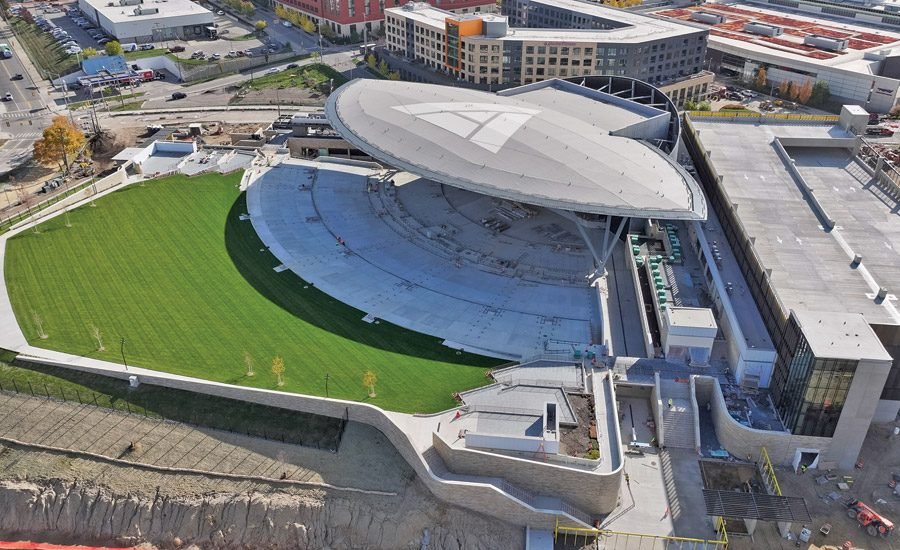
From above a river to below, the Acrisure amphitheater project poses intriguing challenges. Crews are shoring up a site shaped by decades of buried debris from bygone eras and erecting a steel canopy the size of a football field that will protect crowds gathering for concerts and other events along the Grand River in Grand Rapids, Michigan.
“Our geotechnical work was extremely difficult,” says Scott Veine, project executive for Pioneer Construction, which has partnered with another Michigan-based company, Barton Malow, to build the 12,000-seat structure, which is due for completion in May. “We were building on a lot that has been developed and redeveloped since the beginning of the [20th] century, and all the layers of that story were still down there,” Veine says.

The amphitheater was completed in March 2025.
Photo courtesy of Barton Malow
The 10-acre site along Market Avenue was once an island in the Grand River. In the early 1900s, riverboats navigated a canal that later became Market Avenue, delivering people and goods to the heart of the city. Over time, the canal was filled in, often with available materials, to create more land for development. A farmer’s market took the place, followed by a coal-fired power plant that supplied electricity to the furniture factories that lined the river. An incinerator operated by the Michigan Department of Transportation and the city of Grand Rapids followed later by the city’s Department of Public Works.
“When we started digging, we found everything,” Veine says. “The old riverbed, the incinerator stacks, the remains of the power plant, even the railroad tracks where coal used to come in.” This layered past had consequences. Parts of the site were contaminated, meaning that all excavated material had to be treated as Class II spoils. Instead of sending this material to landfills, the project team took a sustainable approach. Some 180,000 cubic meters of material were used to create the site’s huge grass berm and seating bowl, with much of the existing material encapsulated underneath.

The amphitheater is part of a larger revitalization of the riverfront that will bring world-class entertainment and economic engagement to Grand Rapids, Michigan and the surrounding region.
Photo courtesy of Barton Malow
“That meant we kept a lot of waste out of landfills,” Veine says. “From a sustainability standpoint, it was pretty neat and pretty innovative.”
Stabilizing the soil beneath the amphitheater required nearly every geotechnical tool the team could muster. To support heavy point loads from the stage, deck and parking deck, crews installed micropiles drilled deep into the rock. In other areas, controlled modulus columns were used to web and stabilize entire sections of the site, not just individual load points.
“That meant we kept a lot of waste out of landfills.”
—Scott Veine, Project Executive, Pioneer Construction
A third technique, reloading, proved particularly effective under the seat bowl. Crews built the berm in stages, allowing it to settle under its own weight before adding more material. Over approximately eight months, the top of the berm was compressed nearly 6 feet.
“You could see it happen,” Veine says. “We had instruments all over the place, and you could see the graphs rise, level off, then rise again. Once it finally settled down and stayed, we waited about a month to make sure there was no more movement before we built the rest of the bowl.”
Further complicating matters was the geology of the region. Grand Rapids is known for historic gypsum mining, and gypsum lenses embedded in limestone can dissolve over time, causing long-term settlement. To mitigate this risk, the team drilled deep micropiles and injected low-mobility grout up to 60 to 80 feet below grade, stabilizing voids well below the surface.
All of these bases had to be carefully sequenced to maintain a 24-month construction schedule, no small feat in a tight urban site flanked by the river, Market Avenue, active rail lines and the US 131 S curve.

Workers placed 180,000 cubic meters of soil on the berm of the amphitheater and topped it with fresh turf.
Photo courtesy of Barton Malow
“We couldn’t wait for one thing to end before we started another,” says Veine. “While we drilled and overburdened in one area, we were erecting structural steel in another. It’s a very different way to build compared to a hospital or a tall building.”
This overlapping schedule became even more critical once attention turned to the amphitheater’s most visually appealing feature: its steel roof.
In March 2025, the project reached a major milestone when crews broke through the canopy’s structural steel. At that time, a massive amount of steel had been placed, indicating a major step towards the completion of the site.
The canopy comprises approximately 3.2 million pounds of structural steel, with 54% cantilever. Veine notes that the structure could cover virtually any professional or collegiate stadium, and required five super trusses to form its backbone, including a central truss so deep it could hold a two-story house.

The amphitheater canopy is supported by two nodes, each weighing 21,000 pounds and supported by deep micropiles.
Photo courtesy of Barton Malow
The canopy is supported by two steel columns, with three branches on each side, which converge at cast steel nodes at ground level. These nodes create an unobstructed view for spectators while improving acoustic performance by keeping sight lines and sound paths clear.
“The burdens are enormous,” says Veine. “You have gravity loads going down, but you also have massive wind lift. It’s basically a giant wing.”
Each of the two primary columns transfers the load to a concrete foundation block supported by twenty-five 9-in. nested micropiles, squashed outwards like tree roots. These piles extend approximately 100 feet into the bedrock and are driven another 50 feet into the bedrock to resist both downward force and wind uplift.
“There weren’t really any silos. The meetings weren’t about keeping people out, it was about making sure everyone understood where the team was going.”
—Colin Martin, Project Executive, Barton Malow
Due to the size of the canopy, much of the fabrication had to happen on site. The trusses were assembled in the field before being lifted into place, which required complex crane planning and rigging engineering. Two custom cast steel nodes, each weighing about 21,000 pounds, were fabricated in Brazil. Domestic forges were large enough to handle the nodes, but could not provide the required machining.
“The engineering was done in Toronto, the sales team was in Dallas, the casting was done in Brazil, and then we flew the nodes in a C-17 to Miami and transported them to Grand Rapids,” Veine says. “That gives you an idea of the complexity.”
In total, toolmakers placed more than 1,600 tons of steel and more than 51,000 pounds of bolts throughout the project. The largest armor weighed nearly 255,000 pounds.
Building the canopy was based on a collaborative delivery model. Instead of using a traditional hard bid process, the team used a design-assist approach that brought together early fabricators, engineers and steel assemblers. Local companies partnered with national stadium specialists, combining regional knowledge with large-scale experience in a team that became known as Steel Team 6.

What eventually became the £2m canopy of the Acrisure Amphitheater reached substantial completion in July 2025.
Photo courtesy of Barton Malow
“There weren’t really any silos,” says Barton Malow project executive Colin Martin. “The meetings weren’t to keep people out, but to make sure everyone understood where the team was going.”
Martin says the culture took root during preconstruction when leadership from both companies worked closely with the property and business partners to shape the project.
“You could tell early on that this was going to be a real joint venture,” he says. “The collaboration between estimators, planners, project managers and business partners was seamless. When we got to the field, it felt like one team.”
At its peak, around 350 workers were on site daily, with around 1,200 workers involved during construction. Crews worked just 60 feet from the river’s edge, coordinating closely with the city, the US Army Corps of Engineers and other contractors currently building a public riverfront park that will wrap around the site.
The amphitheater is scheduled to reach substantial completion on May 1, with its first public concert set for mid-May, an immovable deadline that added pressure to all phases of the project.
“You feel it,” Veine says, “There’s an excitement created, and that creates pressure, but it also brings energy. Everyone knows what this project means to the city.”

The canopy was assembled on site with four shoring towers used during erection as support.
Photo courtesy of Barton Malow
This sense of community impact extended to workforce development. Pioneer partnered with the West Michigan Construction Institute, a Kent County trade school serving K-12 students, to use the site as an active lab. Students toured the project, shadowed tradespeople during special trade days and learned firsthand about careers in construction.
“We didn’t put the students to work, that’s not allowed, but we opened the place up for them,” Veine says. “They saw ironworkers, electricians, concrete crews in action. Some of these students are now graduating and entering the trades. That’s incredibly rewarding.”
Universities such as Michigan State and Ferris State also used the project as a learning platform, with several students gaining internships and eventually full-time roles at the project.
As the canopy now sits fully above the Grand Rapids skyline, the amphitheater is moving from an engineering challenge to a civic landmark. For those who built it, the project is more than just another job.
“This one is going to be hard to walk away from,” Veine says. “It’s transformative: for the riverfront, for downtown and for everyone involved. This is a once-in-a-lifetime project.”
