

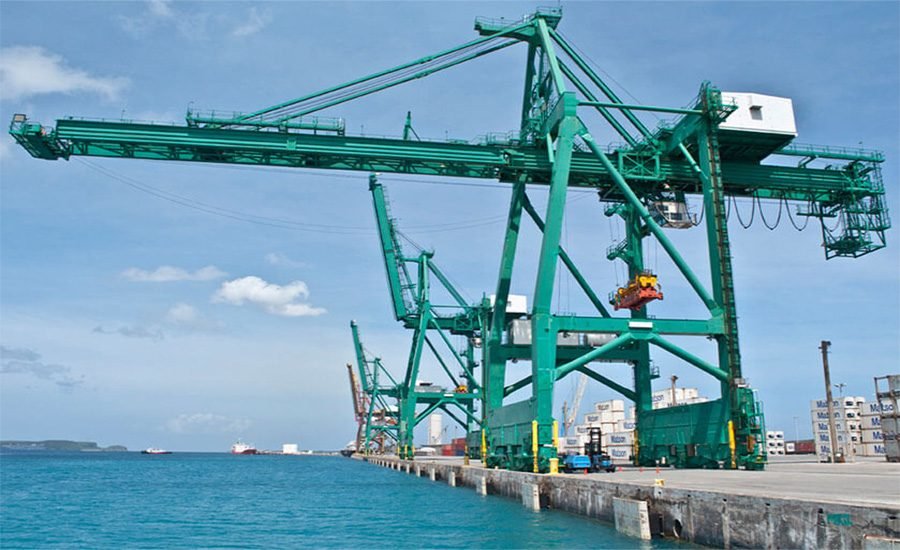
On April 28, the U.S. Department of Transportation’s Maritime Administration awarded about $774 million for port projects nationwide, advancing a construction pipeline that includes marine structures, rail connections, container yards and cargo handling systems.
Transportation Secretary Sean P. Duffy said the investments are intended to strengthen freight movement and economic resilience. “U.S. ports keep our grocery stores stocked, our energy supply chains resilient and our export market strong,” Duffy said in the announcement.
The FY 2025 Port Infrastructure Development Program (PIDP) round, which covers 37 awards announced this week, marks the largest annual distribution in the program’s history, surpassing the approximately $703 million awarded in FY 2022.
The American Association of Port Authorities (AAPA) said the record total reflects, in part, funds recovered through AAPA advocacy after termination in past cycles. John Bressler, AAPA vice president of government relations, said the awards “unlock additional state, local and private investment … in a revitalized American maritime industry.”
The program expansion is tied to the $1.2 trillion Infrastructure Investment and Jobs Act (IIJA) passed in November 2021; the bipartisan bill’s $2.25 billion five-year PIDP allocation runs through FY 2026. Without reauthorization or supplemental funding, the PIDP is expected to return to significantly lower baseline appropriations, reducing the volume of federally supported port projects beginning in FY 2027.
AAPA warned that the FY 2026 cycle includes about $488 million and could “decline dramatically in FY27 after the bipartisan Infrastructure Act expires.”
The pipeline project encompasses marine, rail and terminal works
Project descriptions show a mix of marine, land and intermodal work that translates directly into civil, marine and rail construction activity as projects move towards procurement. MARAD did not identify contractors or designers for most awards, and recipients have yet to release procurement schedules.
Looking for quick answers on construction and engineering topics?
Try Ask ENR, our new intelligent AI search tool.
Ask ENR →
In Skagway, Alaska, a $38.6 million grant will support the redevelopment of an industrial wharf, including the installation of a new fueling head, a roll/off ramp and shore power for tugboats, along with the demolition of aging wooden wharves and legacy fueling infrastructure.

Federal grants for port infrastructure rose under IIJA to a peak in fiscal 2025 before falling in fiscal 2026, and industry groups warned that funding could decline further after IIJA support is phased out.
Credit: ENR
In Duluth, Minn., $27.5 million will fund the reconstruction of about 1,150 linear feet of dock wall and the demolition of former grain elevators to redevelop approximately 7.5 acres of space.
At Florida’s Port Canaveral, a $20.2 million award will support the rehabilitation of North Cargo Berths 1 and 2, including repairs to walls, concrete curves and dock deck structures, along with replacement of fenders, water lines, lighting and bollards. Port officials said the work will extend the life of the structures by “20 to 30 years,” with construction expected to begin in early 2027 and be substantially complete about 16 months later.
Access improvements to rail-linked ports represent another important part of the awards. In Whittier, Alaska, a $20.4 million award will help improve a rail tunnel connecting the port to the Alaska Railroad’s main line, expanding clearance for double-stack container operations and adding about 30 railcars.
The Port of Beaumont in Texas will use $37.8 million to add approximately 13,784 linear feet of rail track, rebuild its interchange and upgrade associated utility systems.
Land expansion projects focus on container throughput and terminal efficiency. A $48 million award to Port Houston in Texas will support the development of a roughly 47-acre container yard at its Bayport terminal, which includes a new terminal gate, reinforced pavement sections, and stormwater, water and electrical infrastructure.
RELATED
Duffy says he will not “hold back any projects” as DOT Reviews Grant Awards
Improvements to the facilities included in the prize package
Cargo handling equipment and terminal modernization are also central to the program. MARAD issued a separate statement on the Port of Guam award, which detailed a $59.6 million investment for three shore-based ship cranes and terminal upgrades that are expected to increase throughput and reduce vessel wait times by 15% to 20%.
The agency said the project includes typhoon fastening systems designed to meet FEMA standards for Category 4 and 5 storms, as well as workforce training partnerships. “The port of Guam is directly related to the well-being of the people of Micronesia and to the defense of the United States,” said Acting Secretary of the Navy Hung Cao.
Industrial and bulk cargo projects are also represented. In Donaldsonville, La., a $43.4 million grant will support a dock transportation system to move iron ore pellets from berths to a planned steelmaking facility, while in Baltimore, $39.7 million will fund the Phase 2 expansion of Tradepoint Atlantic’s TiL container terminal, including yard construction and cargo handling equipment.
California Reps. Julia Brownley and John Garamendi, and Sens. Adam Schiff and Alex Padilla said more than $22 million will support the Port of Hueneme in Ventura County and the Bay Area’s Port of Richmond.
“The funds will rehabilitate an essential pier and deepen the berth to support larger ships,” said Kristin Decas, the port’s general manager and director.
As project sponsors move into design and procurement, FY2025 awards are expected to generate a flurry of near-term construction activity, but with IIJA funding slated to fall after FY2026, contractors and port authorities are looking at whether federal support will keep the pipeline going for years to come.
