

Molly Burns
Vice President of Business Development
FA Wilhelm construction
The AEC industry in the Indianapolis region remains active, with a steady flow of construction opportunities and continued investment from companies locating or reinvesting in central Indiana, says Molly Burns, vice president of business development for Indiana-based FA Wilhelm Construction.
The company, which was founded in 1923, has 4,500 employees and a long history in the state.
Indianapolis and surrounding communities have seen strong growth in recent years, with a wave of publicly funded projects including parks and recreation facilities, police and fire stations, parking garages and major infrastructure improvements, he says.
But a new state law, Senate Bill 1, may affect future projects.
“A big topic in the AEC community right now is how SEA 1 will reshape how local governments finance infrastructure and capital projects,” says Burns.
The law, which takes effect this year, is primarily a property tax relief package for homeowners and some businesses. However, it requires certain debt-financed projects to obtain petitions or referendums from voters if tax-backed debt exceeds specified thresholds.
“The question everyone is asking is: With SEA 1’s changes to local tax and tax structures, will communities continue to invest at the same level?” Burns says. “This uncertainty is influencing how municipalities plan future projects and how contractors anticipate public sector opportunities.”
An example of a new recreation project that received public funds is in the nearby town of Fishers, Indiana, which opened the 120-acre Fishers White River Park in December 2025.
The park features over 5,000 feet of riverfront access along with 2.45 miles of trails, including trail connectivity to Fishers Heritage Park in White River. The park also features a kayak launch, native plantings, and two scenic boardwalks with views. In 2022, $4.7 million in READI 1.0 funds were awarded for park construction through the Indiana Economic Development Corp., which seeks to attract investment and improve local communities.
Another important issue is the boom in data center development.
“Project sizes are trending smaller, with fewer megaprojects in recent years.”
—Mary Burns, Vice President of Business Development, FA Wilhelm Construction
“Indiana has already attracted large-scale investment, and the Indianapolis region is now seeing its own pipeline of projects, some active, others still navigating approvals and infrastructure issues,” he says. “The industry is particularly focused on the labor implications, as data centers require an intensive, fast-paced workforce that can draw skilled trades away from other sectors.”
In February, a Meta data center campus opened in Lebanon, Indiana, about 30 miles from Indianapolis. It is expected to span 4 million square feet in at least 11 buildings on a 1,500-acre campus.
Google had proposed a data center campus on about 460 acres in Franklin Township, which is part of Indianapolis. Residents expressed concerns about water and energy use, environmental impacts, traffic and noise. Google withdrew its zoning application in September 2025.
Burns says the AEC market in general is shifting toward smaller jobs.

Source: Dodge Data & Analytics
“Project sizes are trending smaller, with fewer megaprojects in recent years, and competition is increasing as contractors from slower regions enter the market,” he says.
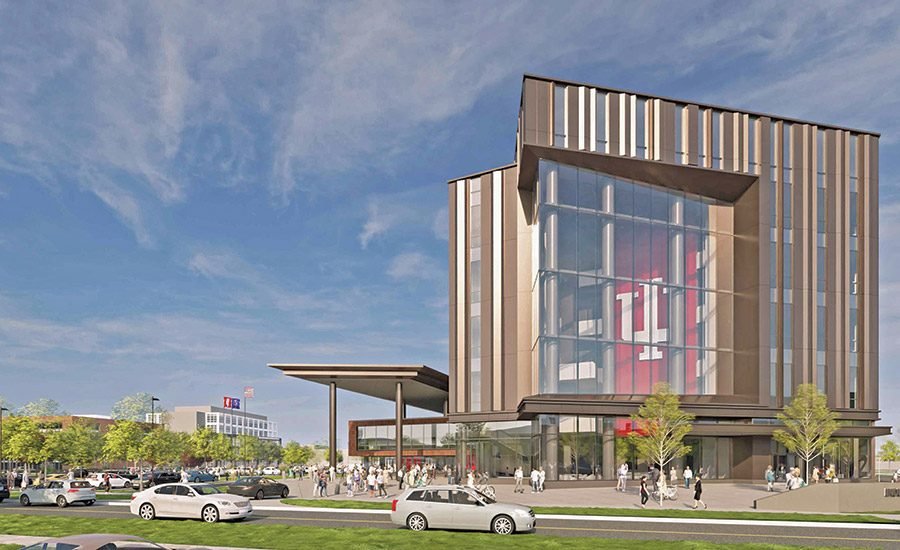
One of the projects FA Wilhelm is working on is the Indiana University Launch Accelerator for Biosciences, known as IU LAB. The facility is Indiana University’s new biosciences research and innovation center being built in the Technology Innovation District 16 in downtown Indianapolis. The five-story building will feature limestone, brick and glass.
“It is designed to position Indiana as a national leader in the discovery, commercialization and development of life science talent,” says Burns.
Looking ahead to 2026 and beyond, Burns is optimistic.
“Next year is likely to continue [the current] pattern: a strong but competitive market with more right-sized projects and a premium for early collaboration and value-based delivery,” he says.
