

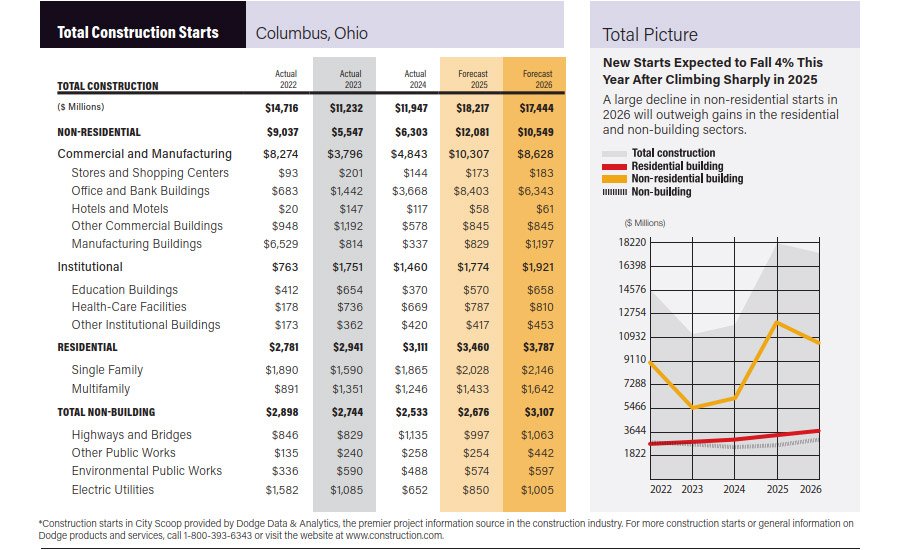
“There is a strong sense of momentum in the Columbus AEC community right now,” says Stan Hendricks, vice president and Columbus business leader for Gilbane Building Co. “The market remains active in several sectors, and this growth is expected to continue in the future.”
Hendricks points to the $2 billion expansion at John Glenn Columbus International Airport as an example. The project will replace the original 1958 terminal with a 1 million square meter facility, increase gates from 26 to 39 and introduce expanded retail and passenger services, a gateway project that reflects the city’s growing national profile.
“Major investments are shaping the landscape, most notably the new airport project, continued expansion of healthcare infrastructure and an increase in mission-critical data center, life science and technology work coming to Central Ohio,” Hendricks says. “Together, these projects reflect a region that is growing and diversifying.”
Kayla Mahoney, a project architect in Gensler’s Columbus office, sees the same trajectory.
“Columbus is experiencing sustained momentum, and for the AEC community, it’s creating a rich environment for impact,” Mahoney says. Continued population growth, projected to reach 2.6 million in the metropolitan area by 2030, and economic diversification are driving demand for nearly all building types. “Designers and builders have a real opportunity to help shape what the next city will be,” he says.
This demand has a broad basis. Columbus is becoming a major Midwest hub for data centers, fueling highly technical and mission-critical projects. Mixed-use development is accelerating as the city invests in walkable, experiential neighborhoods. Healthcare continues to be a constant driver, complemented by growth in technology and life sciences.

“The housing shortage remains a challenge,” says Mahoney, “but it has pushed architects and planners to rethink density, diversify housing types, and provide more mixed-income communities.”
Investment in large-scale infrastructure reinforces the city’s momentum. Mahoney says the new airport terminal, which Gensler is designing in partnership with Moody Nolan, sets a high bar for design excellence.
“Investments like the airport expansion and major mixed-use developments downtown shape first impressions,” says Mahoney. “They signal that Columbus is connected, ambitious and welcoming.”
For contractors, backlogs remain healthy and bidding activity is steady.
“The general conversation in the industry is about sustained growth,” Hendricks says. “Columbus continues to attract investment and the construction industry is responding to this demand with confidence.”
He notes that construction often lags behind broader business cycles.
“Our industry tends to operate as a lagging indicator, meaning we’re still doing work that reflects several years of previous economic growth,” he says.
“Finding skilled labor can affect schedules, especially on complex projects like data centers and large infrastructure builds.”
—Kayla Mahoney, Project Architect, Gensler
Gilbane’s current portfolio illustrates a range of activities. The company is involved in a planned $226 million global ambulatory cancer center for OhioHealth that will total 199,000 square feet and nearly double the size of its administrative campus. Gilbane is also preparing to start the city’s municipal court project. The eight-story Franklin County Municipal Courthouse is expected to cost about $300 million and replace the existing facility at 375 S. High St.
Another of Gensler’s projects is 530 W. Spring St., a 26-story mixed-use tower, which will offer 244 apartments, an 88-key hotel, retail and dining spaces, Class A office space and a large service deck with year-round event space.
Despite the optimistic outlook, challenges persist.
“Workforce remains one of the most pressing long-term challenges facing our industry,” says Hendricks. “For nearly a decade, we have seen a tightening of the supply of skilled labor and addressing this gap is a top priority.”
Mahoney agrees. “Finding skilled labor can affect schedules, especially on complex projects like data centers and large infrastructure builds,” he says.
Looking ahead to 2026, both leaders are hopeful that the market will continue to thrive.
“Because of our backlog, 2026 looks like another active year,” Hendricks says. “We do not foresee any major changes in the near term. The portfolio remains strong and confidence across the sector is high.”
