

Dubai International Airport (DBX) handles nearly 100 million passengers a year, connects 291 destinations in 110 countries and is at the heart of the world’s busiest air corridor.
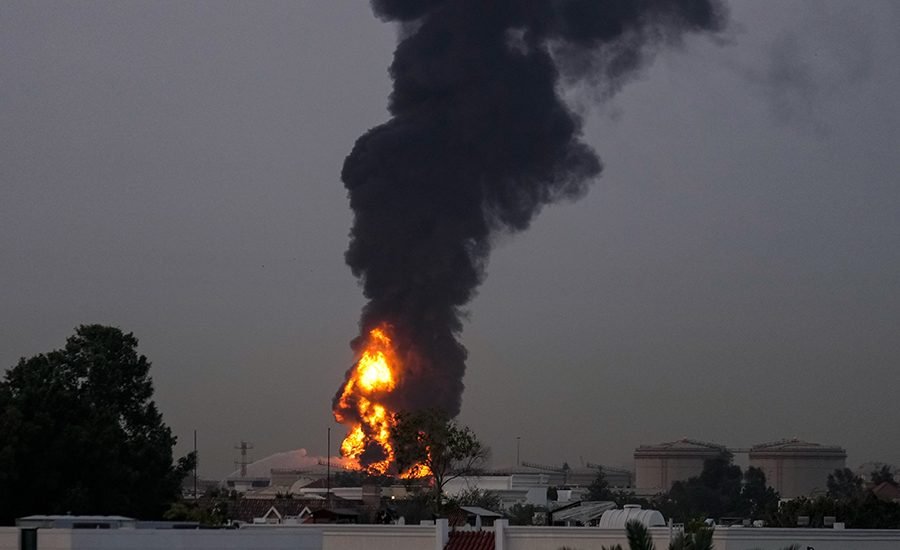
On the morning of March 16, a drone attack on a fuel storage tank near the airfield shut it down completely.
The Dubai Civil Aviation Authority suspended all flight operations at the airport as a precautionary measure after the strike ignited a fire near one of the airport’s fuel tanks, according to a statement released by the Dubai Media Office on X. Civil defense teams contained the fire with no injuries reported.
Emirates issued a warning urging all passengers to stay home. “All flights to and from Dubai have been temporarily suspended,” the airline wrote. “The safety of our passengers and crew is our highest priority and will not be compromised.”
Some flights were diverted to Al Maktoum International Airport in Jebel Ali. Bloomberg reported that operations were suspended for more than seven hours, the longest shutdown since Dubai reopened under designated safe air corridors in the early days of the conflict.
Not the first strike
This was not an isolated incident. Monday’s fuel tank attack was the fourth drone-related incident at Dubai airport since the US and Israel launched joint strikes against Iran on February 28 under Operation Epic Fury, according to CNBC.
Iran has since retaliated against several Gulf Cooperation Council states with a sustained missile and drone campaign. Dubai’s media office reported that two drones that crashed injured four people near the airport three days before the March 16 strike, according to Reuters and the Associated Press. A separate drone was intercepted over the Fujairah oil hub the day before, also setting it on fire.
Looking for quick answers on construction and engineering topics?
Try Ask ENR, our new intelligent AI search tool.
Ask ENR →
Flightradar24 reported on March 5 at X that cancellations at seven major regional airports — Dubai International, Hamad International in Doha, Zayed International in Abu Dhabi, Sharjah International, Kuwait International, Bahrain International and Al Maktoum International — exceeded 19,000 flights in the first seven days of the conflict.
British Airways, Lufthansa Group, KLM, Cathay Pacific, Finnair and Virgin Atlantic had already suspended service to Dubai until the end of March or beyond before Monday’s incident.
Linus Bauer, founder and global managing partner of UAE-based aviation consultancy BAA & Partners, told The National that the structural consequences will extend far beyond individual cancellations.
“If the outages are short-lived, the impact is manageable,” Bauer said. “If airspace avoidance persists, airlines face structurally higher operating costs, weaker aircraft utilization and profit margin pressure, particularly on long-haul networks that rely on Middle East traffic corridors.”
RELATED
Dubai unveils $35 million plan for world’s largest airport
Why a fuel tank can ground a mega-airport
The impact of the March 16 strike shows how large hub airports are designed to operate. At DXB, aviation fuel is distributed through underground hydrant systems that run below the apron and gates, allowing dozens of aircraft to be fueled simultaneously without tankers.

An Emirates Boeing 777 passes through Terminal 3 at Dubai International Airport, where underground hydrant feeding systems under the apron allow dozens of wide-body aircraft to be fed simultaneously.
Image courtesy of art_zzz/Adobe
This infrastructure enables the performance that made Dubai International the world’s busiest international airport in 2025, when Dubai’s airports reported 95.2 million passengers, the highest annual international traffic ever recorded by any airport, along with 454,800 aircraft movements.
Paul Griffiths, chief executive of Dubai Airports, said in the operator’s February 11 traffic statement that “check-in traffic is no longer an exception, but part of its operational reality.”
When the capacity of the hydrants is reduced even partially, the bottleneck is immediate. Airlines can switch to tankers, but at the cost of significantly slower fuel rates and reduced gate turnover.
In a system designed for tight aircraft rotation banks, this mismatch propagates into departure delays, missed connections and cascading schedule disruptions across an airline’s global network.
The International Air Transport Association guidelines on airport fuel storage capacity identify supply disruptions as a critical risk capable of causing flight cancellations, diversions, payload limits and emergency refueling stops in airline operations.
Aviation security firm Osprey Flight Solutions, which works with airlines on conflict zone risk planning, has noted in published guidance that airports operating near active conflict zones often turn to emergency response frameworks designed for weather events and mechanical failures — contingency plans not intended to respond to potential sustained attacks.
The issue of redundancy
Dubai has long understood that DXB alone cannot support the emirate’s long-term aviation ambitions. In April 2024, Sheikh Mohammed bin Rashid Al Maktoum approved a $35 billion expansion of Al Maktoum International Airport designed to accommodate 260 million passengers annually, with 400 aircraft gates and five parallel runways.
Dubai Airports has set a first-phase capacity target of 150 million passengers per year over the next decade, with Emirates expected to begin operations from the facility in 2032.
But secondary ability can only do so much. Al Maktoum absorbed the diverted traffic when DXB suspended operations, as it has in previous incidents. But a hub airport that handles a fraction of DXB’s volume cannot replicate the hub function that dozens of international carriers and millions of connecting passengers depend on.
Anita Mendiratta, an aviation and tourism consultant, framed the geographic stakes in an interview with the Associated Press in the early days of the conflict.
“In the Middle East, an eight-hour flight distance covers two-thirds of the world’s population,” Mendiratta said. “When that corridor is blocked, it forces aviation to move far north, which is going into other potentially conflicted airspace, like Russia, like Pakistan, or to fly south. That puts a lot of pressure on airlines.”
RELATED
Dubai unveils $35 million plan for world’s largest airport
The engineering lesson
The March 16 attack reinforces a principle that engineers have long understood: It doesn’t take catastrophic damage to stop a complex installation.
A strike on a single support system (fuel storage, power supply, communications infrastructure) can produce the same operational result as the broader destruction of a runway or terminal.
For airport engineers and planners, the recent DBX shutdown is a case study in what distributed redundancy is designed to avoid as well as the limits of forward planning.
