

Full flow has been restored to the Potomac Interceptor sewer line outside Washington, DC, ending a nearly two-month, around-the-clock effort to repair the 72-in. pipeline after a Jan. 19 rupture that spilled about 243 million gallons of untreated sewage into the nearby Potomac River.
Despite permanent repair of the 1960s pipeline and related infrastructure, the District of Columbia Water and Sewer Authority (DC Water) said it is now focusing on environmental remediation in the surrounding area, including a half-mile long, previously dry section of the historic C&O Canal in Maryland, which was used as a diversion channel for interceptor flow while emergency repairs were made.

Cleanup of the contaminated site in the areas affected by the Potomac Interceptor overflows is initially complete, but further environmental remediation will be performed. Photo courtesy of DC Water
“What we’re seeing here has been Herculean,” DC Water CEO and CEO David Gadis said at a March 17 briefing. The hastily constructed canal bypass had prevented nearly two billion gallons of sewage from reaching the river since late January, he said, allowing the waterway to recover from extensive pollutant discharge. The event is one of the largest sewage spills in the United States.
“The bacteria tests are trending in the right direction,” Gadis said, noting that most areas downstream are close to being within safe limits for recreational use.
DC Water has yet to officially state the projected cost of the spill response and repair effort, reported to be a $20 million to $30 million effort, or how the incident will affect the scope and cost of a planned $625 million rehabilitation program for the agency’s entire 54-mile network of pipes.
President Donald Trump’s February 21 disaster declaration, requested by Washington Mayor Murial Bowser (D), authorized the Federal Emergency Management Agency to coordinate all disaster relief efforts, which have also involved the Baltimore District of the US Army Corps of Engineers, the US Environmental Protection Agency and the Maryland Department of the Environment. Public assistance funding administered by FEMA, which must be approved by Congress, will cover 75% of approved costs.
A quick response
The Potomac Interceptor transports up to 60 million gallons of wastewater per day from the Maryland and Virginia suburbs of Washington, DC to the Blue Plains Wastewater Plant for treatment. DC Water says the break, which is still under investigation, sent sewage into an adjacent natural culvert where it was then channeled under the canal and into an unnamed tributary of the river.
Looking for quick answers on construction and engineering topics?
Try Ask ENR, our new intelligent AI search tool.
Ask ENR →
The first few days after the break was discovered saw DC Water and its contracting team, led by Anchor Construction Corp. and city-based Fort Meyer Construction Corp. faced major weather events, debris flows and other challenges to keep the crippled pipeline operating while limiting environmental damage around the collapse site and drainage areas contaminated by the overflow.
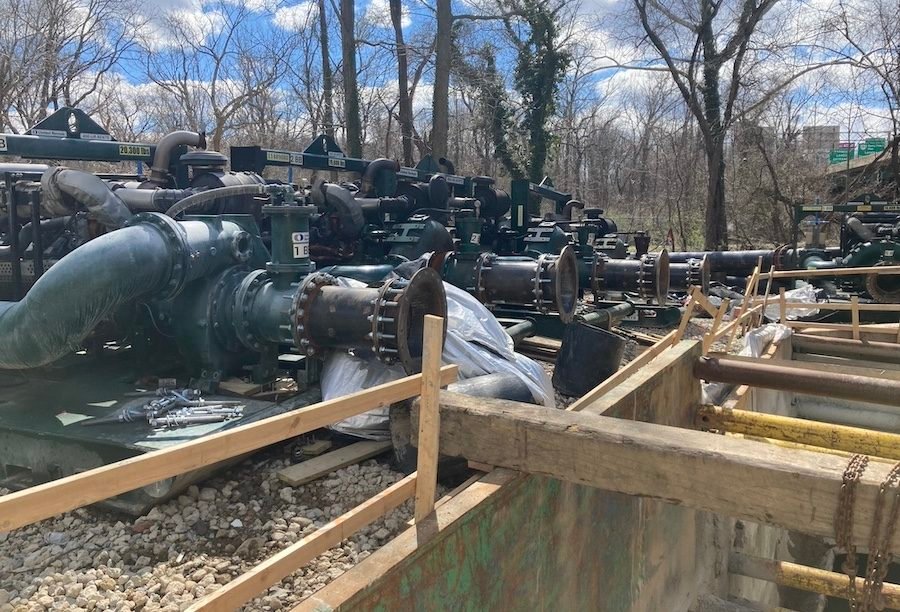
Within a week, the team had implemented an eight-unit, 60-million-gal-per-day bypass pumping system that prevented large backsplashes of sewage and reduced pipe flows enough to allow inspectors safe access inside. The discovery of a large internal blockage of large rocks and boulders at the site of the collapse presented a literal and figurative obstacle to the repair effort.
Moussa Wone, DC Water’s vice president of engineering, told ENR that the blocks likely originated from backfill during the original construction of the underground pipe. “It was essentially a collapse, although we’re still not sure what caused it,” he said.
With the addition of seven more upstream pumps and a steel bulkhead that completely diverted the interceptor flow around the collapse zone, contractors lifted the crown of the pipe to safely remove the obstructions and installed a geopolymer liner to reinforce 320 feet of adjacent upstream and downstream sections. Tests confirmed the stability of the repair area, allowing DC Water to phase out the pumps and restore full flow through the section on March 14.

DC Water is evaluating other sections of the Potomac Interceptor and other infrastructure in the system to ensure no similar breaks are imminent, DC Water CEO David Gadis said at a March 17 briefing.
Photo by Jim Parsons for ENR
Comprehensive cleaning
As the emergency repair progressed, stormwater from a mid-February rain overwhelmed the area’s drainage system and flooded DC Water’s pump site. To protect the area and prevent further contaminated soil from entering adjacent waterways, the US Army Corps of Engineers and Grunley Construction Co., Rockville, Md., installed an 11-pump stormwater diversion system with a capacity of nearly 7,900 gallons per minute.
Maj. Charles Martin, the Corps’ project manager, said soil and water quality testing will determine how much longer the system will be needed as environmental restoration of contaminated areas continues. Two to three inches of soil and accumulated materials are being removed, followed by the installation of organic mats and a new ground cover. Completed the restoration of a natural tributary where the waste water spill entered the river, as well as its adjacent coastline
“Currently, our contract end date is March 31, which includes demobilization days,” Martin noted. “Once remediation of the area has been successfully completed and we receive favorable soil test results, the diversion system will no longer be required.”
He said a water intake downstream for the Corps-operated drinking water system serving metro Washington was not in use when the spill occurred and should not require any special maintenance before its planned reactivation this summer.
Two sections of the Potomac Interceptor where the crown was removed and surrounded with 20-foot-deep trench boxes for emergency repairs will remain open-flow channels for the permanent repair effort, which includes lining a 2,700-foot section to encompass the collapse area. Material has been ordered for what is expected to be a nine-month process, with installation soon to begin of mechanical systems to put new pipe sections in place, DC Water said.
To restore the channel, a temporary upstream dam constructed by the National Park Service will provide fresh water to flush the diversion area to the interceptor. Cleanup, cleanup and disposal of the contaminated soil will follow, a process that DC Water said will likely take up to two months.
Wone said the Park Service “bought into this plan from day one, just asking [to] be informed and repair the area once we are done. The cooperation was remarkable.”
Meanwhile, the U.S. Environmental Protection Agency will now lead region-wide water quality testing on the river, while environmental advocates and experts continue independent testing and monitoring of water and sediment quality, including the Potomac Riverkeeper Network, the University of Maryland and George Mason University.
DC Water is also evaluating other sections of the Potomac Interceptor to make sure no similar breaks are imminent, “We’re looking at the rest of the pipeline and what it takes to make sure this doesn’t happen again,” Gadis added.
“This episode is far from over, as DC Water and state and federal authorities must coordinate repairs, response and restoration for months, even years, into the future,” said Betsy Nicholas, president of the Potomac Riverkeeper Network.
