


New research and development of structural steel construction methods was the main focus of the North American Steel Construction Conference, held April 22-24 in Atlanta. But the nearly 7,000 attendees at the American Institute of Steel Construction’s annual event also found that advances in artificial intelligence came up again and again in sessions with manufacturers, design engineers and architects.
Fast Floor, the steel floor system designed for the basic Speed Core building system, is now nearing the end of its testing phase, said institute president Charlie Carter. “What we’re testing now as a second phase is a beam-to-joist connection with the same type of drop connection, which is a little bit different than it would be with a column,” he said. “We thought about doing the first round of this, just a beam-to-flange connection, but we thought that’s not enough information for someone who wants to use the whole system. So we’re pushing into finding a beam-to-beam connection, and once that’s done, we’ll have the whole package for anyone to use, and it’s going to be a much faster connection system.”
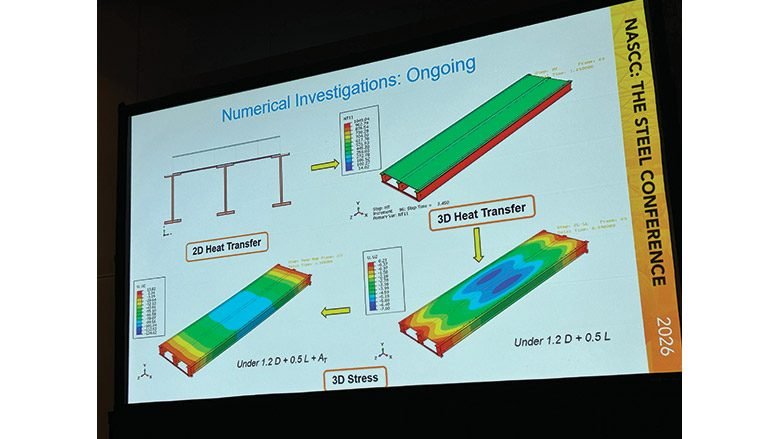
Carter said Amit Verma, a professor of civil engineering and a recognized expert in fire and building engineering at Purdue University, will conduct fire tests, one of the final tests required for the Fast Floor system. “We’re leaning toward a performance-based fire design for this type of system,” he explained. “The best way would be if we didn’t have any fire protection required and it performed well, and that’s what we’re hoping Dr. Verma will come up with with the final results that will actually come out in the next few months.”
Keep the patent-free fast floor
Carter assured reporters at a press conference that Fast Floor, like Speed Core, would remain patent-free and any engineer could use it in their designs.
“We’ve supported research, along with foundations and manufacturers and others, to have a non-proprietary system come to market that any manufacturer and any developer and any architect can use without any licensing fees or anything,” Carter said.
He added that the institute promotes “that we want to have the steel product, the steel in the building, and that supports our fabricators and directors. So there’s no license fee. It’s not patented. It’s a system that anyone can use, and we do that with pretty much all of our research.”
The institute also said it will have a newer, more robust version of its Steel Construction Sustainability Guide slated for release in June. Its sustainability leaders said it would be a comprehensive design guide similar to the group’s Steel Construction Handbook or Seismic Design Guide, incorporating tracking of sustainable materials that go into the steel, such as scrap from electric arc furnace mills, inputs such as sustainable energy from solar farms and even details from the institute’s own carbon calculator and environmental product statements.
Looking for quick answers on construction and engineering topics?
Try Ask ENR, our new intelligent AI search tool.
Ask ENR →
AI and demand for steel
Asked about lagging demand for steel beams 30 inches or more wide (popular in data center construction), executives at steelmakers ArcelorMittal, Nucor and Gerdau cited delays from July to November due to demand. All said prices had risen with demand by 40% to 60% in the past six months alone.
To meet this demand, manufacturers are turning to AI tools to do everything from automating safety manuals to confirming proper welds. Matthew Haaksma, quality manager at Orange County Ironworks, explained how to use tools such as ChatGPT and Clark, an AI tool the institute trained on its publications, for inspections and quality control. He noted that integrating AI into the company’s shop floor workflows also introduced challenges, including data accuracy, implementation costs, training needs and the risk of over-reliance on automation. Clark’s chatbot has been updated with the institute’s latest design guides and publications and is available at clark.aisc.org.
