

Private spending on nonresidential construction fell for a fourth straight month in January and is now down 8% from a peak in December 2023, as a decline in manufacturing outweighs gains in data centers and public sector work, according to Associated Builders and Contractors.
In a March 23 analysis of U.S. Census Bureau data, ABC said total nonresidential spending was essentially flat at a seasonally adjusted annual rate of $1.245 trillion, with private sector spending declining while public construction posted modest gains. Private non-residential spending decreased by 0.4% compared to December, while public spending increased by 0.6%.
The weakness is spreading beyond a single segment, according to ABC. Spending fell in nine of 16 non-residential categories in January, including commercial, water supply, education and entertainment construction, along with a sharper decline in manufacturing.
“Private non-residential construction spending contracted for the fourth consecutive month in January and is now down 8% from its all-time high in December 2023,” ABC chief economist Anirban Basu said.
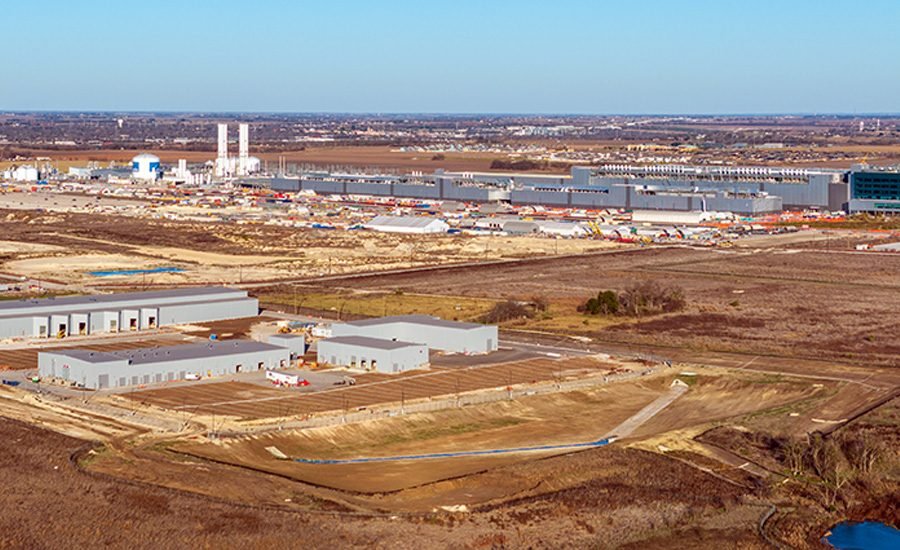
Manufacturing remains the central pressure point. Spending on computer and electronics manufacturing, once driven by the megaprojects spurred by the CHIPS Act, has shrunk as those projects have ended. “With the completion of the mega-projects incentivized by the CHIPS Act, spending in this subcategory has dropped by nearly 40% over the past 18 months,” Basu said.
The setback follows an unprecedented surge in manufacturing construction tied to investments in semiconductors and advanced manufacturing in recent years, much of it fueled by federal incentives. As these megaprojects move from peak construction to commissioning and completion phases, spending is beginning to normalize.
This reduction is now clearly visible in the more general data. Manufacturing spending fell 2% in January and was down 15% year-on-year, while private non-residential construction overall has declined 3% over the past 12 months.
Looking for quick answers on construction and engineering topics?
Try Ask ENR, our new intelligent AI search tool.
Ask ENR →
By contrast, non-residential public construction increased by 4.5% year-on-year, highlighting the stabilizing role of infrastructure and other government-funded projects.

U.S. nonresidential construction spending rose steadily from 2015 through a rise in 2022-24 before leveling off in early 2026, reflecting a cooling in the private sector as manufacturing activity recedes, according to U.S. Census Bureau data analyzed by Associated Builders and Contractors.
Source: Builders and Associated Contractors
Data centers continue to stand out as the primary area of private sector expansion. Spending in this segment rose another 2 percent in January, Basu said, but remains insufficient to offset the decline in manufacturing activity.
Elsewhere, performance is uneven but not uniformly weak. Highway and street construction and related conservation work posted monthly gains, and transportation spending remains positive year over year, suggesting that infrastructure programs continue to support activity even as private development cools.
Basu warned that external pressures could further tighten conditions in the coming months. He cited the ongoing conflict in Iran as a factor that could drive up escalating materials prices and increase uncertainty for contractors already struggling with a private pipeline that is going soft.
Future indicators point to limited and short-term relief. ABC’s construction backlog gauge rose 0.1 month in February from a four-year low in January, a marginal improvement that still leaves contractors with little project visibility heading into the end of the first half of 2026.
For contractors, the near-term outlook is increasingly shaped by this divergence: Firms tied to publicly funded infrastructure and data center development continue to see opportunities, while those reliant on manufacturing and other non-residential private sectors face a leaner backlog as projects get off to a slow start and the backlog remains near recent lows.

Nonresidential construction spending was flat in January 2026, with declines in nine of 16 categories and a 2 percent monthly drop in manufacturing, while public sector spending rose 0.6 percent, according to U.S. Census Bureau data analyzed by Associated Builders and Contractors.
Source: Builders and Associated Contractors
