

The National Geographic Society’s new Museum of Exploration, a combination of 100,000 square meters of new construction and renovation of existing space, celebrates the spirit of adventure. For nearly 140 years, the organization has shared the world’s natural and cultural wonders with millions of people through storytelling channels ranging from its iconic yellow-edged magazine to the real-time immediacy of social media. This summer, it will add a new dimension to the educational mission by opening the expanded museum on its Washington, DC campus.
Designed by architect Hickok Cole and constructed by HITT Contracting, the combination of construction and renovation project will add technology-rich immersive experiences and curated exhibits that aim to capture and convey the spirit that has brought generations of explorers to the literal and figurative ends of the earth, discovering examples of both timeless history and accelerating change.
For this reason, says Ryan Sokoloski, society vice president of facilities and capital planningthe new museum had to differentiate itself in a city already full of spaces of this type.
Instead of crafting just another commercial building, Hickok Cole took its design cues from the natural world. Wall ribbons lining the 400-seat auditorium derive from wind-sculpted sand shapes, while the grand hall’s 45-foot oculus is surrounded by curved acoustic ceilings that emulate rain-covered ponds. “We wanted it to ‘feel’ like National Geographic, with curved shapes that mimic those of nature and mesh seamlessly with the exhibits,” says Sokoloski.

An artist’s rendering of the exterior forecourt of the renovated National Geographic Society and Exploration Museum headquarters, opening in 2026.
Visualization by REDVERTEX, based on designs by Hickok Cole Architects Inc.
Internal integration
The adage that some adventures are so close to the backyard might describe the integration of the new museum project into the society’s four-building campus, which includes the Renaissance-style Hubbard Hall, built in 1904, and others that were added and expanded from 1931 to the early 1980s.
While parts of the new museum could occupy renovated spaces in existing buildings while retaining their historic aspects, “it was pretty clear that we would have to make a stand-alone structure,” says Jason Wright, Hickok Cole’s director of technical operations.
Hickok Cole and HITT team members undertook their own exploration of the campus’ underground gallery passage and three-level garage to ensure clear paths to the 15,000-square-foot structure that will serve as the museum’s main entrance.
HITT’s subsurface work ultimately included drilling micropiles up to 60 feet deep into the bedrock and installing pile caps and structural steel. During that time, the team had learned a lot about the construction areas that will undergo renovations, adds Joe Kmiecinski, HITT’s vice president of site operations.

The National Geographic Society Gardiner Greene Hubbard Memorial Hall in Washington, DC
Photo by Leet Brothers/National Geographic
“We were prepared to encounter all kinds of constructions from the last century,” he says. “Our attitude was that we would deal with what we found. We developed a solid plan, proceeded slowly, and fell apart in the finishes, ready for anything.”
Wright agrees that coordination with the construction team was critical, especially in routing construction systems and related infrastructure.
“We wanted it to ‘feel’ like National Geographic.”
—Ryan Sokoloski, Vice President of Facilities and Capital PlanningNational Geographic Society
“We have a lot of these big ceilings with multiple layers of plaster,” explains Wright. “Once that goes up, you don’t go up again. The coordination of the structure tracks has been tremendous with the subcontractors.”
Because all buildings would remain occupied throughout construction, HITT developed hundreds of procedural methods for tasks such as draining coolers to make connections and scheduling power outages. The team also prioritized dust control and hired an industrial hygienist to conduct baseline indoor air quality monitoring and management.
At the same time, Sokoloski says, the team tried to keep all of the society’s employees abreast of the project’s activities and progress.
“We made regular visits with helmets so they knew the source and reason for the drilling and other noises they were hearing,” he says.
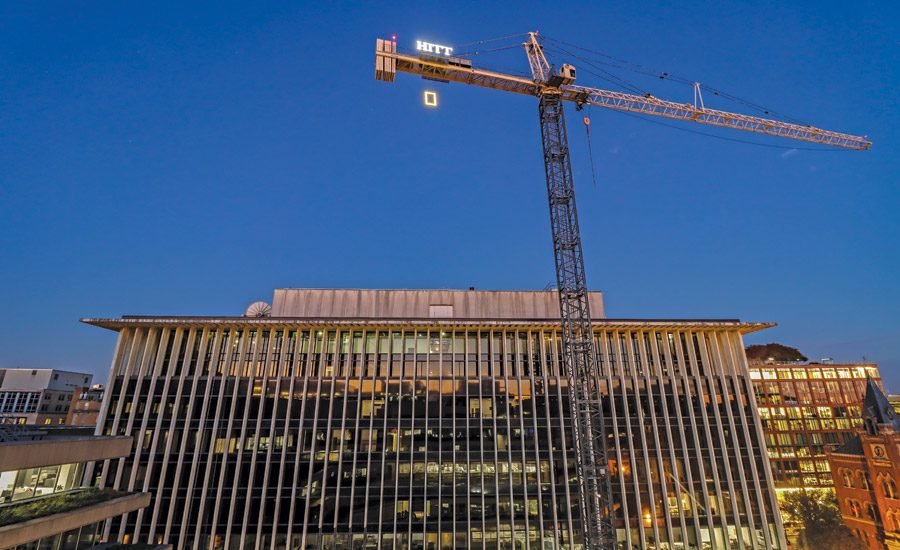
Some of the pavilion’s structural steel welding connections took up to six days to complete because the large 32,000-pound (W40x503) beams not only had to be sized to fit the narrow city streets, but also had to be spliced so they wouldn’t exceed the tower crane’s weight capacity. During installation, the joist splices were raised on temporary scaffolding and then welded into place.


The National Geographic Society project team designed, fabricated and installed a large staircase using an existing opening in the concrete slab.
Photos by Kristen O’Connor/National Geographic
Telling stories through technology
While the Museum of Exploration focuses on the wonders of the natural world, advanced construction planning tools have played an integral role in helping to transfer design from concept to reality. In addition to extensive use of 3D modeling tools, HITT hired Boston Dynamics’ robot dog “Spot” to assist with laser scanning and geo-tagging construction functions.
“What used to require a large team to collect and process all this information seemed to be available almost instantly,” says Kmiecinski. “It was a real vision of the future of construction.”
Sokoloski also credits the project team for helping to incorporate society’s high sustainability standards into the museum through an innovative combination of building systems and materials that have the structure on track for LEED Platinum certification.
Instead of using carbon-intensive lightweight concrete for the project’s floor coverings, structural engineer Arup suggested using normal-weight concrete with a 3/8-in. layer of cement fireproof material sprayed on the bottom, a change that Sokoloski says reduced carbon emissions by 20%.
“It was a real vision of the future of construction.”
— Joe Kmiecinski, Vice President of Site Operations, HITT
Additionally, the concrete knee walls that span the metal roofs use air voids for insulation, eliminating the need for polystyrene material. More than 80% of stormwater is captured on-site through features such as a 48,000-gallon cistern that uses rainwater for toilet flushing and storage water for cooling towers.
Perhaps the emblematic element of the museum’s sustainability is its mill. Instead of using oak as originally specified, the project team sourced 130,000 board feet of reclaimed ash damaged by the invasive emerald ash borer beetle, which has spread across the country over the past 30 years.
“We were able to create these intricate geometric shapes in the building model and share that with our millwork supplier, who optimized it for construction,” says Sokoloski. “It’s been great to see this come to fruition.”
Suitable for a grand opening
With most major construction completed by 2025, the past few months have been focused on wrapping up interior finishes, final inspections and system commissioning, along with exhibition facilities and fit-out of the food and retail concession areas.
“The last 5% of the project is always the hardest,” says Kmiecinski. “As our subordinates have left and National Geographic salespeople have arrived at the exhibits, we’ve become familiar with new groups of artisans to work with.”
While reports at the start of construction estimated the museum would cost $250 million, the society has yet to reveal a final figure. A spokesperson says it is “deeply grateful to donors and institutional partners for helping to bring this extraordinary project to life.”
What is certain, says Sokoloski, is that like any successful expedition, preparation and teamwork were the keys to success.
“All the planning and logistics we did three or four years ago has paid off,” he notes. “With big multi-year projects, it’s common for the design team, the contractors, and sometimes the owner to start giving it a head, because you want it done. That we’ve been able to create and maintain a great team environment from start to finish, that’s honestly what I’m most proud of.”
