

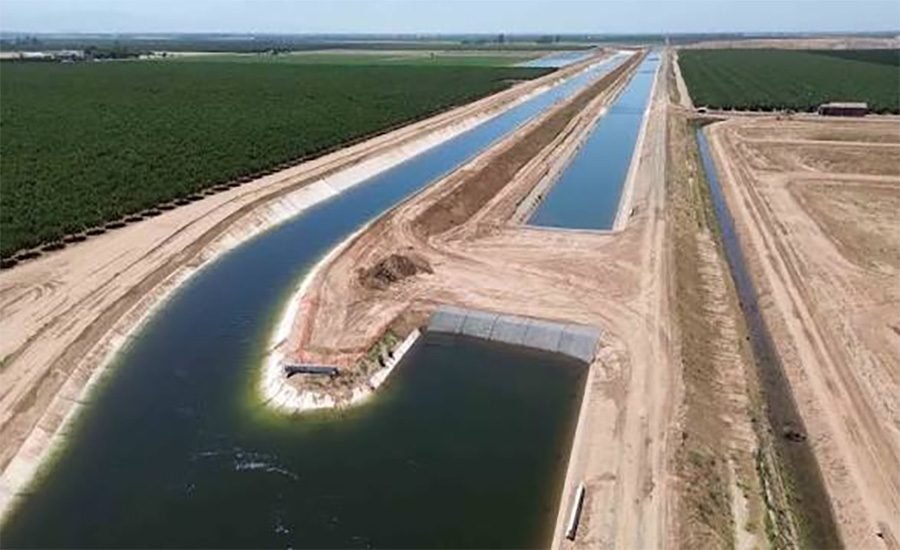

On March 17, the US Department of the Interior announced $889 million in investments for water infrastructure projects in six western states. The funding focuses on canal rehabilitation, sinkhole repairs and system upgrades to restore lost carrying capacity, and provides short-term pipeline major civil work connected to existing US Bureau of Reclamation systems.
The funding comes from the large spending and tax bill signed by President Trump in July 2025. It provides $1 billion through 2034 to restore and expand the capacity of existing federal water systems while expediting authorization for major projects. The allocation is substantial by the project’s standards, but against the wider national picture, it’s a fraction of what engineers say is needed.
California accounts for $540 million of the recovery funding, more than 60 percent of the total, reflecting the depth of the need to rehabilitate the Central Valley’s transportation systems, where subsidence and structural wear and tear have reduced flow capacity for decades.
The largest allocation, $235 million, will fund rehabilitation of the 116-mile Delta-Mendota Canal, a Central Valley Project facility that carries water from the Sacramento-San Joaquin Delta near Tracy in the south to the Mendota Basin.
Originally designed with a maximum capacity of 4,600 cfs, the canal is operated by the San Luis and Delta-Mendota Water Authority under a transfer agreement with Reclamation. The funded work includes raising the embankment, checking for structural repairs and possible construction of a new concrete-lined segment.
Another $200 million is aimed at correcting subsidence along the 152-mile Friant-Kern Canal, which serves roughly 1 million acres of San Joaquin Valley farmland.
Groundwater pumping has reduced the canal’s capacity from its original 4,000 cubic feet per second to about 1,600 cfs (a 60 percent decline), reducing deliveries by as much as 300,000 acre-ft in affected years, according to Reclamation. In the spring of 2024, Phase 1 remediation of the most affected 33-mile middle reach was completed, including the realignment of approximately 23 miles of channel in Tulare and Kern counties. Upper and lower scope negotiations are still ongoing.
Looking for quick answers on construction and engineering topics?
Try Ask ENR, our new intelligent AI search tool.
Ask ENR →
The Friant Water Authority said the funding will advance the remaining work. “The Friant-Kern Canal is a lifeline for farms, communities and groundwater recharge efforts,” CEO Johnny Amaral said, adding that the investment “will have a lasting impact on the communities we serve.”
California’s remaining funding includes $50 million for subsidence repairs along the San Luis Canal, $15 million to upgrade a Tehama-Colusa Canal Authority pumping plant that serves roughly 150,000 acres of Sacramento Valley farmland, and $40 million for planning and preconstruction tied to a proposed 18.5-foot raise of the dam shasta
That project, currently in preconstruction and design, would add roughly 634,000 acre-ft of storage, enough to supply about 2.5 million people for a year, according to Interior.
Outside of California, $100 million will support the Eastern North Dakota Alternative Water Supply Project, a phased system designed to deliver up to 165 cfs of treated water from the Missouri River through a dam, pump station, biota treatment plant and buried transmission pipeline to municipal and rural users in eastern North Dakota, according to a recovery decision record issued in January 2021.
Utah’s $100 million will replace the Strawberry Highline Canal, an open conveyance that has delivered irrigation water to approximately 42,500 acres in southern Utah County since 1913, with a closed pipe to reduce seepage losses and improve delivery efficiency.
Wyoming’s $100 million goes to the Fort Laramie Channel Tunnels, where a July 2019 roof collapse in Tunnel No. 2 left the system operating below its design capacity of approximately 1,500 cfs, operating under emergency repairs. An approved demolition and reconstruction for the May 2025 recovery of approximately 6,642 feet of tunnel along the 85.3-mile canal, operated by Goshen and Gering Ft. Laramie Irrigation Districts.
Investment at the project level is in a deteriorating national context.
EPA’s seventh Drinking Water Infrastructure Needs Assessment and Survey, released in 2023, put the 20-year national investment requirement for drinking water systems alone at $625 billion, a 32 percent increase from the agency’s previous estimate. ASCE’s 2025 Infrastructure Report gave drinking water a C- and wastewater a D+, both unchanged from 2021, and predicts that the drinking water investment gap will grow from $309 billion today to $620 billion by 2043.
That trajectory is now further complicated by the expiration of the Jobs and Infrastructure Investments Act in 2026, which ASCE estimates has been saving taxpayers $700 a year and whose expiration would accelerate the funding shortfall.
The remaining allocations ($30 million for Idaho conveyance improvements, $11 million for South Dakota siphon repairs and $8 million for the North Dakota Garrison Diversion Unit) complete a package that Interior Secretary Doug Burgum said will “strengthen our nation’s water security, modernize aging infrastructure and support farmers, communities and industries who depend on a reliable water supply.”
For the construction industry, the announcement indicates a short-term workload for channel lining, embankment stabilization, pump station upgrades, pipe conversion and tunnel reconstruction linked to existing reclamation systems.
Recruitment packages and contractor selections have not been announced; Interior said delivery of the project will move forward in coordination with state and local partners.
