

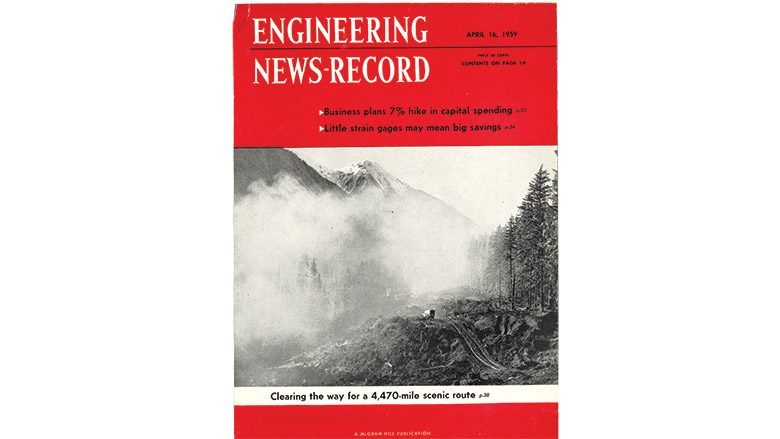

This cover image from April 1959 shows a right-of-way for the Trans-Canada Highway being cut through a section of the Canadian Rockies in British Columbia.
This 143-mile section was the most difficult to build of the entire 4,470-mile route, which stretched from St. Johns, Newfoundland on the Atlantic Ocean to Vancouver, BC on the Pacific Coast.
Many of the workers in this segment were hard rock miners, blasting the sides of steep slopes 500 feet to 1,500 feet above the roaring Kicking Horse River and turbulent Fraser River.
Where the route passed through Glacier and Revelstoke National Parks and Rogers Pass, avalanches and snow slides were real dangers. At one point in the project, explosives placed to trigger avalanches as a test were eaten by grizzly bears before they could be detonated.
More than 4,000 feet of snow covers made of wood or reinforced concrete protected the most vulnerable sections of the highway. The treacherous conditions of the saturated soil around the bridge piers near Terrace Bay, Ontario called for an unusual solution. Electroosmosis was used to stabilize the wet, fine-grained soils while the foundations were being built.
The technique involved establishing a direct current between electrodes placed in the ground to induce the flow of water, along with ions, from the anode to the cathode. This controlled direction of seepage forces reduced the water content of the soil, changing its chemical composition and successfully stabilizing the soil. Construction took nine years, with the highway opening in 1960.
This cover image from April 1959 shows a right-of-way for the Trans-Canada Highway being cut through a section of the Canadian Rockies in British Columbia. This 143-mile section was the most difficult to build of the entire 4,470-mile route, which stretched from St. Johns, Newfoundland on the Atlantic Ocean to Vancouver, BC on the Pacific Coast.
Looking for quick answers on construction and engineering topics?
Try Ask ENR, our new intelligent AI search tool.
Ask ENR →
Many of the workers in this segment were hard rock miners, blasting the sides of steep slopes 500 feet to 1,500 feet above the roaring Kicking Horse River and turbulent Fraser River. Where the route passed through Glacier and Revelstoke National Parks and Rogers Pass, avalanches and snow slides were real dangers.
At one point in the project, explosives placed to trigger avalanches as a test were eaten by grizzly bears before they could be detonated. More than 4,000 feet of snow covers made of wood or reinforced concrete protected the most vulnerable sections of the highway. The treacherous conditions of the saturated soil around the bridge piers near Terrace Bay, Ontario called for an unusual solution.
Electroosmosis was used to stabilize the wet, fine-grained soils while the foundations were being built. The technique involved establishing a direct current between electrodes placed in the ground to induce the flow of water, along with ions, from the anode to the cathode.
This controlled direction of seepage forces reduced the water content of the soil, changing its chemical composition and successfully stabilizing the soil. Construction took nine years, with the highway opening in 1962.
