

In 2024, the University of Denver became the fourth university in Colorado and the first private institution in the state to achieve the Research 1 (R1) classification of the Carnegie Classification of Institutions of Higher Education.
The designation, which is based on the number of research-oriented degrees awarded and the amount of research spending, increased the need for more modern research laboratories. It is the result of a wider trend, with the amount of external funding for research at DU tripling in the past 15 years.
“As you increase your funding volume, you generate more facilities and administration costs, and we’ve been allocating a portion of those dollars to university facilities to support our research,” says Corinne Lengsfeld, DU’s senior vice chancellor for research and graduate education.
“The Faculty of Natural Sciences and Mathematics has grown substantially over the last decade and a half, which has created pressure on our infrastructure and [a new] Construction is necessary to keep pace,” adds Lengsfeld. “They needed more square feet and better wet labs to support the molecular life sciences.”

Workspaces for researchers will be just outside the labs, allowing for more efficient workflows.
Image courtesy of Anderson Mason Dale
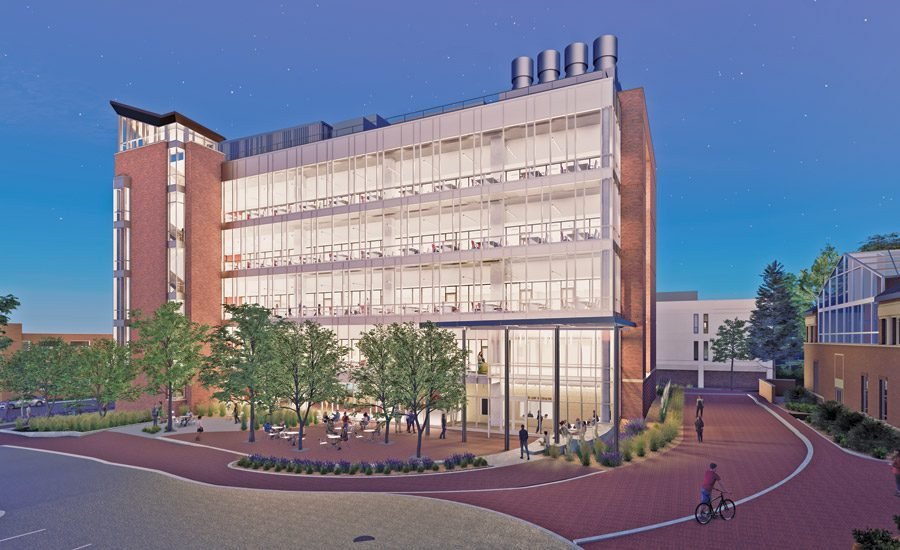
Now under construction, the 73,000-square-foot Integrative Life Sciences Center will help fill the gap. Budgeted at $112 million, the five-story building will have three ground-floor undergraduate teaching labs below four floors of flexible research space when it opens in 2027.
The concept for the building grew out of a comprehensive master plan that was developed in 2018 and updated in 2024. “We limited ourselves to projects that could be accomplished in a reasonable time frame, say a five-year window, and from there, this science building rose to the top,” says Allan Wilson, DU’s associate vice chancellor for facilities management and planning.
The Greenwood Village, Colo., office of Holder Construction is the construction manager/general contractor for the project, working from a design by Anderson Mason Dale Architects of Denver. Holder won the job after starting as an adviser to the project’s construction manager; is the company’s first on-campus project and Anderson Mason Dale’s seventh.
“We actually put a firewall between pre-construction services and GMP negotiation,” says Wilson. “[Holder] he won it because of the work they did in the pre-construction, and it made sense that they would win it, but we left the door open”.
Tom Dobson, a senior vice president at Holder, says the company’s experience with data centers, airports and other technical projects opened the door to the job. Holder’s work as the general contractor for the University of Georgia’s STEM 1 Interdisciplinary Research Building led to an introduction to Wilson at DU. “It was the right time with the right style of project and the right people,” says Dobson. “[Wilson] they presented their master plan for the area and the personalities started to click. These buildings are more complex than normal and require a lot of teamwork.”
Construction began in June 2025 with about four months of “removing utilities from a canal that ran right through the site,” Dobson says. “All the fiber and sewer lines had to be moved.”
With an average daily crew of about 130 workers, the building was finished in February, about two months ahead of schedule. The structure consists of soft reinforced concrete without post tension, and the middle slab is 14 inches thick to minimize vibration.

One of the major challenges of the project has been the choreography of the construction of the MEP systems, which represent approximately half of the budget.
Image courtesy of Holder Construction
Science on display
Andy Nielsen, director of Anderson Mason Dale, says DU’s science buildings have traditionally been “introverted,” but the Integrative Life Sciences Center will buck that trend with glass walls inside and out.
“There’s a lot of transparency that you haven’t necessarily seen in a lot of the buildings on campus,” Nielsen says. “Now there’s this whole idea of ’science on display’ and openness, not just for researchers inside to look in and see views outside, but also for people outside to see the building.”
“Now there’s this whole idea of ’science on display’ and openness, not only for the researchers inside to look … but also for people outside to see the building.”
—Andy Nielsen, Principal, Anderson Mason Dale Architects
Campus tours have historically avoided DU’s science buildings, but that is slated to change once construction is complete next year. Lengsfeld says the push for the labs’ visibility is to “demystify the research experience” for both undergraduates and prospective students.
Using an equally transparent design, the second through fourth level research labs are designed to be flexible over time. “There are no real walls between the spaces,” adds Micah Scott, Holder’s senior project manager. “Being able to take a piece of metal casing and move it from here to there is a lot easier than renovating a lab.”
There is also a functional angle to the design as it allows researchers to take a break or lunch within sight of their lab. “You can’t eat a sandwich at your desk in the lab while you’re doing an experiment,” says Nielsen. “What we have is a very transparent separation … so they can see what’s going on and what other people are doing in the lab.”

An event-friendly pavilion will connect the new building to the current Seeley G. Mudd Science Building.
Photo courtesy of Holder Construction
Massive MEP
With a LEED Gold target, the project is marked by remarkably complex MEP systems that account for nearly 50% of the total construction cost. The laboratories will have between six and 12 air changes per hour, with a mechanical system independent of that of the public spaces. “Getting to seal the building so that individual rooms can be positive or negative, regardless of how they’re designed, is very important,” says Dobson, noting that it affects the process of running ducts through drywall. “You have to put the drywall in, then cut a hole and go through the drywall. The sequence of all that to make the building stick is detailed and precise.”
“If the drywall hadn’t been hung first, you’d never be able to go back up there and close it,” adds Scott. “Tolerances are so small in this scenario, everyone has to be involved.”
Dobson credits mechanical engineer Trautman & Shreve and electrical contractor Intermountain Electric for their work on the project, as well as Holder’s MEP crew. “We have a dedicated mechanical, electrical and plumbing department of over 100 people who do nothing but that,” he says. “That’s what makes these projects successful.”
Installing pumps, chillers, boilers and heat exchangers in the rooftop mechanical attic in March was a major milestone, says Dobson. “All the major mechanical and electrical equipment that goes on the roof has just been put in, so now we can start to see our way down to the finish line.”

The building was completed in February and is scheduled for completion in the spring of 2027.
Photo courtesy of Holder Construction
Connecting old and new
The Integrative Life Sciences Center will connect to the 1980s Seeley G. Mudd Science Building through a new covered pavilion. After the new building is completed in the spring of 2027, Holder will turn his attention to renovations of the Mudd Building and nearby Boettcher West to modernize existing lab spaces.
The new building “resets the lab spaces in general and then allows us to free up square feet at Seeley Mudd and renovate that building and do things that will allow us to grow in that space going forward,” says Wilson.
“These buildings are more complex than normal and require a lot of teamwork.”
—Tom Dobson, Senior Vice President, Holder Construction
During pre-construction visits to Massachusetts universities, DU and Holder representatives learned about a new lab at Tufts University. “Tufts had taken two old buildings and knocked them down with a third new one and a plaza in between,” says Lengsfeld. “Every corner was used. They didn’t waste a dime in this building.”
That catalyzed an epiphany: Rather than a stand-alone building to replace the old, the concept of connecting old and new allowed DU to “maximize our dollars and get the fastest and best return on investment for both scientists and students,” he notes. “It completely changed our view of what we should be doing and why we should be doing it.”
The connecting pavilion will feature a solid wood atrium with glulam (glulam) beams, a “Flower of Life” architectural feature that filters light into the wall, and an event-friendly design.
Lengsfeld says the pavilion and other gathering spaces throughout the building are a means to an end. “It really creates collaboration. I think there will be a very rapid growth of ideas in the first 18 months that we will build on for years,” he adds.
