

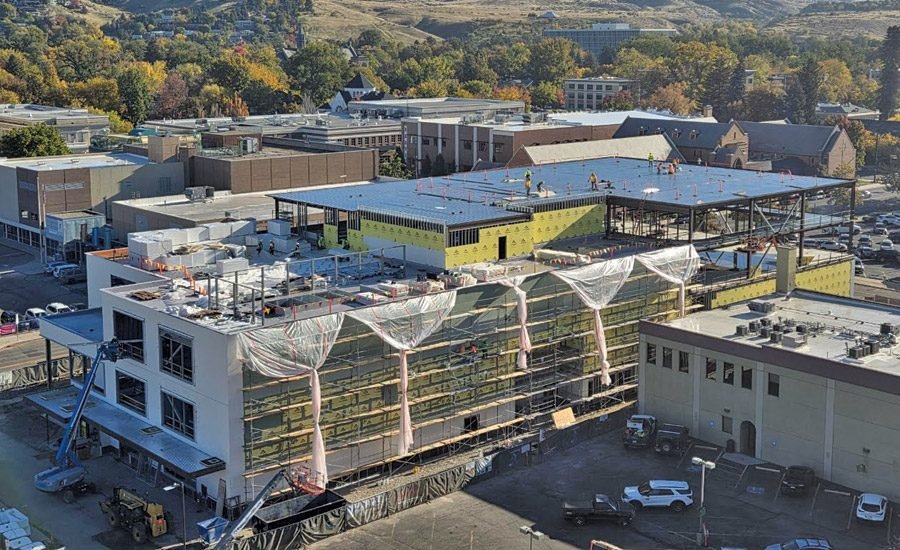
Since its beginnings as a community reading room in 1891, the Treasure Valley Family YMCA in downtown Boise has become more than just a place to swim or join a basketball game. The Y, built in 1968, has grown into a much-loved multi-purpose community center offering a variety of programs, and that community now watches with anticipation as a new facility goes up across the street from the current location.
The $80 million, 109,000-square-foot building is the result of a partnership with the local CapEd Credit Union, which will have a branch in the facility, along with the St. Luke, which will operate a community health center at the site. It will be known as the CapEd Downtown Boise YMCA, a project that has been nearly 10 years in the making, according to Megan Ellis, vice president of the Treasure Valley YMCA.

A rendering shows the athletics track suspended above the practice areas and basketball courts. The new facility was designed for ample natural lighting and visibility.
Image courtesy of Cushing Terrell
Unification programs
The Y serves more than 67,000 Valley members through hundreds of programs and services, with 43,565 youth accessing its programs last year, Ellis says. It is also the largest child care provider in the state of Idaho with 1,200 staff members and 1,000 volunteers supporting this work every day.
A 2017 study to evaluate the building upgrade determined the cost to be just over $20 million without adding any new space. “We knew this wasn’t the best use of our donor-invested funding, so we embarked on a new build,” Ellis says.
The joint venture team of Boise-based McAlvain Construction and Andersen Construction has the CM/GC contract to deliver the project. The new YMCA is being designed by Florida-based GRO Development, which is also the YMCA’s national design partner, along with Cushing Terrell Architects of Billings, Mont. The team had to manage challenges ranging from significant changes to the site plan, being prudent with the nonprofit’s tight budget, and a restricted site in a busy section of downtown near the city’s high school.

A limited site meant closing a street during the day so long span trusses could be delivered, assembled and erected.
Image courtesy of McAlvain Construction
Amy Lindgren, architect of record for Cushing Terrell, says early in the project’s development, the firm worked closely with GRO Development. “We worked with them on early concepts. Then we did a major modification to the initial designs because we had to reduce square footage and make some changes to fit the budget and then work with the city on design revisions,” adds Lindgren.
Key features include two swimming pools, an Olympic-sized pool and a recreational pool area, plus a fitness center with weightlifting equipment, basketball courts and a variety of multipurpose spaces. In addition to the CapEd Credit Union branch and the St. Luke at the new YMCA, Lindgren says the designers and owner wanted to find a unifying feature for the many varied spaces, and that came in the form of an open staircase that reaches from the basement to the building’s fifth floor.
“It’s a centralizing feature that can direct everyone to different spaces. We had to work with the city to get an alternate code to be able to have it open all the way up, but it’s a nice feature and a good way to direct people,” he says.

The enclosed area left no room for the contractor’s crane. The problem was solved by pouring a foundation at subgrade level and erecting the crane through the middle of the structure.
Image courtesy of McAlvain Construction
Challenge management
Like the current facility, the new building will be connected to Boise’s geothermal heating system. Operating for over 100 years and with about 20 miles of pipes throughout the city, this system is the largest in the US
Hot springs in the east end of town produce water at 177°F, which is then pumped into about 100 buildings, including city hall, the state capitol, and even residences. With the use of heat pumps, water can be used for heating and cooling.
“We bring the water to about 170 degrees and pour about 50 [degrees of heat] in heating the pool and the building’s hot water system,” says Tim Johnson, a mechanical engineer at Cushing Terrell, who designed the building’s HVAC system. “I also wanted to use it for space heating, but the cost of the piping. [was too high]. This is when the new rates started. We looked at a few different options and ended up with a VAV (variable air volume) system for the building.”
“We bring the water to about 170 degrees and pour about 50 [degrees of heat] to heat the pool and the building’s hot water system.
—Tim Johnson, mechanical engineer, Cushing Terrell
Johnson says the mechanical team found additional savings with the pool area dehumidification system.
“We went with a mechanical system, and the waste heat it generates is sent to the hot water system, so really anything that evaporates from the pool is reheated,” he says. “It helps reduce the amount of geothermal water they’ll have to pay for.”
Accommodating the varied uses of the facility also required additional consideration for the structural engineers, says Chad Rosenberger, with Boise-based Axiom Engineering.
The space for the pools had to be free of columns, but the floor above the space is one of the multipurpose rooms.
“We used trusses for that longer span [about 75 feet]but we know we should deal with the vibration of it [multipurpose room]”, he says.
The trusses over the pool were 10 feet deep, while those in other parts of the building were 5 feet deep.
“We also added 2 more inches of concrete to the floor pan, so it’s 8 inches thick, but it’s 6 inches everywhere else. [inches]” says Rosenberger.
Long trusses and a restricted site were challenges for the construction team. Austin Crann, senior project manager for McAlvain Construction, explains that the long trusses were each made in two pieces, with four sections in total, and delivered to the site. The street was closed while the team erected the trusses and then put them in place with the tower crane.

Instead of pouring concrete, crews used piles, shoring, and shotcrete at the subsoil level of the facility to save time and reduce costs.
Image courtesy of McAlvain Construction
Crann says placing the crane was tricky because of the limited space. “We ended up pouring a foundation for the crane directly underneath and directly in the middle of the building. Then we mounted the crane and built the building around it,” he says. “The location of the tower crane is now the central staircase [so] when it was time, we removed the crane from the top of the building section by section and then dropped the structural ladder and closed the roof.”
The joint venture team conducted extensive pre-construction value engineering with the YMCA team and the architects. Crann says using shotcrete at subgrade saved time and money, noting it’s a new approach in the Boise area.
“We drove 30-foot steel piles about 15 feet into the ground, so we had 15 feet exposed above grade. Then we went in with shoring and used them as a single-sided form, built our cages on those boards, and sprayed shotcrete,” he says. “From a structural standpoint, it’s just as strong, and we did it in half the time it would have taken to make traditional two-sided vertical shapes.”
The joint venture team worked to secure the materials as quickly as possible, and this helped avoid some of the price escalation that occurred over the past two years. “The other problem was getting things on time and in the right sequence,” says Crann. “We don’t have room on site for storage or for trucks to wait, so [materials] arrive just when we need them.”
The project is currently scheduled for a grand opening in October.
