

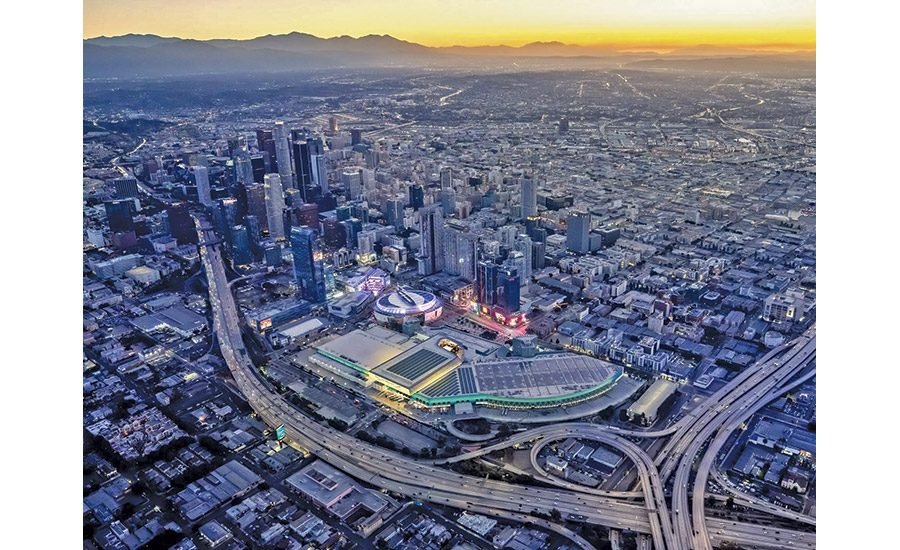
After a year of mega projects in 2024, West Coast projects were slightly smaller in 2025. Of the 10 largest projects in the region, five were valued at more than $1 billion, compared to all 10 listed in the 2024 regional Top Starts.
This year’s superstar is the Los Angeles Convention Center expansion, a $2.6 billion project that brings 190,000 square feet of contiguous exhibition space connecting the existing South and West Halls and a newly constructed 98,000-square-foot rooftop ballroom. The project began on October 1, and most of the construction will be completed by the 2028 Olympics.
The second largest start in the region was the Honolulu Rapid Transit Authority’s $1.66 billion Honolulu Skyline Rail Section 3. When completed in 2030, the extension will add three miles of elevated guidance and six stations through downtown Honolulu.
Another Olympic-sized project is the $1.5 billion Los Angeles Airport (LAX) road improvement, part of Los Angeles World Airports’ $30 billion capital improvement program and the final road improvement project phase of the airfield and terminal modernization program. Aimed to ease flow in and around the airport ahead of the expected surge in visitors by 2028, the 4.4-mile span includes reconfigured roads and bridges, retaining walls, drainage, lighting, signage and intelligent transportation systems. The entry roads will be completed first, before the games, then the exit roads in 2030.
Meanwhile, the race to upgrade hospitals to meet the looming compliance deadline continues. In 1994, the California Legislature passed SB 1953 after the Northridge earthquake, requiring all hospital buildings to be able to remain standing after a major earthquake by 2020 and be fully operational after such an event by 2030.
Spanning 18 acres, the $1.5 billion Kaiser Permanente Railyards Medical Center is a full-service hospital in downtown Sacramento set to open in 2029. Construction includes an eight-story, 662,050-square-foot, 310-bed hospital and five-story, 173,000-square-foot medical office buildings. This facility will be one of the first all-electric hospitals in the state and will replace the existing 60-year-old hospital on Morse Avenue, making Kaiser seismically compliant.
In San Jose, Good Samaritan Hospital invested $1.3 billion to expand its hospital campus and meet seismic safety standards. The project is one of the largest healthcare investments in Santa Clara County history, spanning 715,144 square feet and including a new patient tower, structured parking and infrastructure improvements.
Community Regional Medical Center’s Fresno campus is also undergoing a $350 million seismic remodel, completing major health care-related starts.

Kuilei Place will feature two towers: the mid-rise tower, which spans the 2nd and 12th floors, and the high-rise tower, which reaches up to the 43rd floor.
Representation courtesy of the Kobayashi Group
Only one mixed-use project appeared this year, the $619 million Kuilei Place apartment tower in Honolulu. With 43 floors and 1,005 units, Kuilei Place will see around 60% of its units allocated to affordable housing, while the rest will be allocated to market units.
Another basic element of Top Starts is energy. With a power purchase agreement already in place with Microsoft, Helion is building the world’s first fusion power plant in Malaga, Washington. Called Orion, the $300 million facility will use an ignitionless, pulsed fusion system that is built to directly recover electricity.
More conventional solar construction began last year with a pair of projects: the $416 million Jacumba Valley Ranch Solar Park in California and the $287 million Appaloosa Solar Facility in Pomeroy, Wash.
In Oregon, Sierra Pacific Industries has invested $253 million in improvements to its sawmill facility in Eugene, which will make the complex one of the largest in the country, with an annual production capacity of 650 million board feet when construction is completed in 2028.
Although it just missed this year’s ranking, the $137 million Port of Seward modernization project in Alaska shows that construction is also progressing in the far north. The 41,500-square-foot cruise terminal span includes a state-of-the-art floating dock 100 feet wide and 748 feet long, along with a 200-foot-long split transfer span.
This collection of projects reflects national trends. Nonbuilding construction starts increased in 2025, up 18.7% from the previous year, according to the Dodge Construction Network. Total starts rose 5.4% and non-residential starts rose 4.5%, but residential starts sank 4.8% for the year. Only one residential project made this year’s list: the $170 million Naliko residential community in Kapolei, Hawaii.
