


Patrick Hill is president of global operations at Jacobs, leading teams serving clients and communities in North America, Europe, the Middle East, Asia, Australia and New Zealand. His experience at Jacobs spans more than 25 years, crossing multiple sectors and operations. He holds a Bachelor of Engineering in Chemical Engineering from the University of Melbourne and is based in Melbourne, Australia.
Hill spoke with ENR Deputy Editor Aileen Cho about working in diverse sectors around the world, reducing risk in projects and addressing resilience. A few days after this interview, on April 21, he presented Jacobs Flood IQ, an AI-based intelligence solution to help cities, utilities and government agencies predict, manage and recover from flood events. The tool aims to transform fragmented water and drainage system data into actionable intelligence for preparedness, response and long-term resilience planning.
This interview has been edited and condensed.
ENR: In which countries have you worked? What are the key sectors?
My career has really stretched around the world. In terms of permanent location, Australia and the US have been the two main locations, but my worldwide responsibility includes the Middle East, Europe and Asia.
We are really focused on critical infrastructure and advanced facilities. Water and power, transport, etc., advanced life sciences and electronics, from distribution for the Australian mining industry during a huge iron ore construction boom in the 2000s to working in the US telecommunications sector. We have completed water infrastructure projects during a period of severe drought in water-scarce parts of the world. At the moment, our teams are thinking about offering the refurbishment of the British Houses of Parliament.
How many countries would you say you have worked in?
Looking for quick answers on construction and engineering topics?
Try Ask ENR, our new intelligent AI search tool.
Ask ENR →
I think it would be 40-50 countries that I have visited as a result. We have a permanent presence in more than 30 countries, but we offer projects in many, many more than that.
If I look at the public infrastructure sector right now, we’re seeing a real emergence of alternative delivery methods in the US market. In other parts of the world, this has probably been the dominant delivery mechanism. There is no one size fits all. It depends a lot on an owner’s preferences, how much upfront work they’ve done, risk appetite, scheduling over cost, how strong their supply chain is. For us, it’s really about leveraging that global experience to deliver very locally to our customers.
So what are the effective ways to reduce and control risk?
I almost think of risk in two elements. One is the most regular form we could think of, and I could talk about that second one. I think there’s also a risk of whether we’re really solving the right problem or not.
For all risk management, the sooner you can address it, the better. Your ability to manage risk becomes more limited as you move through the execution phase. But one of the things that I think is really important is, are we solving the right problem? Is the owner creating a project they don’t need? Or should they be drawing a different boundary around it?
There’s a great example of a project we delivered in the Asia-Pacific region. We had a water customer that needed to do this [address] an odorous sewage dump from one of its treatment plants. It stank and they were getting complaints. If the client worked it out on their own with a narrow boundary around it, it would have given a certain result. But nearby, there was also a major power plant that used cooling water. There was a major paper mill that had a demand for processed water and industrial effluents. And there was also an irrigation district nearby that produced about 6% of the country’s dairy products. And so if you draw a different boundary around that project and think about what it could achieve, you end up with a very different solution. You treat the water to a certain level; it opens up a lot of opportunities for recycling and you can ease the demand on the local water catchment to create more environmental flows and then unlock productivity in the irrigation district and also solve some of these industrial problems. So I always come back to that as a great example where if you draw a different boundary around something, you can solve three or four problems, or five problems.
I think there are more opportunities to do front-loading to de-risk projects, whether it’s geotechnical, surveying or data collection or [mitigating] contaminated land, or land acquisition; to really get that kind of thing off the critical path. We have an obligation to the communities we serve, perhaps to do more.
In these politically unstable times, how do you adapt? How does it affect project portfolios?
We have chosen the portfolio of markets we work in very deliberately. We’ve transformed a lot in the last decade to be very focused in these markets around critical infrastructure and advanced facilities. We believe that these markets are actually very resilient in all periods of an economic cycle. What would normally happen is that if the business cycle is strong, you will see both the public and private sectors investing heavily to take full advantage of these economic conditions. You will often see that when there is a moderation in the business cycle, governments often stimulate public infrastructure. We probably don’t see the ups and downs that we might all read about in the press about uncertainty and volatility, be it economic or climate or geopolitical conditions. If anything, we may even see an increase in demand as a result of this.
Take the pandemic as an example. Since then, I think we’ve seen nations wanting to secure their sovereign supply of essential materials or commodities or essential medicines. If you think about trade negotiations over the last 18 months, we see nations or different parts of the world looking to secure their local supply chains, and that has led to more investment in things like semiconductors or defense equipment. And I think the geopolitical context has also created a different need for infrastructure. The best example is in Europe, where obviously we’ve seen some conflicts there in recent years, but all the disruption in the energy system has led to some projects being done. One of the ones we are delivering at the moment is the Suedlink Interconnector. It is an underground cable of 700 kilometers that connects the north of Germany with the south. It really offers an opportunity to connect renewables to key demand centers.
What are some of the projects you are working on that address climate change resilience?
It is certainly reshaping the way we look at design principles. I would say resilience is really a basic requirement of any work we’re doing right now just to set things up for the future. We’re seeing really extreme conditions, whether it’s around heat, flooding or sea level rise, that are driving different projects. Nature based solutions along with engineered solutions is something we are seeing more of. For example, one of California’s major utilities is looking at a large underground program to completely rethink their asset base so that they can minimize their risk and exposure to wildfire risk.
It’s interesting when you think about the weather conditions in places like the Middle East or Europe. We automatically think of the Middle East as hot and dry; Europe is cool or rainy. But the reality is that Dubai airport, for example, in 2024 had a major flood. So we’re seeing a lot of capital planning around flooding in the UAE right now, and a lot of thinking about their water infrastructure. On the other hand, with some of the heat wave conditions we’ve seen in Europe, the aviation sector has had to completely rethink their pavements, whether it’s changing asphalt mixes or adding polymers. I think we’re seeing it [climate events] drive project planning more and more at all levels. Not only are there productivity issues, whether it’s flight cancellations so goods or people can’t move around cities, but also economically, the [ripple effect in] the insurance industry has completely changed the way you think about it. So it’s increasingly at the forefront of everything we do.
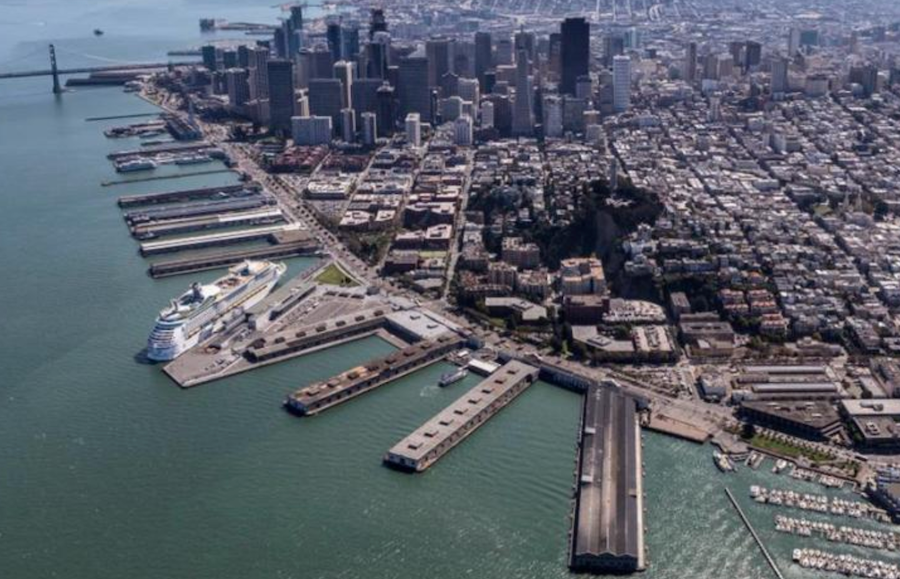
We are in the process of delivering the Bolivar Highway Gate System to the Texas Gulf Coast. It will probably be one of the largest storm barrier systems in the world. There are about $800 billion of critical energy assets that it protects. We have also done some very interesting work at the Port of San Francisco. There are 7.5 miles of coastline there. There are beautiful historic buildings, but there are also some critical services that run along this waterfront. So we’ve been looking at both earthquake risk and flood risk during extreme weather events, and then also sea level rise.
How did you get into this business?
I started as a chemical engineer and built my career in the water sector. I started out working on very large projects, particularly in the drought affected areas of Australia. I spent some time working on projects all over the South Pacific, providing fresh water for some communities in Fiji and things like that. I felt a real sense of purpose in what I was doing. I then started to hold different leadership positions and had the opportunity to work in various sectors and geographies.
Projects are very complex and we often think about the technical elements, but the reality is that it is the people and the trust that is built that often end up being the things that really determine the success of projects: the level of collaboration and the way innovation is leveraged. My role today is how to enable people to do their best work, connect teams or remove barriers, or help them connect with the owners of those assets. We have almost 45,000 people worldwide and they are very, very smart. It’s a great privilege to work with so many smart people.
