

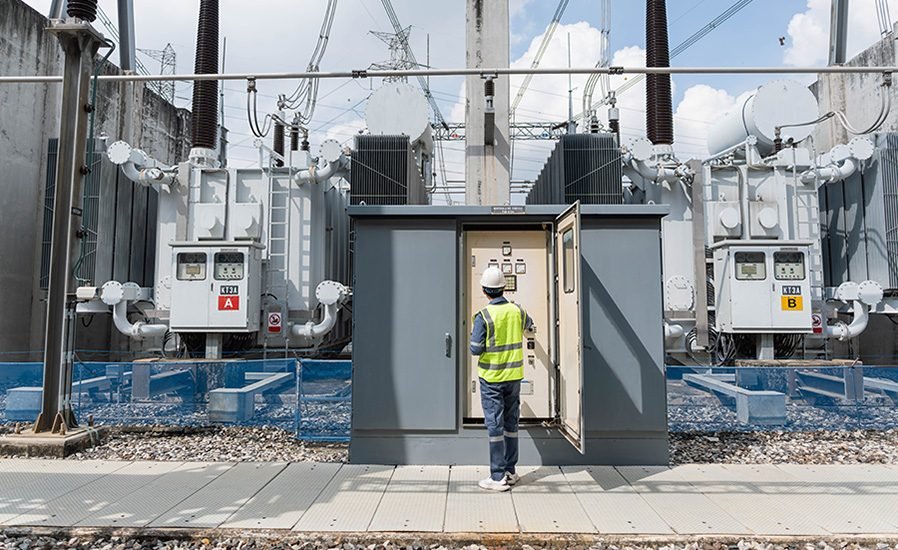

President Donald Trump has invoked the Defense Production Act to speed up the deployment of what the White House considers some of the most constrained segments of US energy infrastructure, such as grid equipment, pipelines and liquefied natural gas systems, as critical to national defense.
Published April 23 in the Federal Register, the determinations authorize the US Department of Energy to deploy tools under Section 303 of the statute, first enacted in 1950, to allow the president to change policies related to the industry in light of national defense concerns. The latest determinations aim to expand domestic capacity in US energy markets through financial support and other changes.
RELATED
Trump DOE issues first loan, $1.6 million, for five-state AEP network upgrade
The determinations follow an executive order signed in January 2025 that called for a “national energy emergency.” In the notices of determination, Trump said that “funding risks, regulatory delays and market barriers” limit domestic capabilities for the development, manufacture and deployment of large-scale energy infrastructure projects.
One determination identifies transformers, high-voltage transmission components, substations and related manufacturing supply chains as “dangerously constrained,” citing long lead times, reliance on imports and insufficient domestic production capacity.
Separate determinations expand federal support for natural gas and LNG systems, including gathering and transmission pipelines, processing plants, underground storage, liquefaction facilities, and marine export terminals, as well as domestic oil production, refining, and logistics infrastructure, such as pipelines and storage terminals.
A broader directive covering “energy-related and large-scale energy infrastructure” goes further, explicitly including engineering, site acquisition and preparation, permitting and funding for early-stage risk mitigation, linking action to the pre-construction phases that often determine whether projects move forward.
Looking for quick answers on construction and engineering topics?
Try Ask ENR, our new intelligent AI search tool.
Ask ENR →
The White House actions cite persistent barriers, including funding constraints, regulatory delays, long equipment delivery times and supply chain bottlenecks, concluding that market conditions alone are unlikely to deliver sufficient capacity in a timely manner without federal intervention, warning that shortfalls could “severely impair national defense capability.”
The move comes amid increased volatility in global energy markets linked to the ongoing conflict with Iran, which has caused swings in oil and fuel prices and disrupted supply routes, putting pressure on domestic energy costs and infrastructure systems. At the same time, U.S. electricity demand continues to rise, with utilities citing rapid growth in power-hungry data centers and industrial loads.
RELATED
The Hormuz bypass infrastructure was sized for a brief outage. This is not that.
The orders establish a legal and policy framework for DOE’s participation, but do not identify projects, funding allocations, or award timelines. DOE has not yet issued announcements of funding opportunities or implementation guidance linked to the determinations, so the short-term impact on project pipelines and procurement is uncertain.
This gap marks a departure from previous uses of the Defense Production Act for energy supply chains.
A previous DOE initiative under President Joe Biden to expand home heat pump manufacturing, for example, was paired with a defined $250 million funding opportunity and application deadlines. At the time, Energy Secretary Jennifer Granholm said the effort was aimed at “strengthening the nation’s energy independence” by expanding US manufacturing capacity.
Until DOE translates the determinations into funding rounds or project-level actions, the measure only signals a potential expansion of federal involvement in energy infrastructure delivery, rather than direct investment in these affected markets.
