

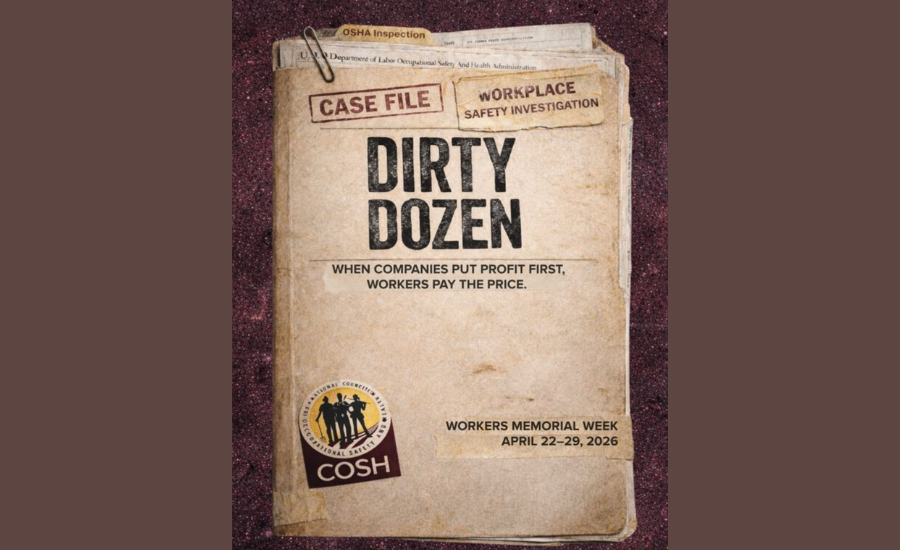

A report by the National Occupational Safety and Health Council raises the alarm about increased heat-related workplace risks as the construction industry enters “the most dangerous time of the year for heat exposure.”
National COSH’s Dirty Dozen 2026 report, released during Workers’ Memorial Week, honoring those who have died or suffered work-related injuries and illnesses, says it has identified 12 companies that “put workers’ lives at risk through unsafe practices, inadequate protections and systemic negligence.” Among the list were homebuilder DR Horton and Massachusetts contractor Revoli Construction, which faces a $4.6 million fine after a deadly trench collapse.
However, according to National COSH, extreme heat adds an additional layer of complexity to workplace risks and the need for stronger safety enforcement, with nearly 28,000 hot weather-related workplace injuries per year, according to the report.
“The Dirty Dozen 2026 makes clear that these tragedies are not accidents, they are the result of choices,” National COSH Executive Director Jessica E. Martinez said in a press release announcing the report. “Employers must be held accountable and workers must be empowered to speak up without fear.”
Increased heat protections
At the federal level, National COSH is also calling for greater accountability from the Occupational Safety and Health Administration amid a 47 percent drop in federal occupational health and safety penalties by 2025, according to a report by Good Jobs First, citing complex outsourcing systems that allow companies to evade responsibility.
“When OSHA steps back, workers are exposed to preventable harm,” Martinez said in a news release urging the agency to expand its National Emphasis Program (NEP) for outdoor and indoor heat-related hazards.
Two days after the NEP directive expired on April 8, OSHA announced that it has updated and extended the directive through 2031.—expanding its heat risk inspection guidelines to include 22 new sectors targeting 55 high-risk industries, including ggeneral freight and logistics, plastic manufacturing, animal slaughter and processing, scheduled air transportation, large warehouses, community food and housing services, individual and family services, and telecommunications carriers.
Looking for quick answers on construction and engineering topics?
Try Ask ENR, our new intelligent AI search tool.
Ask ENR →
While there is no official federal law or rule yet requiring employers to protect workers from extreme heat, the NEP directive, originally released in April 2022, allows OSHA toproactively inspect high-risk workplaces to prevent heat-related illness, injury and death.
The agency can issue heat citations under its general duty clause, even while not on a heat-related inspection.
OSHA began the rulemaking process to consider a heat-specific workplace standard in 2021 by publishing an advance notice of proposed rulemaking for the prevention of heat injuries and illnesses in outdoor and indoor work environments in the Federal Register.
The NEP directive uses OSHA and Bureau of Labor Statistics data from calendar years 2022-2025 to establish its inspection priorities. According to the US Bureau of Labor Statistics Census of Fatal Occupational Injuries, environmental heat exposure killed 999 workers in the United States bbetween 1992 and 2021. However, the The Occupational Safety and Health Administration warns that heat-related illnesses are widely underreported due to diagnostic problems and inconsistent reporting.
