

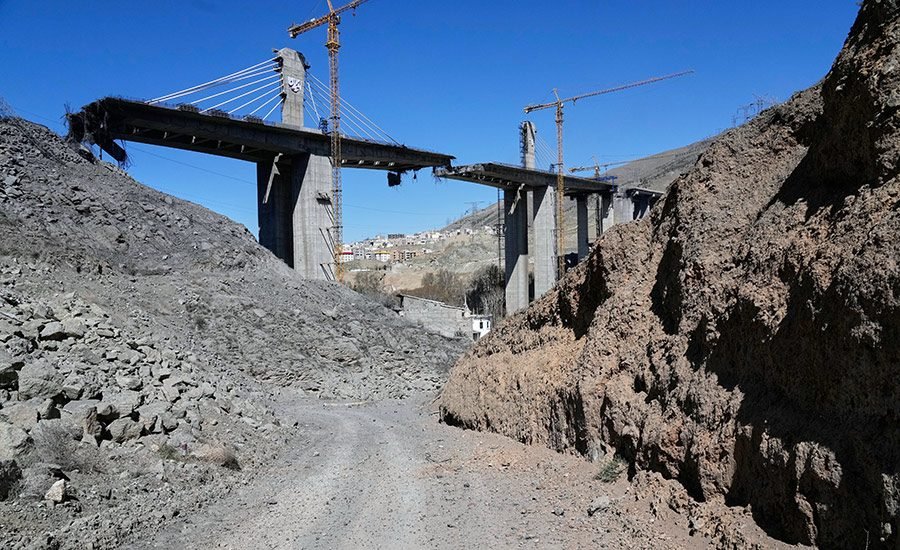

Geopolitical hostilities and a UAE mandate that government-funded projects employ one Emirati for every foreign worker pose a challenge for arbuilding conflict-damaged infrastructure in Iran and the Middle East region. Some Asian countries, especially India, seem willing to play a role in future reconstruction efforts.
These efforts remain in the damage and scope assessment phase as operators map the extent of the destruction. Rystad Energy estimates a $58 billion reconstruction bill, as previously reported in ENR. The first tenders to be issued after the technical scope is completed are likely to cover engineering assessments, turbine and compressor replacements, refinery rebuilds and port repairs, desalination, grid and substations.
Fiscal reprioritization, governance delays, and stricter post-incident standards—radar, anti-drone, and missile defense upgrades—mean that rebuilding now requires a total security tightening, not just rebuilding. The repairs also compete with Qatar’s large North Field gas project and the Saudi-UAE gigaprojects for manufacturing yards, engineering and heavy-lift capacity. As deadlines pass, reconstruction slows and costs rise due to equipment shortages, overstretched contractors, and the need for geopolitical alignment. The UAE’s fast-track placement rule, imposed within two weeks of the war, has added a severe bottleneck to the labor market.
The immediate concern is labor coming mainly from India, Bangladesh, Pakistan and Nepal. With many having returned home due to the war and some unwilling to return to the region, this will be a big challenge, says Syed Farooq, managing director of Al Syed Staffing Solutions. Insurance premiums have risen and the UAE’s post-Iran war recalibration, anchored in a new localization mandate, requires private companies to employ one Emirati for every foreigner in government-linked jobs, “it doesn’t help,” he says.
The labor pressure created by the mandate will hit contractors first. Welding crews, riggers, turbine technicians and piping specialists, traditionally 90-95% expatriate, cannot be quickly replaced by Emirati contracts, Farooq explains.
With major contractors in the Gulf based in Dubai, the rule applies to them wherever they work in the region. “The UAE mandate will increase labor costs as demand for rebuilding increases, adding another friction point to an already capacity-constrained recovery,” he says. “Lower-level local workers in Dubai, Kuwait and Saudi Arabia command salaries well above the large pool of experienced Indian expatriates. This will further slow mobilization.”
LNG repairs and gas processing in Qatar, refinery and petrochemical rebuilds in Kuwait and Bahrain, and marine salvage work in damaged ports that rely on large, mobile expatriate teams in Dubai-based companies can no longer be deployed as freely.
Looking for quick answers on construction and engineering topics?
Try Ask ENR, our new intelligent AI search tool.
Ask ENR →
Fabrication yards, heavy haulage operators, utility contractors and grid restoration crews will also face delays as the 1:1 rule tightens labor availability. This will put UAE companies at a competitive disadvantage during peak rebuilding demand.
India’s advantage
New contractors are being brought in largely outside the UAE, with Saudi Arabia, Qatar, Oman and Bahrain tapping additional capacity from India, South Korea and China as rebuilding demand accelerates. India stands out as a major country capable of supplying labor, materials and engineering capacity at scale. Ajay Kumar, an engineer in the land department of an eastern Indian state, says many listed Indian government contractors with proven records are now looking to the Middle East.
Tata Projects is already looking at damaged data center infrastructure in the Middle East, with outages and destroyed capacity creating urgent demand, according to managing director and CEO Vinayak Pai. “These centers now need to be resilient, with redundancies built in, and that requires a stable operating environment.” The Tata group had announced plans to launch a new business with an investment of $7 billion to develop 1GW AI data center capacity in India.
Meanwhile, Iran’s reconstruction costs range from $58 billion in energy repairs to $270 billion in total national reconstruction. Reconstruction will be led almost entirely by non-Western contractors, as sanctions, financing barriers and political isolation are excluding European, American and most Gulf contractors. Indian contractors are not restricted from working in Iran. One official told ENR without attribution that once all political control passes to Iran, the opportunities are massive.
Until then, Iran’s reconstruction will be dominated by Chinese companies such as Sinopec, CNPC, PowerChina and CEEC, with Russian companies dealing with pipelines, gas processing and energy fields, and domestic players such as Khatam-al Anbiya and MAPNA handling civil works and turbines.
