

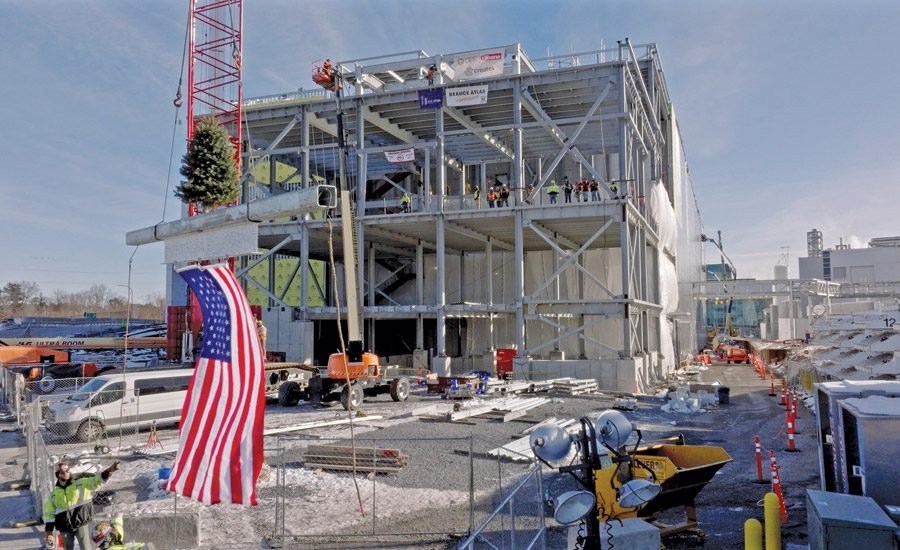
When a project began in 2024 to build a 310,000-square-meter nanotechnology research facility on an existing semiconductor research and development campus in Albany, New York, designers did not have final specifications for the machinery that would be installed.
The joint venture between Gilbane and DPS Advanced Technology Group is adapting plans and building vibration monitoring to avoid disrupting R&D at the complex as it develops the project known as NanoFab Reflection. When completed as planned later this year, the site will house a 200-tonne machine to make microchips. The 50,000 square feet of ISO 5 cleanroom space should also be able to accommodate any equipment the semiconductor industry needs over the next two decades.
“We need to achieve flexible design while being able to anticipate unknown capabilities in the future, all while managing the client’s cost and schedule,” says Nathan Speanburg, senior director of construction at DPS. “It’s quite an enigma.”

The NanoFab Reflection project will be part of a larger semiconductor research campus in Albany.
Image courtesy of NY Creates
NanoFab Reflection will be the first addition in more than a decade to the NanoTech Complex, a group of similar buildings dedicated to semiconductor science. Owned and operated by NY Creates, a public-private partnership to expand the R&D industry in New York State, the building will add about 30% more cleanroom space to the campus. A major component of his inaugural equipment will be a cutting-edge device for etching microchip circuits with ultraviolet light.
The four-story building, a 900-car parking structure and a playground upgrade has a $614 million budget made up of funds from New York State, which is investing a total of $1 billion in construction and new microchip equipment. Pursuing the contract as a joint venture allowed both Gilbane and DPS to lend their expertise. Before Arcadis bought DPS in 2022, the company was primarily engaged in the engineering, procurement, construction and tooling of semiconductor facilities. The DPS team needed a partner with better local resources, Speanburg says. Gilbane has already handled projects of similar complexity and cost in upstate New York, but is looking to work more with semiconductors and advanced technology, says Christian Calabrese, the company’s senior project executive.

Once the building is complete, businesses and other organizations can pay for NY Creates to conduct research on their behalf or send their own teams to Albany to use the equipment.
Photo courtesy of NY Creates
Difficult design
As with other R&D projects, question marks about what the site might hold now and in the future made the design phase difficult.
“Many of the budget issues with an R&D facility occur when it’s designed to maximize capacity,” Speanburg says. “It does come at a price, because you’re adding more and more to the building.”
Ceiling height, energy demand, chemical supply and other factors were discussed by the client and contractors as they planned how to build a site that could adapt to unforeseen needs. “We did several value engineering efforts with this client to keep the budget under control,” Speanburg says.
“A lot of the budgeting issues for an R&D facility come when it’s designed to maximize capacity. It comes at a price, because more and more is added to the building.”
—Nathan Speanburg, Senior Director of Construction, DPS
The JV knew it had to decide quickly on transformer upgrades. Energy-related acquisition packages take first priority, he says, since the projects he and Calabrese have worked on lately have needed some sort of upgrade, especially in upstate New York. The transformers, 45 MVA models that replace two 35 MVA versions, were ordered from a Korean manufacturer. When the 2023 models were chosen, they would arrive about six months earlier than a domestic option. Site designs were about 30% complete when some of the first acquisition packs came out. The team started in January 2024 when the design was 60% done.
The construction site is located between two existing buildings on campus. NanoFab Reflection will be attached to its neighbor to the north: a precast concrete structure. NY Creates wanted to continue with prefab.
But when the specifications for the microchip equipment came, the floor rating in the cleanroom had to go beyond the industry standard of 500 pounds per square foot. Equipment arriving on site required ratings of 750 and even 1,000 pounds per square foot in locations near particularly important equipment. Combined with the goal of having as few columns as possible in the cleanroom, the request for prefabs became a challenge. To make it work, the design team opted for better-value waffle slabs and double-T beams, each 128 feet long and over 90 tons per punch. “They were unheard of,” Speanburg says.

The JV had to organize construction around a single point of entry and exit because the site had existing buildings on three sides.
Photo courtesy of NY Creates
good vibes
All of the construction had to happen while other campus employees worked with vibration-sensitive equipment in nearby clean rooms. The gap between the new facility and the building to its north is less than a foot and a half, Calabrese says. The team mounted vibration monitors on the neighboring building to ensure that the drilling rigs driving 120-foot foundation piles did not cause disruption. Crews tackled the installation of the new transformers after hours. Crews used manually controlled dollys to skid the D7 excavator-sized equipment a half-mile from the assembly site to their final locations.
Off-site manufacturing also helped the project manage the tight boundaries and demands of minimal disruption. The wet mechanical contractor assembled pipe runs up to 60 feet long for the utility building, which houses the refrigeration plant and other mechanical equipment, prior to construction. Installation of the 36-in. and the 60-inch-diameter pipes were coordinated with the steel construction, which saved money and time in field welding, Calabrese says.
A similar approach also extended to parts of the cleanroom building. In microchip facilities, “subfabs” house all the piping for utilities, chemicals, gases, and waste disposal that feed into the cleanroom above. Instead of having all the equipment built on site, the contractors put together a bid package for a modular subfab utility rack that could be assembled in a controlled environment.
Danforth, an EMCOR company, assembled nearly 92,000 pounds of conduit into 200 prefabricated segments, each 24-ft. The parts were delivered to the site and installed over five months.
The modular facility was a new approach for the NanoTech complex, says Ramin Dabiri, senior director of facilities and infrastructure at NY Creates, and helped with site security, cost reduction and time management. The sub-pipe is also slightly oversized for what is needed today in anticipation of the higher demands of aftermarket equipment.

With construction over 85% complete, the team plans to deliver the project by the end of the year.
With the project more than 85% complete, the design and construction team is particularly proud of its safety record. There have been few incidents, Speeburg describes its record as “world-class”, and no deaths during what is now more than a million hours of safe work. “We try to subtly brag” as much as we can,” Calabrese says, “but [the safety record did not happen] by accident.” A large facility with similar safety needs was last built in the area eight years ago. Local union hall members work in commercial locations, but the return of a project with such particular concerns and such a tight schedule meant safety upgrades would be needed.
“Our safety orientation, our walks and everything we do is to bring them back into the fold of semiconductor safety programs,” Speanburg says. “If you don’t do it every day, you need to be refreshed.” The association planned how to evaluate subcontractors and their safety programs before any companies could enter the bidding list, and they also hired two safety professionals for additional on-site training.
The building’s progress means NY Creates can turn its attention to other tasks. The first and most complicated contract to assemble microchip equipment has been awarded, says Christopher Borst, vice president of technology and infrastructure at NY Creates. Site preparations have begun for a sequence of cargo planes and semi-trucks that will deliver different parts of the machine, which will be the size of a double-decker bus once assembled.
While NY Creates wants NanoFab Reflection to be a flexible space, it also wants more space overall. The organization plans to add another 100,000 square meters of cleanroom space to the complex over the next decade.
