

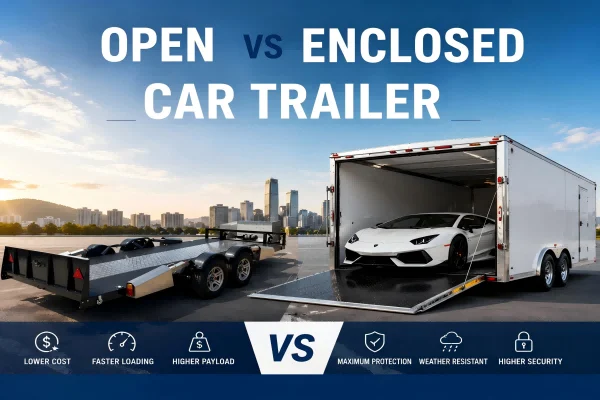
An open car trailer does exactly what the name suggests: it moves vehicles without any surrounding walls or roof. Most open trailers fall into a few common designs: flatbed trailers with fixed ramps, tilt-deck trailers that require the entire deck for loading, and hydraulic tilt car trailers that use an electric system to smoothly lower the deck. The car hauler trailer used by most dealerships and auction companies is usually an open design because it is designed for volume and speed, not fancy presentation.
An enclosed car trailer wraps the load in a complete body structure: walls, roof, rear ramp door or liftgate, and an interior attachment system. Some enclosed trailers are built specifically for motorsports equipment and include storage lockers, tool areas and, in some cases, living quarters. Others are simple cargo trailers used for transporting luxury and exotic vehicles where the owner does not want a $200,000 car exposed to the dirt of the road.
Beyond protection, enclosed trailers are a rolling billboard. Many trucking companies wrap the exterior with branding, making the trailer a marketing asset as well as a piece of work equipment.
The debate between open and closed car trailer configurations is not about which is objectively better. It’s about which one fits your specific operation. Here’s how they stack up among the factors that really matter in day-to-day use:
The price difference between the two is real. A quality open car trailer can cost anywhere from $3,000 to $8,000, depending on size and specifications. A comparable enclosed car trailer starts closer to $10,000 and can top $30,000 for a stacker or race trailer with interior equipment. This does not include the higher fuel costs and larger storage requirements that come with running a closed unit.
That said, operating costs alone don’t tell the whole story. A single insurance claim for weather damage or road debris on an unprotected high-value vehicle can wipe out months of savings from using a cheaper open trailer.
High volume transportation operations (car dealerships, vehicle auctions, rental fleet logistics) have largely stuck with open car trailers for practical reasons. Loading is faster, maintenance is simpler, and access to the frame for routine checks of tires, axles, brakes and attachment points does not require working in an enclosed space.
The ROI math for high-volume operators almost always favors open trailers when the value of the cargo does not require premium protection. Efficiency trumps aesthetics when moving 200 vehicles a month.
The collector car market has expanded significantly over the past decade. High-value classics, low-production exotics, and professionally built race cars are more often transported longer distances. Owners of these vehicles expect closed carry as a baseline, not an upgrade.
Motoring is another constant driver. Race teams at all levels, clubs racing for national championships, rely on enclosed race car trailers to serve as paddock workshops. A stacker trailer that carries two cars and stores spare parts, tools and fuel is a functional base of operations at an event, not just a transport vehicle.
Whether you go open or closed, the quality of the trailer’s construction determines the long-term cost more than the initial price. A cheap open trailer with an undersized frame and inadequate corrosion protection will crack, rust and wear unevenly within a few years. A well-built open car trailer with high-strength steel, proper welding quality, and quality hot-dip galvanizing or powder coating will last a decade longer than the cheap version.
The frame and axle must be properly matched to the trailer’s GVWR. An undersized axle will wear out suspension and brake components faster than expected, and is a safety issue in highway loads.
There is no single right answer in the open versus closed car trailer debate. Open trailers make economic sense for high-frequency commercial transport where efficiency, payload capacity and low operating costs are most important. Enclosed trailers make sense when the value of the cargo, customer expectations or operating conditions justify the additional investment. What matters more than the type of trailer is buying the right level of quality for your use case. A well-built open car hauler that runs a dealer fleet will outperform a cheap enclosed trailer in all metrics that are important to a successful business. Focus on frame quality, axle rating, brake systems and surface protection; then choose open or closed based on what your actual cargo and customers need.
