

How to choose a manual winch for your car trailer loading needs
A manual car towing winch is one of the most practical tools for safely loading vehicles when you need a simple, reliable and easy-to-maintain solution. For owners of car haulers, repair shops, motorsports teams and transport companies, a correctly selected winch can make loading the vehicle easier while reducing the physical effort required during operation.

When choosing a manual trailer winch, buyers need to look beyond basic towing capacity. Trailer type, vehicle weight, load angle, winch mounting position and working environment affect performance. A suitable manual winch helps improve load safety and provides reliable operation without reliance on electrical power.
Why it’s important to choose the right manual car towing winch
The right manual winch directly affects how efficiently a vehicle can be loaded onto a trailer. A winch that is too small can have problems with loading, while an oversized model can add unnecessary cost and weight. Professional towing users often select winches based on actual operating conditions rather than just looking at product specifications.
Common loading challenges without proper shift
Loading a vehicle onto a trailer can be difficult when the vehicle cannot move under its own power, the angle of the ramp is steep, or the surface creates additional resistance. Without an adequate traction system, operators may require additional labor or equipment, increasing loading time and safety risks.
Why trailer owners still choose manual winches
Many trailer owners choose manual winches because they are simple, durable and independent of batteries or electrical systems. This makes them especially useful for outdoor applications where power supplies are not always available. A quality manual winch can provide years of service with proper maintenance.
What is a manual car towing winch?
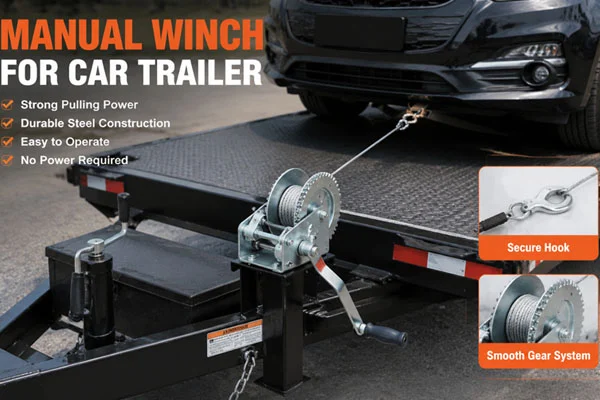
A manual car trailer winch is a mechanical pulling device that is operated by hand to move vehicles on the deck of a trailer. It typically uses a handle, a gear mechanism, a drum, and a belt or cable to create a controlled pulling force. Unlike electric winches, manual models do not require additional wiring, batteries or power systems.
How a manual towing lathe works
The operator turns the handle, which activates the internal gear system and rotates the drum. The strap or cable is wound around the drum, gradually pulling the vehicle forward. The gear ratio allows the user to generate sufficient force while maintaining better control during loading.
Main components of a reliable hand winch
A reliable manual trailer winch usually includes a strong frame, corrosion-resistant gears, a durable handle, and a high-quality strap or cable. These components work together to provide stable tensile performance during repeated loading operations.
Where are hand winches commonly used for car trailers?
Manual winches are widely used in various towing applications because they provide a practical solution for vehicle recovery and loading. They are especially common among users who need reliable equipment without complex maintenance requirements.
Vehicle transport and car transport
Auto hauling companies and trailer operators often use manual winches as backup or primary loading equipment. They help move disabled vehicles, project cars and vehicles that cannot drive onto the trailer bed.
Motoring applications and racing cars
Racing teams and automotive enthusiasts often require careful handling of the vehicle during transport. A manual winch provides a controlled load, helping to secure vehicles with little clearance and reducing the risk of sudden movement.
Repair workshops and equipment removals
Repair facility and equipment operators may use manual winches to move vehicles during recovery, maintenance, or transport tasks. Their simple design makes them comfortable for daily workshop operations.
How to choose the right manual winch for car trailer use
Selecting the correct manual winch requires understanding the trailer configuration and working conditions. Buyers should consider several factors before purchasing to ensure safe and efficient operation.
Check the required pulling capacity
The capacity of the winch must match the weight of the vehicle and the loading conditions. A safety margin is important because the actual tractive force can increase due to ramp angles, tire resistance and uneven surfaces.
Consider trailer size and vehicle weight
A small utility trailer and a heavy car hauler may require completely different winch specifications. Matching the winch to the trailer size helps prevent premature wear and improves reliability.
Evaluate strap or cable options
Straps are popular because they are lightweight and reduce the chance of damaging vehicle surfaces. Steel cables provide excellent durability for harsh environments and heavy-duty applications. The best choice depends on how often the trailer is used.
Manual winch vs electric winch for car trailer
Both manual and electric winches can be effective for loading vehicles, but they serve different user needs. Manual winches are valued for their simplicity, while electric winches are preferred when frequent and heavy duty operation is required.
Advantages of manual winches
Manual winches do not require a battery connection, have fewer electrical components and are easier to maintain. They are a good choice for occasional transports, personal trailers and users who prefer simple equipment.
When an electric winch can be better
Electric winches can save time when loading vehicles frequently or handling heavier loads. Commercial operators with high daily usage may prefer motorized solutions for faster operation.
Installation tips for manual trailer winches
Proper installation is essential for safe winch performance. Mounting position, frame strength and alignment should be checked before using the winch under load.
Selecting the correct mounting position
The winch should be installed where the pull direction naturally aligns with the load path of the trailer. Incorrect positioning can increase stress on the winch and reduce efficiency.
Checking frame strength and alignment
The mounting area of the trailer must be strong enough to withstand the pulling forces. Loose screws or weak mounting points can create safety issues during operation.
Maintenance tips to extend winch life
Regular maintenance helps keep a manual winch running smoothly. Operators should inspect the belt, cable, gears and mounting hardware before routine use.
Belt, cable and gear system inspection
Check for spatter, rust, unusual noises, or damaged components. Early replacement of worn parts can prevent unexpected failures during vehicle loading.
Protection of the winch from weather damage
Since trailers are often stored outdoors, protecting your winch from rain, dirt and moisture can significantly extend its life. Cleaning and lubrication are simple steps that improve long-term reliability.
Common mistakes when buying a manual winch for a car trailer
A common mistake is to select a winch based solely on price or advertised capacity. Buyers should also consider trailer compatibility, frequency of operation, material quality, and after-sales support.
Frequently asked questions about manual car towing winch
What size manual winch do I need for a car trailer?
The correct size depends on the weight of the vehicle, the design of the trailer, the angle of the ramp and the expected working conditions. Buyers should select a winch with sufficient capacity to handle the load safely while maintaining a reasonable safety margin.
Is a manual winch strong enough to load vehicles?
yes A properly rated manual winch can safely load many vehicles when properly installed and used. Widely used for car towing, recovery work and vehicle transport applications.
How often should a trailer winch be serviced?
The inspection should be carried out regularly, especially before heavy use. Checking the strap, cable, handle, gears and mounting screws helps identify potential problems early.
Should I choose a strap or a manual steel cable winch?
A strap is generally easier to handle and better suited to protecting vehicle surfaces, while steel cable offers great durability for demanding environments. The right choice depends on your application.
Can a manual winch be installed on any car trailer?
Most trailers can support a manual winch if the mounting structure is suitable. Before installation, please confirm that the trailer frame and mounting location can support the required pulling force.
Conclusion
Choosing the right manual winch for car towing applications helps improve load efficiency, safety and long-term equipment reliability. By considering capacity, trailer type, installation requirements and maintenance needs, buyers can select a winch that fits their hauling job.
