

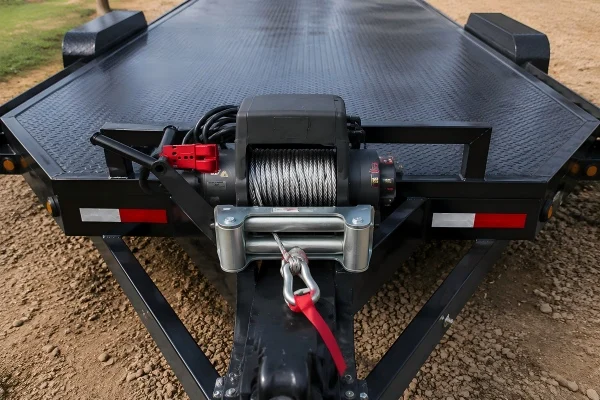
Choosing a winch for use on a car trailer based only on the weight of the vehicle can lead to the wrong result. A car rolling freely down a clean tow ramp requires far less line traction than the same vehicle with flat tires, locked brakes, or collision damage. For most passenger cars weighing between 3,000 and 5,000 pounds, a 5,000 to 8,000 pound electric winch is usually adequate. Commercial haulers, repair shops, recovery companies, dealerships, rental companies, motorsports teams and owners who handle damaged vehicles should consider a 9,000-12,000-pound model. Ramp angle, drum layers, duty cycle, mounting force, rope capacity and power supply must also be considered.
If the wheels turn normally and the trailer has a moderate load angle, the winch does not need to lift the full weight of the vehicle. The following ranges provide a practical starting point for selecting a winch for trailer loading.
These figures do not replace the winch manufacturer’s performance chart. The mounting plate, bolts, trailer frame, rope, hook, battery, step and anchor points must withstand the forces created by the selected winch.
A trailer winch pulls a rolling load horizontally and up a ramp. It does not lift the entire vehicle vertically. So a 4,000-pound freewheeling sedan may require only a fraction of the 4,000 pounds of actual traction.
A normal car tow winch is designed to pull. It should never be used to lift a suspended vehicle or other aerial load.
The usual rule of thumb to choose a winch rated at 1.5 times the vehicle’s weight comes primarily from off-road recovery. Mud, deep slopes and ground suction create much more resistance than a car rolling freely on a steel trailer deck. This rule provides a conservative margin, but should not replace an assessment of actual loading conditions.
Start with the heaviest vehicle the trailer is expected to carry. Use your actual loaded weight instead of just relying on your free weight. Fuel, tools, spare parts, motorsports equipment, vehicle modifications and cargo left inside can add to the load.
If the same trailer regularly handles damaged cars, the best winch for car towing work will typically fall between 9,000 and 12,000 pounds. The extra capacity reduces engine stress, but cannot compensate for a weak trailer frame or mounting plate.
A running passenger car with well-inflated tires usually requires relatively little traction. Straight-line loading and a moderate ramp angle make a 5,000- to 8,000-pound winch practical for most sedans and compact SUVs.
For a low-clearance race car, inspect the rope path, dropout height, ramp angle, and approved towing point. The hook or rope must not contact the splitter, bumper, bottom pan, suspension or steering components.
Build quality, gear ratio, brake design, motor efficiency, sealing, line speed, thermal protection, duty cycle, spare parts availability and manufacturer support all affect actual performance. A well-built 6,000-pound winch can provide more reliable service than a low-cost 9,000-pound unit with frequent use.
An individual trailer owner may load the same operating vehicle only several times per year. Moderate capacity and a lower duty cycle may be acceptable. A manual winch can work for a light, free-rolling car, although it takes more time and physical effort.
Repair shops and recovery companies often encounter flat tires, locked wheels and suspension damage. A high duty cycle electric or hydraulic car trailer winch may be warranted. Dedicated sled blocks, wheels, skids and recovery points should also be available.
A starting block can redirect the rope or create a double line pull. This arrangement provides a mechanical advantage and reduces the force carried by each active rope section. Friction prevents a perfect doubling of the usable traction power and the loading speed will be slower.
Each component of the system must have an adequate working load limit, including the pulley, rope, hook, shackles, secondary anchor point, mounting plate and trailer frame. A transport anchor point should not automatically be treated as a recovery anchor. An arrabas block cannot make an unapproved connection point secure.
Inspect terminals for corrosion, loose connections, heat damage, and poor crimps. Remember that a sufficiently rated winch can still overheat during repeated loading if its duty cycle is too low.
Both options can work well when combined with the drum, cable, hook and operating environment.
Neither type requires maintenance. Replace the rope or cable when the damage exceeds the limits allowed by the manufacturer.
The winch, mounting plate, bolts, welded brackets, cab pass and trailer frame make up a load system. Installing a 12,000-pound winch on thin or unbraced steel does not create a 12,000-pound system.
Mount the winch close to the centerline of the trailer and keep the pull straight. Lateral stretch can cause uneven rope build-up and unwanted loads on the fairing and frame. Before loading, inspect fasteners, welds, plate, rope, hook, electrical terminals, and grommet for damage or deformation.
Park on firm, level ground whenever possible. Securely connect the trailer to the tow vehicle, apply the tow vehicle’s parking brake, use wheel chocks if applicable, and lock the ramps or tilt platform in the correct position.
Once the vehicle is in the correct position, secure it with wheel straps, axle straps, chains or another approved four-point system. Release the winch tension only after the vehicle is properly secured. A winch is a piece of cargo equipment and should never replace haulage lashings.
For most free-wheeling passenger cars, a 5,000- to 8,000-pound winch for car trailer load provides a practical balance of capacity and operating margin. Commercial users, damaged vehicles, heavy trucks, flat tires, locked wheels, and uncertain conditions typically warrant a 9,000-12,000-pound model.
