

Stacked atop two precast concrete plinths at the edge of a public green space in Doraville, Ga., a 4,000-square-foot chair-shaped wooden shell rises, elastically bent wooden slats arching upward from its nearly flat initial position. When complete, the double-curved, 82-foot-span canopy will be clad in stainless steel shingles, capturing the Georgia sun from every angle.
The Assembly Studios Bandshell, nicknamed “the Pringle” by the project team, is slated to open in early June as a FIFA World Cup viewing venue at Assembly Studios, a 120-acre film and production campus owned by Gray Media and Assembly Atlanta. After the tournament, it becomes a permanent outdoor performance space. No one has built such a structure on this scale in North America, the engineering team says.
“It’s sure to attract attention,” says Lucas Epp, vice president and head of engineering at StructureCraft.
The Vancouver-based firm is the structural engineer of record and timber designer for the superstructure. Smith Dalia Architects designed the project. Bailey Construction is the general contractor and Gibson Company is acting as the owner’s representative.

Crews are installing bentwood components during construction of the $10 million wooden gridiron, a key feature of the venue that will debut before the World Cup.
Photo courtesy of StructureCraft
*Click on the image for more details
Inside the Timber Gridshell
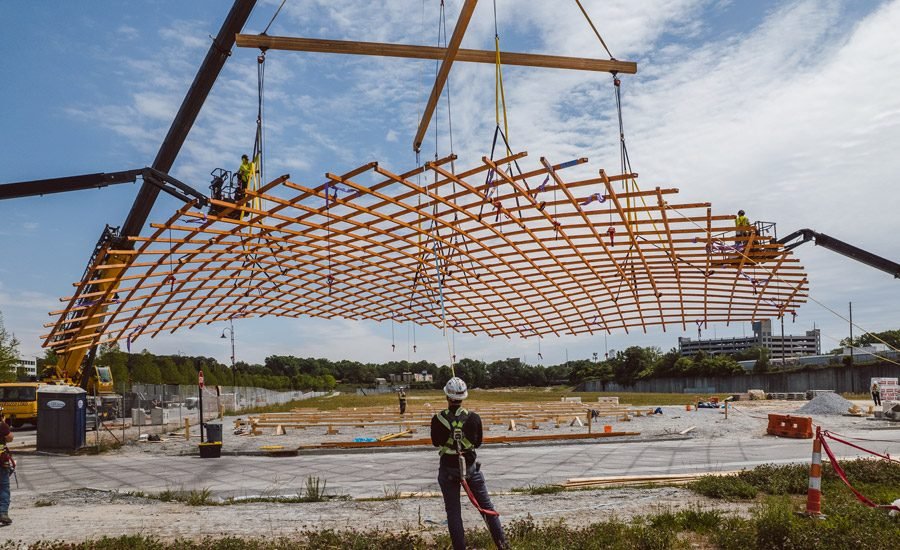
A grid behaves much like a continuous layer, relying on curvature to transfer forces through a lattice rather than solid material. In StructureCraft’s active folding system, the form starts as a 3-inch flat mat. by 3 inches. wooden slats that are lifted into place on a ring beam, allowing the grid to take shape as it rises.
“It’s kind of an elastically bent structure, which takes shape as it’s lifted into place,” says Epp.

A curved timber grid section is installed and temporarily braced, illustrating the precision required to assemble the complex geometry of the structure.
Photo courtesy of StructureCraft
*Click on the image for more details
The grid follows an asymptotic Chebyshev pattern, allowing the wood members to transition from graded square cells to diamond-oriented cells in the finished shell. This scissor action and in-plane rotation enable elastic bending behavior.
Looking for quick answers on construction and engineering topics?
Try Ask ENR, our new intelligent AI search tool.
Ask ENR →
A more familiar approach to this chair shape is a hyperbolic paraboloid, which geometry architect Felix Candela used in his thin concrete shells in Mexico. StructureCraft evaluated this option along with others, comparing structural efficiency, initial stress state, aerodynamic behavior and constructability before selecting the asymptotic grid. Computational fluid dynamics (CFD) analysis and wind tunnel testing informed the aerodynamic evaluation. The shape of the shell’s saddle behaves a bit like a hat that wants to be blown by the wind, Epp says, making aerodynamic performance a key selection factor.

A crane lifts a section of wooden lattice during installation, illustrating the scale of the curved wooden structure as construction progresses.
Photo courtesy of StructureCraft
*Click on the image for more details
Design and precedent
The shell geometry emerged from computational modeling and a series of physical scale models, built at 1:80, 1:50 and 1:10 using StructureCraft’s in-house 3D printers and lasers, iterating through surface and grid design options before arriving at the final form.
The lineage of active wood slat bending is short. Frei Otto’s Mannheim Multihalle, built in 1975 for the German Federal Garden Exhibition and derived from models of hanging chains, is the fundamental example. Two more followed in the UK over the next three decades: the Weald and Downland gridshell and the Savill Garden gridshell.

Workers guide and secure timber members as a curved grid section is placed during installation.
Photo courtesy of StructureCraft
*Click on the image for more details
“After that, these types of slatted grills pretty much died out and nobody really dealt with them around the world,” Epp says. He attributes the gap to engineering and construction’s limited reliance on the approach and structural complexity of a building type in which the construction process is inseparable from the design process. When design and construction are handled by separate parties, he says, structures like this become very difficult to execute.
Some asymptotic grids have been explored in academic research and some built in steel, Epp adds, but he is not aware of any significant wood precedent at the scale of construction projects.

The curved geometry of a wooden grid emerges during installation, with the wooden lattice shaping the “Pringle” profile of the structure.
Photo courtesy of StructureCraft
*Click on the image for more details
Fabrication, Ring Beam and Ground Interface
The double-curved glulam ring beam that receives the grid posed the biggest fabrication challenge for the project. Rather than sourcing custom members, StructureCraft produced the components in-house at its facility in Abbotsford, British Columbia. Western Forest Products supplied individually bent glulam billets, which were cut into 60-foot shippable segments. StructureCraft’s master carpenters then developed a proprietary method to create the required double curvature using custom plywood templates, finishing each segment with a CNC-chamfered visual surface and hand planing.
The six segments of the ring beam are joined and connected to precast concrete plinths at level. Tolerances needed to be tight enough for the wood grid to fit the beam precisely while still accommodating construction variability, so StructureCraft designed adjustable connections at both the plinths and splices between segments.

A curved timber grid section is installed on site, shaping the architectural form of the structure as construction progresses.
Photo courtesy of StructureCraft
*Click on the image for more details
The pre-cast plinths were cast with curved profiles to match the ring beam and placed over the foundations using a grout pocket detail, which allowed for precise shoeing and lifting prior to grouting. The footings transfer the shear, moment and torsion of the shell to the foundations to resist overturning under the wind. An underground rebar tie connects the two foundation points to resist the horizontal thrust generated by the arch casing. The light weight of the structure relative to its footprint meant that there were no significant geotechnical demands on the Doraville site.
To confirm that the 3 inch. by 3 inches. The slats could withstand bending demands, StructureCraft conducted large-scale tests in Abbotsford. Epp says that bent wood introduces complexity beyond standard analysis: Stress is initially locked in when the wood is bent, but dissipates over time. Engineering had to keep initial stress levels below cracking thresholds during erection, while ensuring that the structure retained sufficient reserve capacity to handle wind and live loads.

A rendering illustrates the finished timber grid pavilion, where the swept timber shell defines a civic space for public events.
Courtesy of Smith Dalia Architects
*Click on the image for more details
Erection and device
Getting the flatwood mat to lift cleanly and transform into its final shape as it lowered onto the ring beam required what Epp calls the most complex assembly scheme in StructureCraft’s nearly 30-year history. The system had to allow substantial movement and shape changes throughout the lift sequence while precisely controlling its geometry to land the grid at the six beam connection points.
“It was an incredibly complex platform to allow for that amount of movement,” says Epp. “We found that out, which is really fun.”

An aerial view shows the curved grill taking shape as crews install the roof decking and complete the wood latticework.
Photo courtesy of StructureCraft
*Click on the image for more details
The team performed several iterations prior to lifting on site. Epp flew to Atlanta and spent two days working on mating techniques with the team before they arrived at a workable approach.
Atlanta’s rain shaped several design decisions. The finished shell will be clad in custom stainless steel shingles for long-term durability and to create dynamic reflected light throughout the day, according to Smith Dalia Architects’ project description.

Workers install roofs and structural elements as the grid’s curved geometry resembles the site.
Photo courtesy of StructureCraft
*Click on the image for more details
Project cost, status and prospects
The $10 million project cost covers the entire scope, including site work, civil engineering, landscaping and MEP. The structural grid was established the week of May 19, with crews scheduled to install the plywood diaphragm the following week, followed by the deck and secondary components. Substantial completion is scheduled for June 8, ahead of the FIFA World Cup viewing events planned for the site.
After the tournament, the band becomes a focal point for the local performing arts. Smith Dalia Architects describes the programming as ranging from movies in the park to large-scale concerts.
Epp says he hopes the Doraville project will help revive interest in folding active wood grids, a typology he says has been underutilized for decades. StructureCraft is currently exploring the concept of an airport project in Africa and is in discussions about a separate structure in North Dakota. “It’s beautiful. It’s incredibly efficient. I think it can be iconic if used in the right way,” he says.
