

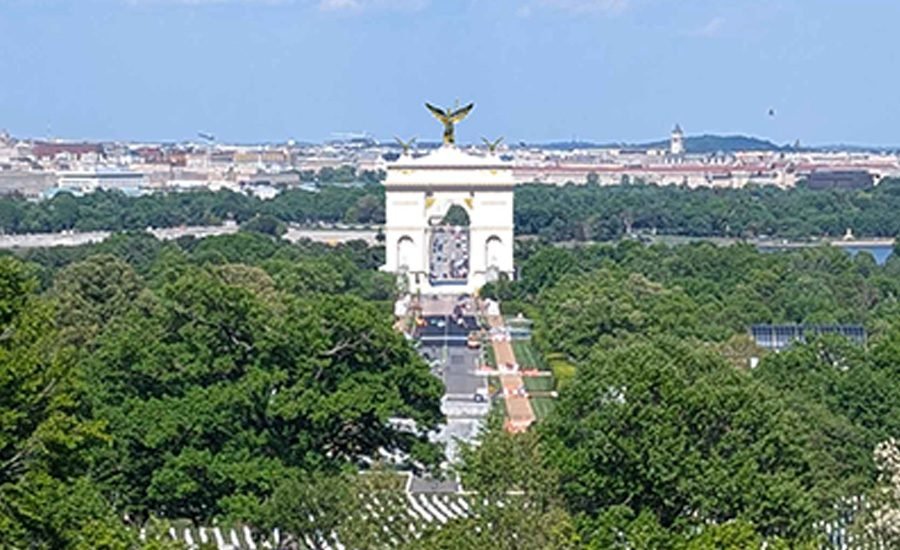

A memorial arch proposal spearheaded by President Donald Trump won concept approval from the U.S. Commission on Fine Arts on May 21 and heads to the National Capital Planning Commission this week, advancing a project that would place the structure between Arlington National Cemetery and the Lincoln Memorial, even as opponents seek to block it in federal court.
The project, which Trump has promoted as the “Arc of Independence” and is listed in CFA review materials as the “Arc de Triomphe,” has moved quickly through federal review channels in recent weeks.
Court documents show the administration has obtained CFA approval, requested a Federal Aviation Administration review, conducted site investigations and prepared the proposal for NCPC’s consideration this week as the litigation challenging the project moves toward summary judgment.
The structure would occupy Memorial Circle at the west end of the Arlington Memorial Bridge; the administration has described the project as part of events planned to commemorate the nation’s 250th birthday.
Current designs call for a monumental arch with a large central light, viewing areas and visitor facilities. Revised plans reviewed by the Commission of Fine Arts show a structure rising approximately 250 feet above Memorial Circle.
The latest iteration has been developed by architect Nicolas Leo Charbonneau of Harrison Design. ENR has not been able to independently confirm a project cost estimate, a financing plan or whether a contractor has been selected. Trump previously described the project as privately funded, though the administration has not publicly released a final financing plan.
Design materials submitted during the federal review process show the structure located directly on the ceremonial approach between Arlington National Cemetery and the National Mall.
Looking for quick answers on construction and engineering topics?
Try Ask ENR, our new intelligent AI search tool.
Ask ENR →
Plaintiffs challenging the project argue that it would disrupt the historic sight lines between Arlington House and the Lincoln Memorial that were intentionally preserved as a symbol of national reunification after the Civil War.
At its May 21 meeting, the Fine Arts Commission approved revised concept plans for the arch despite significant public opposition. According to court filings filed by opponents of the project, roughly 1,600 public comments were submitted to the commission over two review periods, and nearly all opposed the proposal.
During the CFA meeting, President Rodney Mims Cook Jr. defended the proposal, saying, “Washington is not a static city. It must grow to allow the next 250 years of Americans to celebrate their achievements.”
At the same meeting, Rebecca Miller, executive director of the DC Preservation League, criticized the scope of the review, telling commissioners, “This is supposed to be the approval of the concept, and they’ve moved on.”
The plaintiffs filed for summary judgment on May 27, asking Judge Tanya Chutkan to rule that Congress never authorized the project and that construction cannot proceed without complying with the Memorial Works Act and other federal review statutes.
They claim that Memorial Circle falls within “Area I” under the Monuments Act, where Congress must approve the placement of memorials. The filing occurred while the administration’s motion to dismiss remains pending before the court.
The administration has taken a different position.
In its motion to dismiss, the Justice Department argues that the lawsuit is premature because the National Park Service has not issued a final permit and construction cannot begin until the agency completes applicable reviews and issues a final decision.
Government lawyers have also argued that the authority for the project comes from a 1925 law associated with improvements to the Arlington Memorial Bridge and Columbia Island. The plaintiffs counter that the bridge project was completed in the 1930s, the original commission disbanded and there is no congressional authorization for the current arch proposal.
The project’s next milestone comes on June 4, when the National Capital Planning Commission is scheduled to consider the proposal as formal action.
ENR reached out to Justice Department and National Capital Planning Commission staff for comment, but did not immediately receive a response.
RELATED
The order halts the White House ballroom at the start of vertical construction
Ballroom appeal goes back to court
A separate legal challenge involving the administration’s proposed White House Ballroom project returns to court June 5 when the U.S. Court of Appeals for the D.C. Circuit is scheduled to hear arguments on Trump’s proposed White House Ballroom and East Wing modernization project.
The ballroom dispute stems from a March ruling by U.S. District Judge Richard Leon, who found that the challengers would likely succeed in claiming that Congress never authorized the project. The administration appealed and construction activity has continued while the case continues.
Recent filings have shifted some of the administration’s argument toward security considerations, with officials saying a permanent White House event facility would reduce reliance on outside venues and strengthen protections for large gatherings and state functions.
