

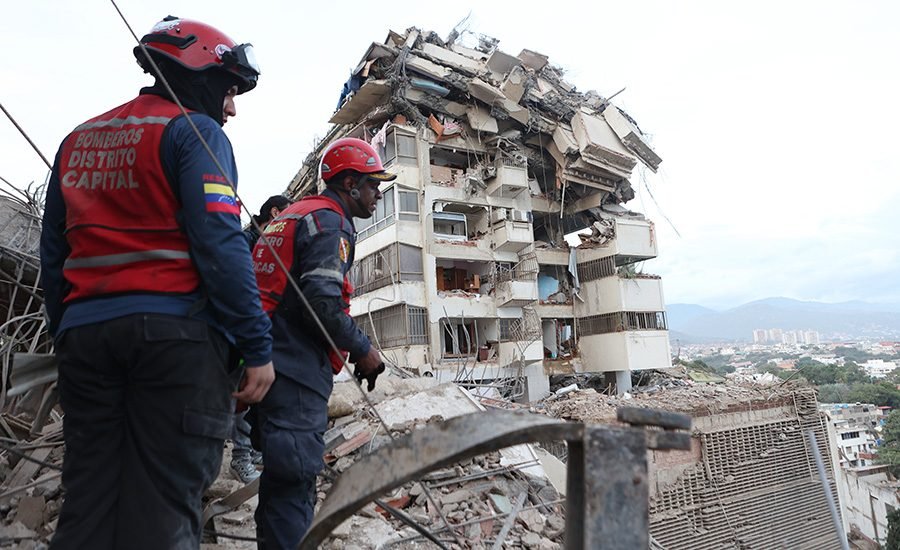
Five days later, the scale of damage from a pair of massive earthquakes in Venezuela is visible. The official death toll has risen to 1,719 according to the Venezuelan government as of June 29, and that number is expected to rise as search and rescue teams comb through the rubble of collapsed buildings. The country has also been rocked by more than 500 aftershocks since the June 24 magnitude 7.5 and 7.2 earthquakes, including a magnitude 5.2 aftershock on Monday morning, which has slowed search and rescue efforts still underway.
The northern coastal state of La Guaira, which includes port cities and Simón Bolívar International Airport, was particularly affected by the earthquakes, with considerable damage to medium- and high-rise buildings as well as transport infrastructure.
More than 40 search and rescue teams from 27 countries have been mobilized to help in the effort to free people trapped in collapsed buildings and structures, according to the United Nations International Search and Rescue Group (INSARAG), which is coordinating the international response. The agency and Venezuelan authorities have already agreed to acquire 10,000 body bags to prepare for recovery operations.
It is too early to assess the scale of damage to buildings in the quake zone, but the UN currently estimates that between 2,000 and 2,500 structures have been damaged, and many have completely collapsed, according to Gianluca Rampolla, the UN resident and humanitarian coordinator in Venezuela. The latest official numbers from the Venezuelan government as of Monday said 855 buildings have been damaged and 189 have collapsed.
For now, the UN mission is currently focused on addressing Venezuelans injured and displaced by the earthquake, Rampolla said.
“Along with the search and rescue operations, we are focusing, along with the [Venezuelan] government, by providing emergency health care, shelter, food assistance, water and sanitation and logistical support to ensure not only the storage but also the distribution of all supplies coming into the country, as well as protection,” Rampolla told reporters during a UN press conference on June 29. country.
With uneven code enforcement, some older buildings are seeing significant damage
The greatest damage to buildings from the earthquake appears to follow experts’ early estimates, with buildings built before Venezuela adopted modern seismic codes in recent decades. And there’s the broader problem of uneven enforcement of building codes that can magnify potentially damaged buildings, notes Andre R. Barbosa, professor of structural engineering at Oregon State University.
Looking for quick answers on construction and engineering topics?
Try Ask ENR, our new intelligent AI search tool.
Ask ENR →
“In general [Venezuela] appears to have up-to-date build codes. New buildings, if designed and built to code, should perform well. So building code enforcement and mitigating informal construction would probably be the most important measures in Venezuela to prevent similar damage,” explains Barbosa, who is also a research associate at the National Science Foundation’s Natural Hazards Engineering Research Infrastructure Network. “Meanwhile, existing buildings that have not collapsed under this sequence of events, but fall outside building codes, as they still would have to be reconditioned in the future. was observed in Mexico and New Zealand in the 2010s.”
As response efforts shift from search and rescue operations to structural assessments of buildings in the coming weeks, Barbosa says inspectors won’t have their work cut out for them. “[Inspectors] will look for indicators of failure modes such as damage to beams, columns, walls and connections between beam-column joints.”
In addition, he adds, “since in Venezuela they have many masonry walls that are used as partitions and facade walls, when these have large cracks they become a danger to the safety of life and often require the displacement of people for the duration of the repairs”.
