

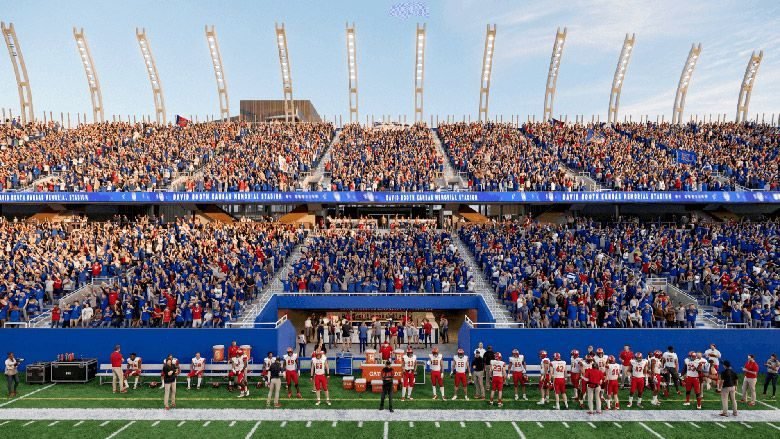
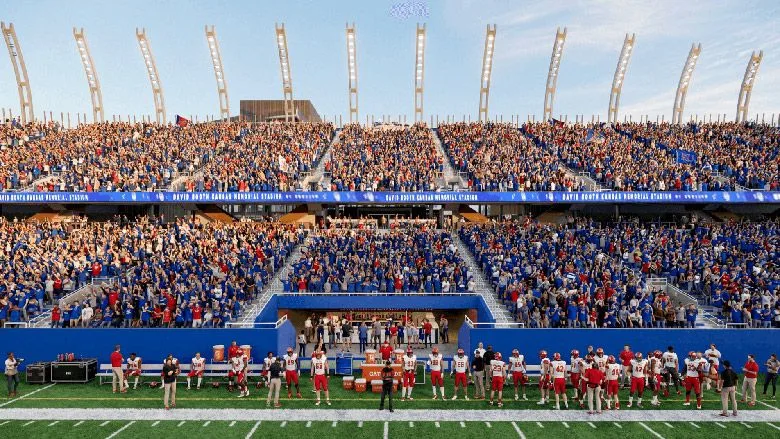
The new wheat-inspired light columns towering over the University of Kansas’ David Booth Kansas Memorial Stadium are more than just an architectural feature for Jayhawk fans; they also represent a complex engineering challenge tackled by the Clark-JE Dunn joint venture overseeing Phase 2 of the $450 million Gateway District and Stadium Redevelopment Project.
In early July, the university in Lawrence, Kan., along with development partners Edgemoor/Sunflower Partners and Clark-JE Dunn, broke ground on more than 1,200 tons of structural steel on the east side of the stadium’s new bowl, a milestone that also marked the installation of the stadium’s new wheat columns and permanent lighting system.
The stadium redevelopment is part of the larger KU Gateway mixed-use district. In addition to rebuilding the east side of the stadium and expanding seating, the district will include a hotel, restaurants, office space, student housing, underground parking and a public plaza.
Phase 1 of the project, completed in 2025, provided new seating on the north and west sides of the stadium, field improvements, new video boards and an improved players’ tunnel. Phase 2 focuses on rebuilding the East Stands and completing the surrounding Gateway District.
Acceleration of the lighting sequence
The columns, designed to evoke Kansas wheat swaying in the wind, pay homage to the state’s agricultural heritage while reflecting the Jayhawks’ “Wave the Wheat” tradition, in which fans raise their arms and sway after touchdowns.
Installing them became one of the biggest logistical challenges of Phase 2, said Chris Desko, project executive for the Clark-JE Dunn joint venture, which was tasked with making sure the lights were on for night football games, even as teams demolished and rebuilt the stadium’s east stands.
Early plans called for two existing light towers on the east side to remain in service during construction before being removed after the 2026 season. However, as the permanent steel design progressed, it became apparent that the towers would occupy the same space as the new stadium structure, making their subsequent removal nearly impossible due to limited crane access within the rebuilt bowl.
Rather than delay construction or risk disrupting future night games, the Clark-JE Dunn team accelerated the fabrication and installation of the 19 permanent wheat columns months ahead of schedule. Columns encircle the horseshoe-shaped stadium on the north, east and west sides, rising up to 135 feet above the field. Each varies in height and supports six to 12 light fixtures that illuminate the playing surface.
The team removed the old light towers, reused the existing light fixtures in the new columns, relocated the electrical equipment and temporarily activated the permanent lighting system in time for the team’s 2026 season.
Lighting arrays were assembled and routed at ground level before crews used two cranes in a coordinated lift to lift the fully assembled structures into place above the field.
“As we advanced the east bowl, it became clear that the original light towers and the new structure wanted to occupy the same space,” Desko said. “By pulling the permanent lighting and its supporting steel forward in the sequence, we solved a major access challenge before it existed and kept KU’s 2026 season under the lights.”
Running against the clock
The compressed construction schedule left little room for delay.
“From the day we took down the east stands, the clock started ticking,” said David Young, project manager for the Clark-JE Dunn joint venture. “We had less than eight months to demolish the existing structure, erect the new lower bowl and concourse, and bring the wheat columns and lighting online. Getting these complete items done was a huge win for the team and for KU’s 2026 season.”
The milestone keeps the project on track to provide full field lighting for KU’s home opener on Friday night, Sept. 4, while allowing stadium construction to continue without interruption.
Banks Floodman, director of development for Edgemoor/Sunflower Partners and a former KU football player, said the structural steel cladding reflected both personal and community investment.
“Seeing the beam go home just how much of an impact this project will have on members of the KU and Lawrence community,” Floodman said.
With the structural steel complete, crews are turning their attention to closing the stadium and making progress on interior work as the project moves toward completion, Desko said.
