

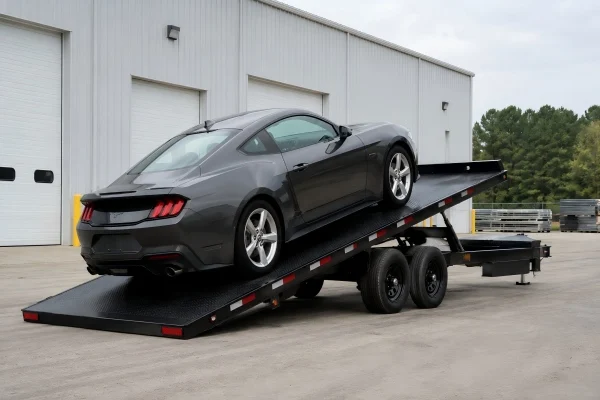
A tilt deck trailer is often the best choice for frequent loading, solo operation, and vehicles with low clearance because the deck itself becomes the loading surface. A ramp trailer may still be more practical for occasional use, mixed loading, lower purchase costs and buyers who prefer a simpler structure. The right choice depends on the load, loading frequency, working conditions, towing vehicle and maintenance capacity.
Both types of trailer move vehicles or equipment to an elevated deck, but provide access in different ways. A tilt-bed trailer changes the angle of its deck, while a ramp trailer keeps the deck fixed and connects it to the ground with separate or attached ramps. This structural difference affects load angle, setup time, operator effort, load placement, payload capacity, and maintenance.
A tilt deck trailer has a deck that swings back until its trailing edge approaches or touches the ground. The deck then forms a large loading surface for driving or towing a vehicle.
For many commercial operators, a tilt deck trailer is better because it reduces setup time and manual handling. It is especially useful when one person loads the trailer several times a day. However, comparing tilt trailers and ramps does not produce an answer for every buyer. A fixed deck ramp trailer typically costs less, contains fewer moving components, and stays level while loading multiple separate items.
A tipping deck trailer is generally best when loading is done frequently, the vehicle has limited ground clearance, or heavy ramps would create unnecessary physical strain. Ramps can be better when budget is limited, different ramp positions are needed, or multiple items need to be loaded in stages.
The most useful comparison focuses on how the trailer will perform on a day-to-day basis. Loading angle, loading time, load layout, trailer weight and maintenance all affect the actual cost of ownership.
Loading angle is one of the main reasons buyers choose a tilt deck trailer. A lower angle reduces the risk of a vehicle coming into contact with the ground or deck during loading. Floor clearance is just one measurement. Buyers should also consider approach angle, departure angle and breakup
When choosing a trailer, prioritize size, weight capacity, and durability. Safety features such as reliable brakes, solid hitches and robust materials are essential. Also, evaluate your trailer’s storage options, insulation, and ventilation, especially if you plan to travel in extreme weather conditions.
