

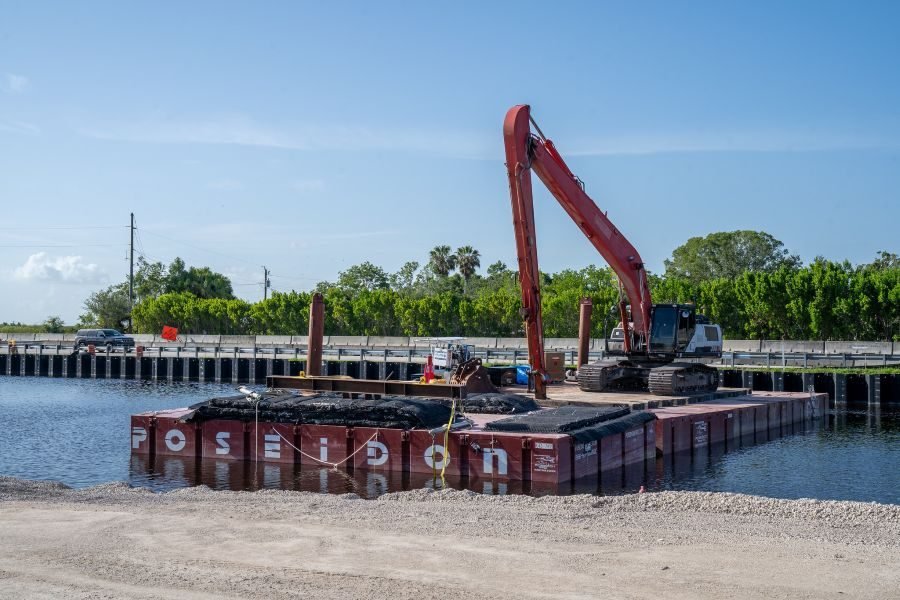

Florida state officials recently signed an agreement with the US Army Corps of Engineers to accelerate Everglades restoration, allowing a key component of the project to reach construction completion five years ahead of schedule.
The deal is part of a broader, decades-long effort to revive the biologically diverse ecosystem, sometimes called the “river of grass.” The massive network of wetlands, mangroves, cypress swamps, freshwater wetlands, and estuarine waters covers 1.5 million acres in South Florida, but was fragmented with a boom in agricultural and industrial development in the early 20th century. Protection and restoration efforts have largely focused on allowing fresh water to flow unhindered from the center to the south of the state.
The Florida Water Management District, which is overseeing the construction of the reservoir in coordination with the Corps, says the July 21 agreement ensures that enough federal funding will go to the state to allow critical restoration components to move forward, including the construction of a seepage management pumping station, which will allow the Everglades Agricultural Area (EAA) reservoir project to be completed. in September 2025. Both projects aim to move water south to Everglades National Park and Florida Bay.
“This is a unique and innovative partnership because it streamlines delivery, cuts red tape and accelerates critical restoration efforts to send more clean water south while protecting the people and environment of South Florida,” an SFWMD spokesperson told ENR in an email.
In 2025, the state signed a memorandum of understanding with the Corps so it could take the lead in implementing restoration projects without federal oversight. The new agreement is based on the MOU, according to the SFWMD.
Gov. Ron DeSantis (R) has pushed to speed up the timeline for the restoration effort and has committed roughly $9.5 billion to Everglades projects during his time in office. One of the objectives has been to speed up the completion of the reservoir by five years.
A key piece of a bigger puzzle
The reservoir is considered critical because it is designed to send an additional 370,000 acre-feet of new water south into the Everglades annually. It is a component of the Central Everglades Planning Project, which was authorized to begin construction under the Water Resources Development Acts of 2018 and 2021.
Looking for quick answers on construction and engineering topics?
Try Ask ENR, our new intelligent AI search tool.
Ask ENR →
State officials announced in April of this year that all federally administered contracts needed to meet the 2029 accelerated completion goal were in place, ensuring funding and resources are secured through the project’s completion.
Many projects in the restoration effort are already underway. The S-355W Spillway, part of the Central Everglades Planning Project, is 60 percent complete, with contractor Kiewit, design engineer WGI and WSP providing construction management services.
At the reservoir, contractors include Thalle Construction for embankments and structures; a Forgen-Odin joint venture for the foundation; and Harry Pepper & Assoc. for the inlet pumping station.
Jacksonville District Commander Col. Brandon Bowman said in a statement, “The work we do isn’t just about moving water or pouring concrete; it’s about securing South Florida’s ecological and economic future for generations to come,” adding, “We keep making history, we keep working together, and we get the job done.”
