

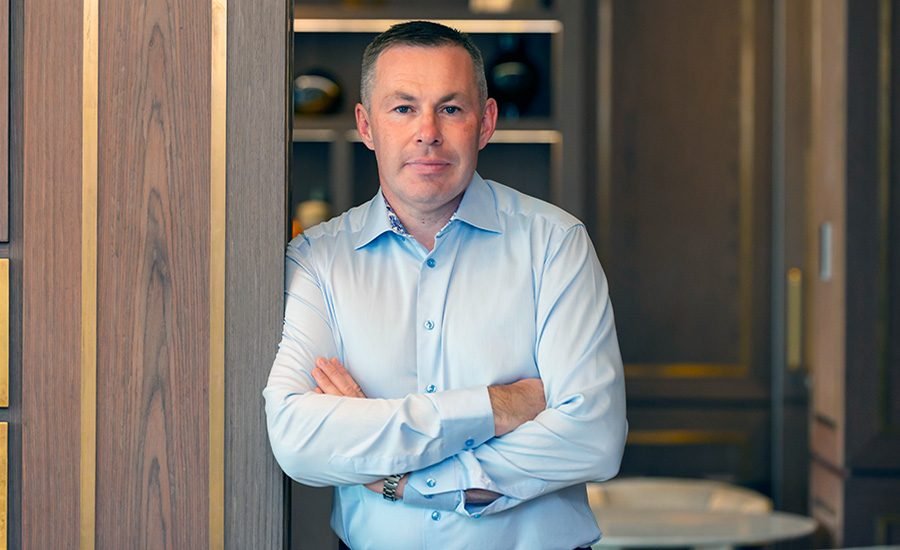
H&MV Engineering said Sept. 17 that it plans to add 1,000 U.S. jobs over five years as the Ireland-based high-voltage engineering and construction company establishes its U.S. headquarters in Dallas.
The hiring plan expands on what H&MV told ENR in August, when it employed more than 200 people in the U.S. and expected its workforce to exceed 500 within five years. The company entered the U.S. market in late 2025 and acquired Amarillo, Texas-based Cooke Power Services in January, adding local construction teams, statewide licensing and regional utility relationships.
H&MV CEO PJ Flanagan, who started his career at the company as an electrical apprentice, spoke to ENR about the infrastructure needed for ever-larger data center campuses, the long-lasting electrical equipment and the workforce needed to build it.
The conversation has been edited for length and clarity.

Everyone talks about power availability as a constraint on data center construction. From where you sit, what’s really stopping projects from getting off the ground today, and what does a realistic delivery schedule look like?

Flanagan: From our point of view, the supply chain is key. We are fortunate to have a lot of equipment on order long before a project starts. We are involved at a very early stage. The biggest thing I see sometimes is speed to market. Sometimes people don’t put in the early stage design time it takes to get projects out the moment they say they’re going to put them out. It can be 24 months to 36 months from when someone says they want to build a data center [and] have a network connection. It depends on the voltage, depending on the capacity, depending on the size of the megawatt. But if you have to give an answer, 24 to 36 months is usually a good amount of time to get any data center up and running.
ENR | When a hyperscale customer comes to you today, how different is the power requirement than what was asked of you two or three years ago?
Flanagan: I think everyone has decided they want to build data center campuses. Data center campuses are now gigawatt scale. It used to be hundreds of megawatts. Everyone looks at the big picture and everyone believes in the bigger picture now. Whether it’s hyperscalers or co-locators, I think everyone now sees greater scale and supports larger-scale projects on a campus. This is also very positive for us because these are bigger substations that we have to build.
ENR | Are these data centers starting to look like utility-scale infrastructure projects rather than conventional customer connections?
Flanagan: I think any project that needs a gigawatt of infrastructure needs to be a serious infrastructure project, and that’s at utility scale. What that implies on campus is totally different, I guess, than what a utility is [builds] to connect different states or different regions into one state. But the infrastructure on campus for the data center is utility scale, yes, 100%.
ENR | What are you seeing in transformers, switchgear and other long-life electrical equipment? Are customers doing anything differently because of these delivery times?
Flanagan: All these devices are part of the network infrastructure. It’s not just data centers and battery storage and solar that are looking for them. You are looking for these to build a substation to support the grid infrastructure to support these projects as well. I think standardization is a massive thing. By leading with first principles from design, getting standardization right, you can have long-lasting items on order. For people like H&MV, when you are big in the market and have several different projects, we can run the risk of ordering teams. We know we have a number of customers who will need it. There are factory slots, but I think the design team standardizing and commissioning the equipment at a very early stage is key to getting to market quickly.
ENR | H&MV plans to add 1,000 jobs in the United States over five years. Which positions do you think will be the hardest to fill?
Flanagan: There is a shortage of people across the sector. I think the electrical engineering positions locally [are] challenging Obtaining electrical engineers [with] high voltage experience is challenging at the moment. Engineering can be a remote position. H&MV [has] a huge advantage with the support staff we can bring in from Ireland and other far away places. Ireland has been recognized for having one of the strongest engineering cultures globally across a range of sectors and high voltage is no different. I think we are in a very good position to support scarcity here. It’s one of the main reasons we decided to come to Texas to expand H&MV here.
ENR | How long does it take to turn a new hire or trainee into someone capable of doing the specialized high-voltage work you need?
Flanagan: we [have a] four-year program back in Ireland. It’s something like, two to four years, we’re looking at here. There are different levels, no doubt. If it’s a trainee at 20, you’re talking about four years. If it’s somebody who already has a trade and you’re moving them into a high-voltage specialty, there’s a lot of different levels when you’re talking about substations. You’re talking about cable unifiers, you’re talking about wires, you’re talking about steel builders. There’s a great selection, and it might be two to four years, I guess, that’s where we’ll see it.
ENR | You acquired Cooke Power Services earlier this year rather than building your entire U.S. construction operation organically. What ability has this acquisition given you immediately?
Flanagan: Immediately Cooke Power Services [was] exactly what we needed in the market. knowledge They are a family business [that has been] in business over 20 years. Their knowledge of the supply chain, their knowledge of how to build in the different regions of Texas and outside of Texas and the rest of the United States, I think was crucial for H&MV. This would have taken a long time to build. I think bringing the Cooke Power guys in, supporting them and working with them and now seeing them grow rapidly under H&MV ownership also gives them energy and the belief that they can grow their teams. We are already seeing the results of this.
ENR | Texas and Louisiana are currently H&MV’s most active US markets. What other markets are starting to show the same characteristics?
Flanagan: I think there are two big regions where we have clients that we’ve worked with [with] in the past, which had large rates of development, but are quickly followed by Nevada, New Mexico, Georgia, Mississippi, Oklahoma, and Utah. There’s a great list that we’re really looking to grow here over the next couple of years. I think Georgia is the state that is really catching up. New Mexico, Oklahoma and Nevada too.
ENR | H&MV says it has an order book of $2.3 billion and a pipeline of $18.6 billion. How much of each is US work and how much of the US pipeline is directly attributable to data centers?
Flanagan: There is a high percentage. I don’t have the breakdown at the moment, but there is a high percentage of each of them [that is] part of our growth strategy. We have a strong order book here, and I think we would feel much more comfortable talking about exactly where we are 12 months from now in the order book. But the numbers are very strong right now, and that’s why we’re moving so quickly, and we have to hire a lot of people to build these projects.
ENR | You started at H&MV as an electrical apprentice and now you run the company. When you walk into one of these projects today, what do you see that someone who entered the business through finance or management might not?
Flanagan: I think the knowledge to understand what is needed [for] a project to build. The vision you can see when you walk into a project and know if it’s been built in a good, safe way and with knowledge of people’s understanding [the work]. I think having that knowledge from a young age and going up all the ranks of a company, I think that’s very important when you’re a CEO and you’re a leader because you can always ask the hard questions that others, I guess, from different backgrounds, wouldn’t be able to ask in detail.
ENR | Data center development has met with growing public resistance in the US. What could developers do differently to address community concerns?
Flanagan: I think that anything, when you look back through the generations, that really goes to the beat and takes over the market very quickly never has enough time to explain it. [itself] to the people And here comes the backlash. I think there could be improvements in bringing people along for the ride. Especially our customers, some of the hyperscalers and co-locators now, over the last 12 months, are really engaged with people to explain it in a lot more detail. And I think this is very important. Things move so fast and there is no time to explain. But people catch up in time.
ENR | If we have this conversation five years from now, what do you think the industry will find out about building the electrical infrastructure needed for AI?
Flanagan: I think there is still a question mark. There are a number of [projects in the] queue, and will it be real? It’s definitely going to be real because that’s how the world moves. I think we might have underestimated how much has to be built so quickly to get going. And I think a lot of thinking is going on, and I don’t think we have time to think. I think we need to go out and build to stay ahead of the infrastructure needed to support these data centers. So I think it’s just the rhythm. No one will really believe where he will be in five years. But we can see that with all the data we have. We can really see what needs to be built here.
Looking for quick answers on construction and engineering topics?
Try Ask ENR, our new intelligent AI search tool.
Ask ENR →
