

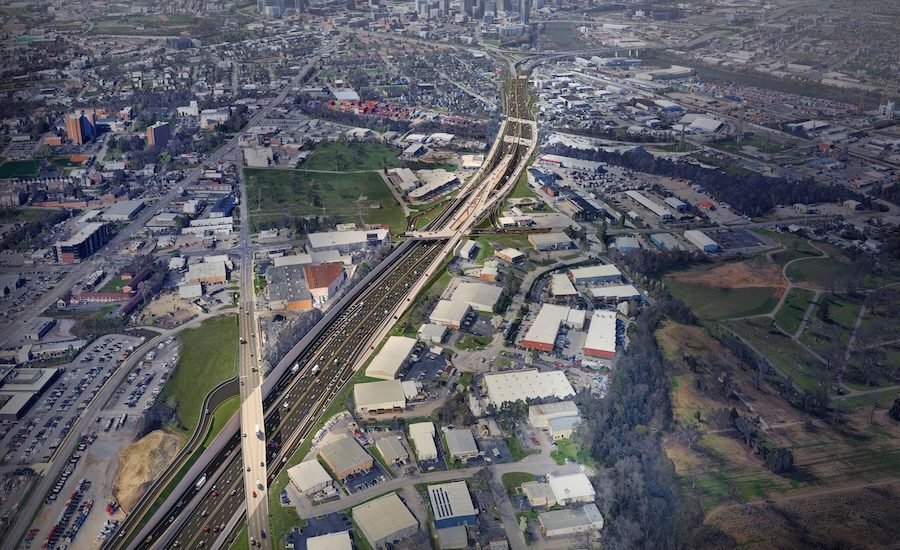
Tennessee has approved a $24.8 billion public-private partnership (P3) award for a $9.2 billion managed lane project along a congested 26-mile stretch of Interstate 24 southeast of Nashville, marking the largest interstate express lane P3 deal in U.S. history.
The deal, approved Aug. 19 by the state’s Transportation Modernization Board, caps a rapid transformation of Tennessee’s transportation program. Just three years after the state enacted legislation allowing P3 transportation, officials selected the DriveTN consortium and advanced one of the nation’s largest highway infrastructure bids, creating a model that other transportation agencies can study as they look for new ways to finance and deliver major projects.
To achieve this rapid development, TDOT Commissioner Will Reid says that after the passage of the Transportation Modernization Act in 2023, TDOT brought together expertise from across the department, including engineering, operations, finance, legal, environmental, communications and procurement, and supplemented that expertise with specialist advisors who have completed similar projects around the world.
“At the same time, we invested in the processes, governance and oversight needed to manage a project of this magnitude,” he says. “Before we asked the organization to offer something new, we made sure we had the ability to do it responsibly.”
This preparation led to a competitive procurement process which selected DriveTN, consisting of Transurban, Tikehau Star/Infra/Capital, Webber and AECOM as lead designer and Ferrovial and Cintra as first.
A recent study estimates transportation infrastructure needs across the state of Tennessee at about $87 billion. With that in mind, TDOT focused on a 26-mile stretch of I-24 between Nashville and I-840, Tennessee’s most congested corridor, serving 174,000 vehicles a day, with more projected each year.
“The Transportation Modernization Act gave Tennessee new tools to respond to challenges like this,” says Reid. “It allows us to leverage private capital, private sector expertise and alternative delivery methods while preserving traditional transportation revenue for projects in communities across the state.”
Looking beyond this project, the state is already planning its next moves. During its Aug. 19 meeting, the Transportation Modernization Board authorized the development of three potential future corridor improvements: a northern improvement that could extend Choice Lanes along I-24/I-65 through downtown Nashville; an eastern improvement that could extend Choice Lanes along I-40 past Nashville International Airport; and a southern upgrade that could extend Choice Lanes along I-24 through Murfreesboro and along I-840.

With the contract approved, attention turns to construction of the 26-mile corridor. While officials say heavy construction is expected to begin in 2029, current efforts are focused on finalizing the agreement, completing required reviews, validating commitments and, as Reid puts it, “moving forward in a way that delivers the project safely and efficiently.”
In the meantime, officials say extensive preparation is underway, including utility coordination, right-of-way activities, environmental commitments, permitting, federal coordination, design integration and community engagement.
Building the project while maintaining traffic on one of the region’s busiest interstate corridors remains a major challenge.
“One of the most innovative aspects of the DriveTN proposal is the decision to place much of the Choice Lanes infrastructure along an elevated outer alignment rather than concentrating construction in the center of the interstate,” says Reid. “This approach creates greater flexibility in organizing construction and allows parts of the work to occur outside of existing travel lanes.”
The project includes major highway reconstruction, bridge replacements, new bridge construction, retaining walls, utility coordination, intelligent transportation systems, and significant traffic management requirements.
“Each element has to work together within a carefully sequenced program,” Reid says, adding that the biggest construction hurdle the team faces is delivering what is essentially a new transportation system within one of Tennessee’s busiest and busiest interstate corridors.
“Success is measured by how effectively the whole system comes together while continuing to serve the people who rely on that corridor,” says Reid. “This is one of the advantages of the P3 model. The team responsible for designing and building the facility is also responsible for operating and maintaining it long-term. This encourages decisions that prioritize safety, durability, reliability and lifecycle performance from day one.”
