

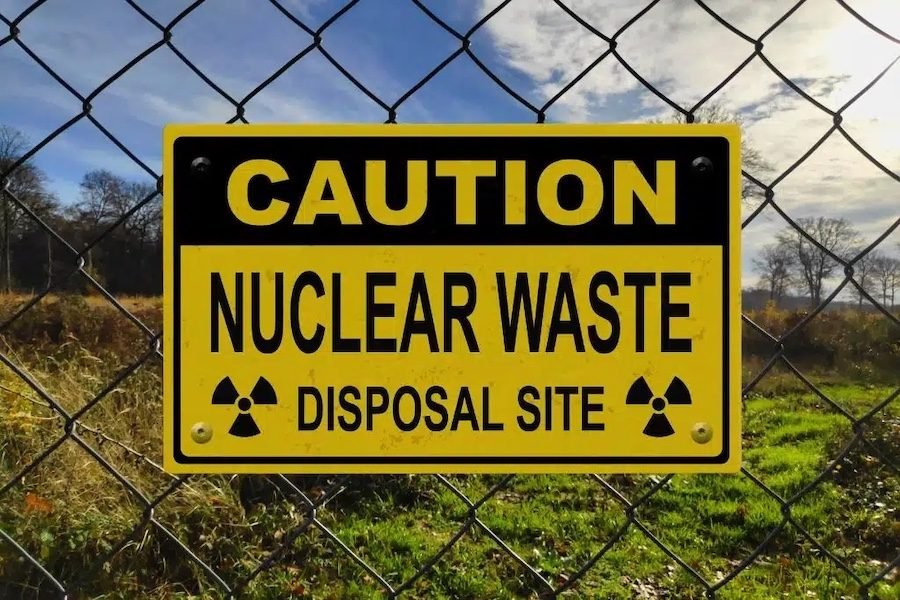

Lawmakers are resuming the nation’s decades-old debate over spent nuclear fuel management amid the Trump administration’s continued push to boost the energy sector and a new U.S. Department of Energy initiative to locate fuel-use and waste-storage facilities in six states.
Congress established a national framework for addressing spent fuel disposal issues by enacting the Nuclear Waste Policy Act of 1983, including the lack of a permanent disposal solution, state and federal responsibilities, and financing of construction costs. The law was amended in 1987 and established the Yucca Mountain site in Nevada as the United States’ only permanent and unique repository for the deep underground disposal of high-level radioactive materials and spent fuel.
But several administrations tried to change the nuclear policy framework, leading to political headwinds and other issues, such as the government’s lack of a centralized site for temporary waste storage. Yucca Mountain remains abandoned, with continued strong opposition from numerous interest groups.
Nevada Democratic Senators Jacky Rosen and Catherine Cortez-Masto introduced legislation in August to permanently block any future consideration of Yucca Mountain in Nevada as a U.S. nuclear waste repository.
Most recently, the Senate Environment and Public Works Committee held a hearing on Sept. 23 seeking experts for ideas on how to approach nuclear waste management, including who should manage and dispose of the material and how and where it is stored.
“First, history has shown that nuclear waste management is a multigenerational infrastructure project,” committee chairwoman Sen. Shelley Moore Capito (RW.VA.) told the hearing. “Successful policy must be built long-term and durable, with strong bipartisan buy-in from Congress.”
Fuel production-waste management ‘Campus’
Looking for quick answers on construction and engineering topics?
Try Ask ENR, our new intelligent AI search tool.
Ask ENR →
The hearing comes as the Department of Energy proposes a voluntary federal-state initiative to modify the US nuclear fuel cycle ecosystem through co-location. Launched in January, the Nuclear Lifecycle Innovation Campus program would establish sites that focus on fuel fabrication, enrichment, reprocessing or recycling of spent nuclear materials, advanced separations and waste stream management, at an estimated cost of $50 billion.
After an agency request for information, 28 states applied for the program and six were chosen for consideration: Idaho, Louisiana, Oklahoma, Tennessee, Utah and West Virginia, which have signed non-binding memoranda of understanding with the DOE. The program is designed to safely manage the nation’s more than 95,000 metric tons of spent nuclear fuel, but Yucca Mountain has a legal limit of 77,000 metric tons. , Congress will eventually have to pass legislation to formally repeal its repository designation as the Trump administration pursues the new multi-state storage plan.
The DOE said it expects to see campuses deployed rapidly with initial facilities online by 2027. Private partners, state and local entities would manage facility-specific infrastructure construction and related costs for each campus, with federal support limited to specific, authorized assistance mechanisms, according to the RFI.
Several lawmakers and witnesses at the hearing endorsed the program, noting that reprocessing can recover about 90 percent of the energy still contained in spent nuclear fuel and can reduce the amount and radioactivity of the remaining waste, although it cannot eliminate the need to dispose of the waste. They also agreed that Congress should provide adequate resources for DOE to carry out its statutory disposal mission.
“Prolonged federal inaction has resulted in a in fact national nuclear waste policy of indefinitely stranding spent nuclear fuel at sites in 35 states, with negative impacts on the sites’ host communities, electric utility customers in 42 states who have paid for an unsuccessful disposal program, and U.S. taxpayers,” said Katrina McMurrian, executive director of the Nuclear Waste Strategy Coalition, a bipartisan group.
While encouraged by the DOE initiative “after enduring years of federal failure,” the coalition urges Congress to restore an integrated national waste disposal program and form an independent waste management organization to lead it, he said. Congress should also provide sustainable access to the federal Nuclear Waste Fund to pay for the program, McMurran noted.
The program should include “the essential permanent geological disposal of spent nuclear fuel now stranded at numerous sites and communities of operating and closed commercial reactors,” he noted, adding that while the waste is safely stored at these sites, “taxpayers are charged millions every day beyond the January 31, 1998 payment date set forth in federal law.”
While the program has its state advocates, particularly governors, not all politicians are on board. Tennessee Republican Rep. Ed Butler sent a letter Aug. 10 to Gov. Bill Lee (R) opposing the state’s proposed campus believed to be planned in the Oak Ridge area, saying the safety risks of the waste outweigh the economic benefits. “We are a state of innovation and advanced technology, not a dumping ground,” he said. Counties that could host satellite storage sites are also opposed, with concerns also growing in Idaho and Oklahoma.
Slow progress
Luke Barrett, chairman of the American Nuclear Society’s Nuclear Waste Policy Working Group, said spent fuel and reprocessing waste can be safely stored, transported and immobilized, but require isolation for thousands of years through geological disposal. While other countries are making good progress toward locating and building repositories, the U.S. has accomplished little over the past 16 years, he said.
His group supports DOE’s initiative, but urges Congress to authorize investigation of permanent disposal sites beyond Yucca Mountain and to advance the regulatory framework needed to support those sites.
“We have learned a lot from Yucca Mountain and international experiences, and this knowledge can improve our regulatory framework for potential new geological disposal sites,” he said. Congress should allow DOE to begin accepting and disposing of nuclear fuel, especially spent fuel that is stuck in permanently shut down reactors; it should also continue to support recycling research and development, as well as the early commercial deployment of these technologies as markets mature, he said.
“The most robust approach will be through a consent-based process that includes affected communities, states and tribal nations,” said Kathryn Huff, professor and chair of the department of nuclear engineering and engineering physics at the University of Wisconsin-Madison.
Centralized temporary storage could reduce taxpayer liabilities, remove fuel from reactor shutdown sites and other storage sites and establish transportation capacity, he added. But to work, the operating storage term, capacity, renewal conditions, benefits, monitoring requirements and connection to the permanent dump must be established.
Congressional authorization would also be needed before the DOE could build and operate the interim storage facility, he said. Citing the agency’s latest financial reports, Huff said the Nuclear Waste Fund’s balance exceeds $51 billion but is unreachable.
Sen. Edward Markey (D-Mass) echoed Huff about the need for community buy-in before moving forward, pointing to Nevada’s lack of public consent. He criticized the Department of Energy for putting together state MOUs without clarifying how its vision will be developed in conjunction with affected communities.
“For all intents and purposes, these will be permanent interim storage [sites]. Once there, these sites are never going anywhere. So the community needs to understand that,” he said.
Markey also said the DOE is seeking community confidence in nuclear waste storage and other functions that have significant national safety and security implications amid political concerns.
He specifically criticized the administration’s firing last year of members of the Nuclear Waste Technical Review Board and Christopher Hanson, a member of the US Nuclear Regulatory Commission and former chairman, who is now an adviser to the New York Power Authority on its program to build up to 5 GW of nuclear power by 2040.
Markey took issue with deregulation that limits the agency’s ability “to ensure the safety and security of our reactor fleet.”
