

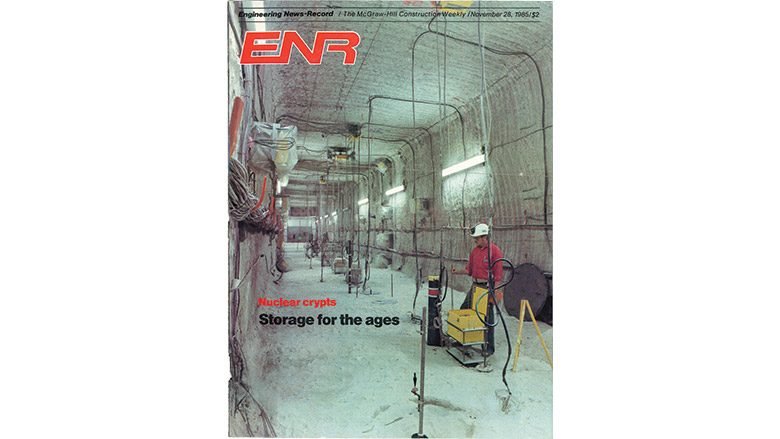
This 1985 cover story looked at the US Department of Energy’s costly plan to manage radioactive waste from the nation’s nuclear power plants and military programs.
The Nuclear Waste Policy Act, signed by President Ronald Reagan in 1983, established the framework for the storage, transportation and disposal of high-level waste.
DOE was responsible for planning, locating, constructing, and operating permanent geological repositories for the waste.
By 1984, the agency had investigated nine sites in the South and West and issued 1,300-page environmental assessments for each.
DOE then recommended three sites for which more intensive characterizations should be conducted.
These were Yucca Mountain in Nevada (volcanic tuff), Deaf Smith County, Texas (bed salt), and Hanford, Wash. (basalt).
In 1987 Congress directed the DOE to focus its efforts exclusively on Yucca Mountain. Using deep boreholes, extensive geochemical, geological and hydrological tests were carried out and a five-mile long exploratory tunnel was excavated.
Looking for quick answers on construction and engineering topics?
Try Ask ENR, our new intelligent AI search tool.
Ask ENR →
Congress approved the selection of Yucca Mountain as a depository in 2002. But political resistance has stalled development.
The first resistance came from Nevada. The Obama, Trump, and Biden administrations later blocked the effort, and Congress has since ended funding for Yucca Mountain’s development and licensing.
Separately, DOE managed to build the Waste Isolation Pilot Plant, a repository 2,150 feet underground in a salt formation near Carlsbad, New Mexico, that contains low-level waste (clothing, tools, and other items contaminated by plutonium and other radioactive elements).
