

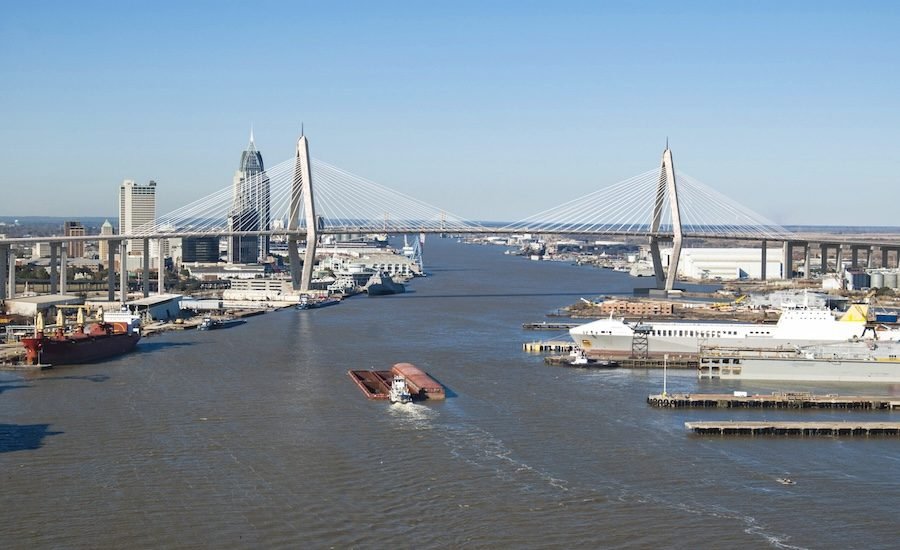

A federal loan has cleared the way for construction to begin on the initial phase of Alabama’s Mobile River Bridge and Bayway project.
The Alabama Department of Transportation issued a notice to proceed to Kiewit Infrastructure South Co.’s design-build joint venture, Massman Construction Co. and Traylor Bros., Inc. (KMT) on Sept. 25, agency spokesman Tony Harris said. A ceremonial opening is scheduled for October 2.
Completed Sept. 18, the $2.52 billion Transportation Infrastructure Innovation and Financing Act (TIFIA) loan provides the final funding component for the $3.2 billion first phase, anchored by a new 2.5-mile-long cable-stayed bridge spanning the Mobile River Navigation Channel. The bridge will eliminate a long-standing bottleneck by bypassing a pair of tunnels built in the early 1970s. ALDOT previously received $675 million from two federal grant programs for the project.
KMT has been preparing for the planned five-year construction phase since being selected for the project in 2023. Along with improving travel times along I-10 and access to the Port of Mobile, the six-lane toll structure will provide a more efficient passage of the Mobile River for hazardous cargo vehicles that currently must be detoured through neighborhood streets.
After more than 30 years of planning, the Bridge and Bayway project has faced a difficult road to reality. ALDOT’s original plan called for building the main bridge along with replacing more than seven miles of existing concrete viaducts across Mobile Bay, known as the Bayway, with wider structures elevated 14 feet above the 100-year storm level.
Amid public resistance to a proposed toll structure, ALDOT scuttled its plan to pursue the project as a public-private partnership in 2019. Delays and costs continued to mount, however, with an ALDOT fact sheet citing unexpected geotechnical and engineering challenges on the Bayway as increasing labor and material costs.
Already the largest infrastructure project in state history, the program was on the verge of becoming financially unviable, ALDOT said. Adding right-of-way acquisition, utility relocation, contingencies, capitalized interest and toll system integration pushed the total cost estimate for Phase 1 above $4.1 billion, compared with the design-build contract value of $3.2 billion, the agency said.
ALDOT has not released a revised cost estimate for the Bayway improvements. Harris said the agency will “continually seek additional funding opportunities with the goal of beginning construction for the replacement of the existing Bayway in 2036.” As an interim measure to improve capacity, KMT’s Phase 1 work includes rebuilding approximately one mile of the Bayway and narrowing the existing viaducts to provide three lanes in each direction.
The toll won’t begin until the bridge opens, currently scheduled for late 2031. Under a toll policy adopted Sept. 8 by the Alabama Toll, Bridge and Tunnel Authority, the tolls will be higher than the $2.50 per trip and $40 per month that local officials approved in 2022 and will no longer remain flat. Tolls will increase annually by 5% or the regional inflation rate, whichever is higher, for the first 10 years. Subsequent increases will be the greater of 2.5% or the rate of inflation.
