

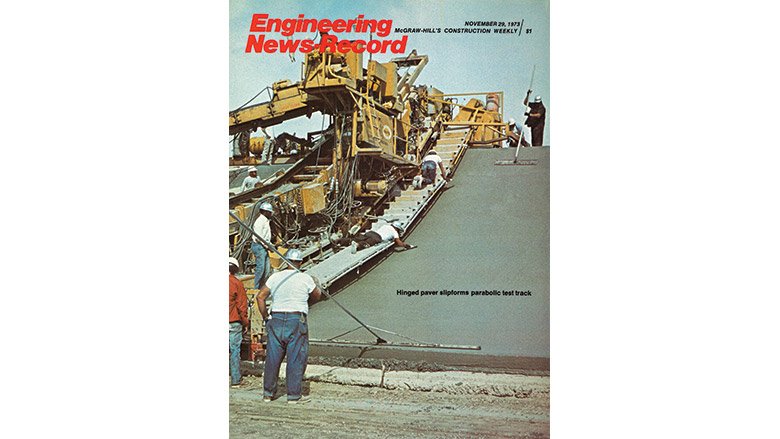

This 1973 cover image shows a custom-designed slipform paver constructing the parabolic surface of a super-elevated high-speed test track at the Ohio Transportation Research Center (TRC Ohio).
Although some paving contractors said the task was impossible, MF Velotta & Sons completed the job in 67 days.
The 7.5-mile-long oval track has two 1.88-mile-long straightaways that gently wind up and around elevated 17.9-foot-tall turns. Designed by Howard, Needles, Tammen & Bergendoff, the track consists of 10-inch-thick unreinforced concrete, with reinforcement in certain sections.
Below the concrete surface is a 4-in. layer of 7% cement base and 4 inches of stabilized subbase. The machine’s 48-foot-wide steel tray was deflected to the correct configuration for the concrete being placed.
It had two control systems. The main system was a two-wire system that controlled both steering and elevation. The second system was a laser transmitter that was picked up by receivers at central hinge points.
Laser controls checked the central angles of the machine, which determined the geometry of the concrete.
The pavement mix was 1.25 inches. to 1.5-inch concrete with an added water-reducing agent. Located on a 4,500-acre site in East Liberty, TRC Ohio remains the nation’s most comprehensive independent automotive test facility and proving ground, serving industry, government agencies and academia.
The test track is the centerpiece of TRC Ohio and remains in use to this day.
Looking for quick answers on construction and engineering topics?
Try Ask ENR, our new intelligent AI search tool.
Ask ENR →
