

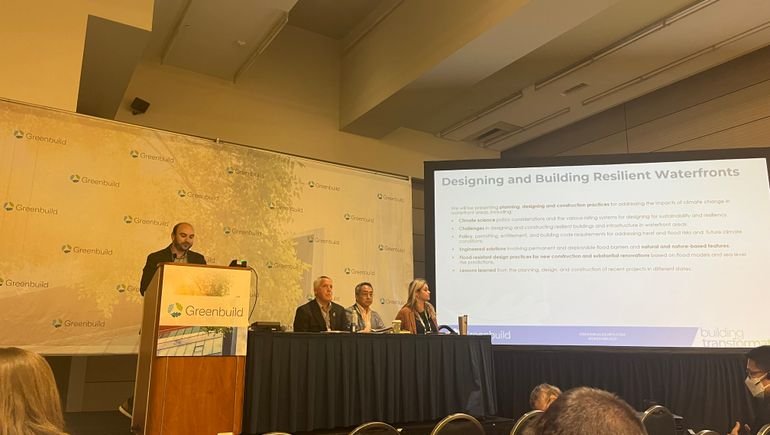
Waterfront developments are both prized and uniquely vulnerable to extreme weather conditions, and building a resilient waterfront project requires a multifaceted approach with all stakeholders, green building experts said during a panel at the Greenbuild 2023 International Conference and Expo.
Storm surges and flooding exacerbated by climate change are a major concern for waterfront sites, and floodplain management is a crucial consideration, said Joseph Sutkowi, director of waterfront designers at the Waterfront Alliance, a nonprofit New York City-based for-profit focused on waterfront and coastal development. Changes in the shape and speed of water in a river system can have far-reaching effects, affecting communities both upstream and downstream, he said.
For example, when near-record rainfall hit New York City in late September, it overwhelmed the city’s drainage systems and exposed the Vulnerability of the Metropolitan Transport Authority to flooding.
“You also have to think about flooding on your site,” Sutkowi said. “How do you protect yourself from coastal storms? Then you also have to consider climate hazards and how these will intensify storms, how rainfall will change and how sea level rise will come into play.”
Other challenges include geotechnical concerns, corrosion control, stormwater runoff management, and allowing for complexities due to overlapping jurisdictions from multiple agencies, such as local and state agencies and the Army Corps of Engineers, for example, Sutkowi said. Habitat preservation and public access requirements further complicate the process.
But waterfront projects are still worthwhile, especially because of the economic opportunities and cultural significance of waterfront areas, Sutkowi said.
“People want to be on the waterfront, there are incredible views, it’s something that can really increase property value,” Sutkowi said. “Above all, whether it’s Brooklyn Bridge Park in New York City or the small botanical garden along the Flat River in my hometown in Michigan, the waterfront is the flagship of the community.”
Role of rating systems
Several rating systems already exist to facilitate the planning and construction of resilient waterfronts. These systems aim to incentivize both public and private development to exceed code requirements and promote sustainable practices.
For example, the Waterfront Alliance’s Shoreline Design Guidelines consider factors such as hazard assessment, flood management, access, and marine habitats.
Other rating systems, while not unique to waterfronts, can still be adapted to address the unique challenges these projects pose. The US Green Building Council’s Resilient Design Pilot credits, for example, cover climate hazard assessment, coastal storm protection, floodplain management and habitat restoration.
Waterfront design from a construction perspective
Resilient waterfront design today should always take into account the inevitability of coastal hazards, including waves, high-intensity rainfall and waves, said Wayne Cobleigh, vice president of GZA GeoEnvironmental, a services company construction management company based in Norwood, Massachusetts.
For that reason, general contractors should focus on three areas of focus: people, operations and buildings, said Kayla Reddington, regional sustainability manager for New York-based Turner Construction. It’s not just about designing buildings that can withstand environmental challenges, he said, but ensuring that construction activities can also run smoothly, even in the face of adverse conditions.
Timely responses to problems during construction and flexibility to adapt to changing circumstances remain essential. To do this, he emphasized that resilience requires collaboration. General contractors must work closely with architects, engineers, and other stakeholders to effectively execute these strategies.
Reddington pointed to the David H. Koch Center for Cancer Care at Memorial Sloan Kettering Cancer Center for driving this concept. Faced with the risks posed by the East River in New York, the project’s resilience measures included elevating critical equipment and creating an extensive flood barrier system, he said.
Another case study involved the redevelopment of a former Monsanto chemical site, Cobleigh said. Project teams had to deal with soil contamination and took steps to clean up the soil and create a resilient design to combat future flooding. This project achieved LEED Platinum certification due to several sustainable features, including a livable shoreline that protects against erosion.
“Some of the main takeaways and priorities are that this is obviously a collaborative process,” Reddington said. “We have people here from many disciplines that represent how important it is that this collaboration begins as soon as possible.”
The Greenbuild Conference is owned by Informa, the parent company of Industry Dive.
