

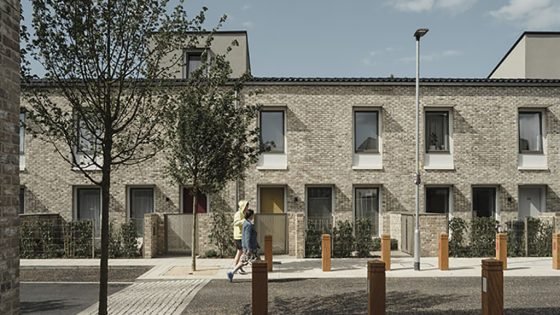
A Scottish council has paused a requirement for its new homes to meet the Passivhaus sustainability standard amid concerns about high costs.
Last week, Midlothian Council members backed a motion to halt the pursuit of Passivhaus compliance in future developments until the council could better consider its costs and benefits.
The decision does not apply to schemes currently under construction.
Passivhaus is an international design standard for high energy efficient buildings that ensure a low level of temperature fluctuation. Passivhaus buildings require less heating and cooling and therefore emit less carbon and are not as expensive to run as normal buildings.
Stuart McKenzie, the Scottish National Party’s cabinet member for housing, suggested a rethink of the commitment to Passivhaus, “given the variation between what we expected it would cost and what it actually costs”.
Midlothian’s Net Zero Home Design Guide, published in March 2022, specifies the Passivhaus standard for new council buildings from 2022 onwards.
Of the earlier decision to obtain Passivhaus certification, McKenzie said: “I think we made the right decision for the right reasons at the time.” But he proposed stopping the policy “so we can better understand the variation in costs and why this is significantly more expensive.”
McKenzie added: “It could be that the way forward is that we continue with Passivhaus and continue to charge additional costs. Or we may find another methodology that delivers equally warm homes.”
A report to the meeting set out a cost comparison at sites that did and did not specify the Passivhaus standard. The three sites with Passivhaus had a cost per unit of between £324,000 and £341,456. For those where Passivhaus was not specified, the cost per unit was between £182,866 and £302,500.
But the report acknowledges that “assessing the specific impact of building to Passivhaus standard on cost is difficult to determine” due to factors including a volatile market and high inflation, adding that “no a direct comparison is possible.”
McKenzie’s motion was seconded by SNP councilor Stephen Curran. He called for an analysis of the impact of Passivhaus, saying it was “hard to believe” a claim that it would cut energy bills in a local development by 80 per cent.
The council’s site executive director, Kevin Anderson, agreed to provide this analysis.
He noted that the Passivhaus commitment was “one of the pathways” through which the council planned to reach net zero by 2030.
Anderson said: “Clearly there is [an] implication in terms of net zero commitment for the council, if we are not going to offer this solution for the housing stock, aAlthough, as it turns out, there are other routes available, which we will offer and are delivering in other places where Passivhaus doesn’t seem to be the solution.”
