

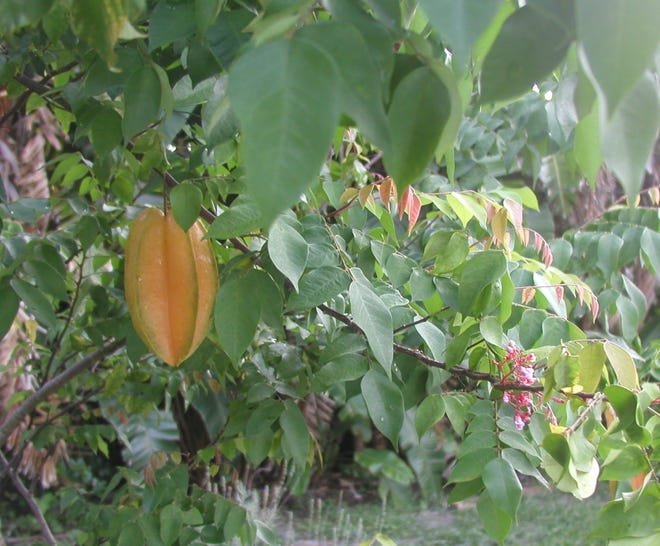
I like to see the residents growing some of their own food. It can be as small as growing a tomato plant on the balcony or as large as growing five hectares of fruit trees.
The amount of food grown doesn’t matter as much as the fact that they are growing something they can eat.
For those who want to maximize their efforts, it is possible to design an entire landscape with edible plants, as trees, shrubs, vines and ground covers produce edible fruit, foliage and seeds. With careful planning, edible plants can provide a year-round supply of delicious food.
I’ve mentioned in previous articles that gardening in Florida is different compared to other states. Here in Florida it is much more complicated because we have two seasons, one warm and one cool, each with crops that have specific months in which they must be planted.
The best way to successfully grow vegetables here in Florida is to check out the Florida Garden Guide, which can be found at edis.ifas.ufl.edu.
Some examples of warm-season vegetables that are usually planted in the fall and spring are tomatoes, peppers, cucumbers, cantaloupe, and okra. Examples of cool-season vegetables, which can be planted now during the winter, are broccoli, cauliflower, cabbage, lettuce, mustard and cabbage.
Vegetable plants don’t have to be limited to a traditional garden, because they can be grown all over the landscape if the light conditions are right. For example, Bright Lights Swiss Chard is a colorful cultivar that can be grown in full sun or partial shade for a pop of color. Plus, you can eat it.
So don’t limit your vegetable plants to just the garden. Add them to your entire garden.
Many tropical vegetables can be grown during the hot summer months if you feel like gardening in this type of climate. Examples of tropical greens are Malabar spinach, New Zealand spinach, Jerusalem artichoke, jicama, and chayote. Some additional miscellaneous food crops that we can grow are sugarcane (sugar)mexican breadfruit (monstera delicious) and the vanilla orchid plant (Vring planifolia), which produces vanilla beans.

When it comes to edible plants, many herbs can be grown here as well. We have herbs that grow well in our poor sandy soil, such as rosemary, sage, thyme and oregano. Then there are the herbs that do best with richer soil, such as parsley, chives, dill, fennel, pineapple sage, mint, lemongrass, edible ginger, and turmeric
I like to have mint growing in the ground because it smells wonderful when it is cut. I recommend planting lemongrass in a container, because moving a mature plant would require a backhoe.
Finally, we don’t want to forget the fruit crops. The University of Florida’s FruitScapes website, trec.ifas.ufl.edu/fruitscapes, has lists of temperate (deciduous), subtropical, and tropical fruit crops. Each list has separate bulletins on the individual crops, so there is a lot of information available.
Fruit trees and deciduous shrubs that can be grown are apple, blackberry, raspberry, blueberry, Chinese date, fig, grape, muscadine grape, peach, nectarine, pecan, common persimmon, Texas persimmon, plum and pomegranate.
Examples of subtropical fruit crops include atemoya, avocado, banana, caimito (star apple), canistel, carambola, coconut, coffee, guava, jaboticaba, jackfruit, lemon, longan, medlar, lychee, macadamia, canistel, cacao, coconut, mamoncillo (genip), mango, pineapple, pitaya (dragon fruit), sapotilla, white sapot and tea.
Tropical fruit crops can survive on the beaches and Merritt Island south of the shoreline if we don’t get a freeze. If your yard is small, look for dwarf varieties of fruit trees.
The amount of food we can grow in Central Florida is enormous. If you’ve been toying with the idea of growing your own fruits, vegetables, and herbs, now is a good time to decide what you want to grow and sketch out a design for your garden.
When creating a layout, use the mature height and spread of the plants you’ve chosen so you don’t plant them too close together or buy too many plants. This information is found in fruit crop bulletins and the Florida Horticulture Guide.
For herb plants, do a quick internet search for grass followed by ifas. For example, you can type ifas de oregano to find information about oregano from the University of Florida.
List the fruits, vegetables and herbs you like to eat. Then walk around your garden, balcony or porch and look for places to grow the plants on your list. This winter, you can start growing some vegetables and herbs and then plant a fruit tree or two in the spring.
Start planning now and design your deliciously edible dream landscape.
Sally Scalera is an Urban Horticulture Officer and Master Gardener Coordinator at the University of Florida’s Institute of Food and Agricultural Sciences. Email him at sasc@ufl.edu.
More from Sally
Here’s what you need to know about milks to attract monarch butterflies Sally Scalera
Do you enjoy gardening and helping others? Become a Master Gardener | Sally Scalera
Autumn has arrived; here’s what to do in your garden in October | Sally Scalera
