

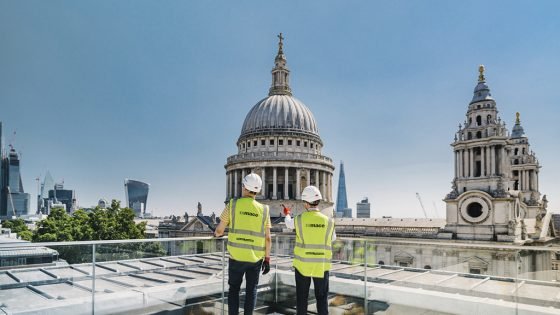
Mace has called for London to become the ‘circularity capital of the world’, saying £1.25 billion could be saved by reusing materials and components.
The Closing the Circle The contractor’s report, published today (October 26), calls for circular economy principles to be incorporated into the building’s life cycle to ensure materials are reused and recycled rather than left to back off
Adopting a circular model would prevent more than 13.8 million tonnes of material and components in the capital from being wasted over the next 10 years, saving the equivalent of 11 million tonnes of CO2, he says.
In the decade to 2021, construction and demolition activities generated 1.54 million tonnes of identifiable waste in the City of London alone, of which only a tenth was recycled.
However, the report argues that London is the natural home for the global circular building economy because of its innovative construction companies, developers and occupiers with a strong interest in sustainability, and planning authorities that already promote practices of circularity.
In particular, Mace is calling for the development of physical and virtual ‘material banks of circularity’, which would allow smaller companies to tap into materials produced elsewhere in the industry, along with material passports to track origin of materials within the supply chain. allowing easier reuse.
It also wants to see industry and government come together to build a credible circularity accreditation scheme that allows customers, investors and contractors to demonstrate the value of their commitment to circularity.
The company also calls for regulation of circularity and a financial incentive through a reduction in Section 106 requirements when circular practices are adopted.
James Low, Mace’s global head of business, said the transition to a circular economy was one of the most important innovations needed to deliver zero-carbon buildings and infrastructure.
“This requires the whole industry to come together to provide the information, products, building practices and behaviors needed to realize the potential carbon savings associated with a more circular model in London over the next decade,” he said.
Mace Construct managing director of commercial offices, Ged Simmonds, said the report illustrated how London could become the circularity capital of the world.
“In the UK capital, we have a unique ecosystem where construction companies, planning authorities and building occupiers come together on one global issue,” he explained.
“By embracing and enforcing circularity in our built environment projects, we can make meaningful and significant strides in our shared pursuit of a sustainable world.”
