

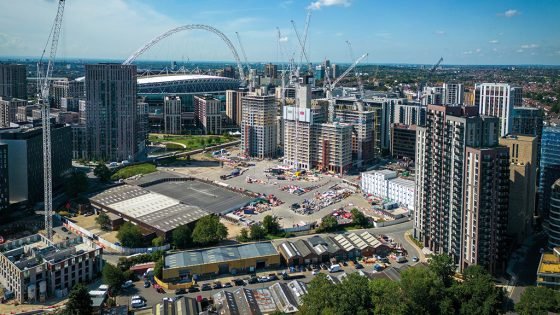
Sisk is reducing built-in carbon and optimizing off-site manufactured components in its latest work at Wembley Park
Project client: Quintain
Total cost: £230 million (fixed price contract)
Type of contract: JCT design and construction
Main contractor: John Sisk
Architect: Haworth Tompkins
Structural engineer: Elliott Wood/CampbellReith
Basics: Harrington Builders
Demolition: Good Demolition
Stacking: Keller
Cores and concrete frames: Byrne Group
MEP: Halsion (NE03)/HE Simm (NE02)
Facade contractor: Techrete
Start of construction: November 2021
Expected delivery: May 2025
The poet Sir John Betjeman had a curious obsession with Metroland, the suburban areas of north-west London that sprang up in the early 20th century amid the expansion of the Metropolitan Line. “The appeal of Metroland was remoteness and quiet,” wrote Betjeman, describing “trees and fairies and a hundred and one things on which the fingers of Dame Nature have long lingered in the ‘time to expose this beautiful variety of wood slope, trout stream, meadow and hill sites”.
It is safe to say that this bucolic description did not fit the stadium built at Wembley for the British Empire Exhibition in 1923. Nor does it apply to the modern Wembley Park area with its growing variety of residential blocks high-rise, such as the NE02/NE03 scheme, which is being built on a former car park and offices.
“We have created a system by which we do not leave holes
on the facade and the balconies literally stick together”Daniel Mackell, Sisk
John Sisk & Son is building two high-rise blocks on each plot for Quintain, which is developing 85 acres of land near the stadium for residential, leisure and commercial uses. When completed in 2025, two structures on plot NE02 (17 storeys and 27 storeys) will consist of a total of 487 dwellings. Two more blocks of NE03 (10 floors and 21 floors) will deliver a total of 282 flats.
The total scheme will have an area of 9,593 square meters including green spaces/landscaping.
Sisk is no stranger to working with Quintain on projects at Wembley Park, but the £230m design-build deal for NE02/NE03, announced in September 2022, is the biggest he has worked on to date. As of mid-September this year, NE02 and NE03 were 44% and 52% complete, respectively, and fit-out work was underway.
Sisk took possession of the site in November 2021, hiring subcontractors to demolish the parking lot and office buildings in the pre-construction phase. Subcontractor Keller drove 1,080 continuous flight auger piles before the individual cores of each block were slipped by Byrne Brothers, who also constructed the reinforced concrete frames for the new buildings. All concrete for the project is being poured off-site and cast-in-place.
“We’ve finished frames in NE03 and passed three of the four frames in NE02,” says Sisk project manager Daniel Mackell. The time it takes to pour the slabs depends on the size of the floor slabs and the weather conditions, so it can vary between six and 14 days.
CantiDeck crane loading platforms are installed floor by floor next to the facade before cladding. Platforms are positioned to clear the rear strut and then load prefabricated bath pods, closely followed by the front. “While the facade is gradually installed on the building, we can make everything airtight and release the equipment next,” says Mackell. “When we have enough clear space (usually about 10 stories) below the fixtures, fans, CantiDecks, and general logistics of the framing contractor, we start with the prefab. [facade] under. As the frame moves up and out of the way, we begin to clad the building below.
Prefabricated facade
Three heavy duty Terex cranes, capable of lifting up to 14 tonnes at 45 meter reach, are being used to coat NE02 and NE03 simultaneously. The facade panels are manufactured off-site by Techrete in Lincolnshire and weigh up to 10 tonnes. The largest panels are 7.5 meters wide.
“Generally [on other schemes] we try to finish the frames and then start the cladding. But in NE02 we can’t wait for level 27 to finish and then do the cladding or we’ll never finish the project!
In this work, the team placed recesses in the screen and used a Bomecon I-Boom counterweight lifting platform to pick up the precast panels and cantilever them under the formwork. It means we can start wrapping these buildings as close to the formwork above as possible. We can cover a floor a week.”
By using prefabricated facades, the new buildings differ from the nearby seven-block Canada Gardens, which were completed in 2021 with brick facades. “One of the reasons for designing the brick was to reduce embodied carbon,” says Matt Voyce, chief executive of client Quintain. “Behind this brick [at Canada Gardens] you have concrete, so you’re almost doubling your incorporated carbon. We love brick – it stands the test of time and looks great. But we also want to give different parts of the estate their own personality.”
Mackell adds: “We are using concrete facades with ribbed joints, in different colors [such as terracotta] and different finishes.” The panels are all concrete, with articulation achieved through highly detailed molds in the casting process. “Acid and grit etching is done after the molds are attached,” he explains. “Once that’s done, the windows and doors are put out of place.”
Buro Happold is conducting operational and embodied carbon assessments in NE02 and NE03. Voyce claims the carbon incorporated will be 80 percent lower than its projects completed in 2021 and 20 percent lower than its projects completed in 2022.
This is achieved not only in the facade but also with granulated blast furnace slag (GGBS) as a substitute for cement in slabs, columns and core walls. “We can go up to 40 percent [GGBS] in our slab mixes in sunny conditions, but it becomes a little more limited in the winter months,” notes Mackell. “Right now [before autumn] this is the time when we want to step up, especially in areas like the roofs and the podiums, where we can leave the formwork a little longer and let the concrete cure a little more”.
Balconies with clip
Sisk worked with Reading-based manufacturer Sapphire Balconies and Techrete to develop a lightweight (350kg) non-combustible aluminum balcony system for NE02/NE03. “It’s about optimizing thermal efficiency, trying to reduce thermal breaks in the facade, but also safety by making sure we’re reducing any fire risk,” Voyce says of the system.
Sisk also wanted to make the balconies airtight to start the dry. “So we created a system where we leave no holes in the facade and the balconies literally stick together,” says Mackell. “This is something quite unique that has not been applied to any other project that I know of.”
He adds that this method helps with efficiency by eliminating the need to hang cribs on the edge of the building. “All the load is transferred; instead of going directly into the structure, the load is transferred through the facade panel.”
equipment
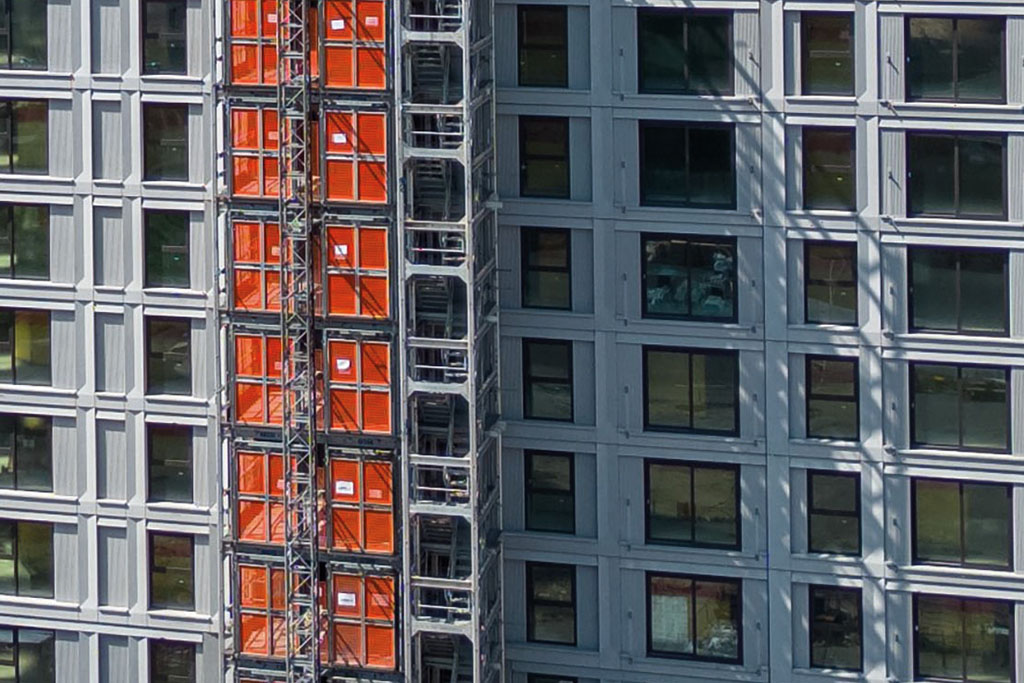
when CN visits, the first batch of off-site fabricated 3D elevators has arrived for installation. “One thing we have done slightly differently with this project [compared to other jobs for Quintain] the MEP is divided [mechanical, electrical and plumbing] between SE Simm and Halsion,” says Mackell. This decision was made in part because of the large number of apartments being built in both buildings, he adds.
Halsion are making their own 2D elevations in Kent to install in NE03, while HE Simm is installing larger 3D elevations made by Pinnacle in NE02. “It allows us to see which option is more effective,” says Mackell. “This information will be great for lessons learned when looking at future projects.”
The hotel-style risers are adjacent to the hallway of the apartments. The 3Ds are tall enough to cover three floors and pass through a glass-reinforced plastic (GRP) floor grid at each level. These are loaded with cranes through the holes in the slab.
The 2D elevations are brought into the floors by goods hoist and fitted to the riser walls, with GRP grating cast into the floor slab by the framing contractor. Each 3D module can be brought to the site and dropped into the building in the space of a couple of hours, Mackell says, whereas previously it would have taken several workers longer to install multi-story elevations.
The innovative thinking in the NE02/NE03 extends to drylining, with Sisk aiming to use prefabricated plasterboard partitions from Platt Reilly. Fabricated off-site partitions are designed to fit into floors. “But as you can imagine, just from a fire safety perspective, there’s a lot of testing going on, getting approval from certification bodies and buy-in from consultants, contractors and the client,” he says Mackell. “There are several types of walls. These are fully tested and the walls that require a fire rating get it.”
New buildings taking shape may have prefabricated drylining partitions “within six months on the upper floors,” he says. “We’re looking to use the prefab walls in this project. And if it’s a success, I suspect we’ll use them in all the floor plates in our next project.”
Reducing facade reporting times
 Sisk says it has been using a digital tool with 3D BIM modeling data to reduce the NE02/NE03 prefab reporting process from “days to minutes”. A dashboard tracks the progress of manufacturing, delivery and off-site installation.
The contractor found that limitations in software and file formats made it difficult to effectively use the 3D model to report on previous jobs. This led to inefficiencies in off-site manufacturing tracking, forcing teams to rely on updates from multiple sources, including non-standardized Excel trackers. Real-time visibility into the production status of each facade panel was missing, resulting in time-consuming tasks.
Previously, the project team spent up to 72 hours collecting, updating and reporting on more than 1,700 individual prefabricated facade panels. Sisk estimates that the new approach is up to 72 times faster and offers up to 98% time savings compared to the traditional process.
The firm adds that the success of the reporting tool has led to “substantial interest” from undisclosed sources in implementing additional asset tracking capabilities for various building components, including exterior-fabricated windows of the site and its installation.
“In addition, this has sparked curiosity to establish a tracking system for the installation of vertical modules,” adds the firm.
Security concerns
The design and construction of NE02/NE03 has a different safety dimension. As its location, 400 meters from Wembley Stadium, is a potential target for terrorism (as demonstrated by the November 2015 terrorist attack at the Stade de France in Paris), the design of the ‘envelopment was carried out in consultation with the Metropolitan Police’s architectural liaison officer.
Brent Council’s planning documents in August 2016 said the new buildings needed to be “adequately terror-resistant” to withstand an explosion, the exact intensity of which is classified for national security reasons.
