

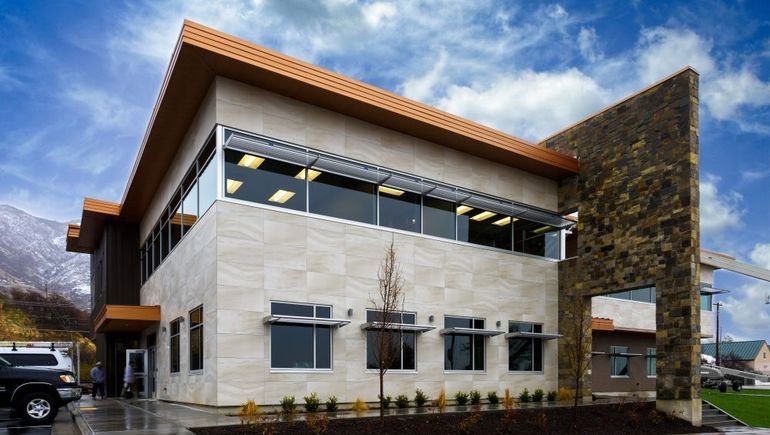
We all know the environmental and business reasons why commercial buildings need to be more efficient and low carbon. From sports facilities and airplane hangars to elegant office spaces (and everything in between), commercial structures account for about 20% of energy use in the United States. And the built environment is responsible for 40% of global greenhouse gas emissions.
“Pre-engineered buildings offer creative, economical and highly sustainable opportunities,” says Christen Funk, president of Butler Manufacturing, an industry leader in pre-engineered metal solutions.
By reshaping perspectives on how creativity and carbon reduction can coexist in harmony, Funk believes the entire construction industry can gain more opportunities. “I want architects and builders to think of pre-engineered metal solutions as a different kind of canvas to create their visions. It’s about changing the dynamic to a mindset of efficiency supported by freedom of design and construction “.
This unconventional, cross-functional mindset is so critical to the evolution of the industry that a recent BlueScope Buildings innovation accelerator launched five new pilot programs designed to revolutionize the construction industry.
Dan Kumm, Senior Director of Business Insights at BlueScope Buildings states, “Forming partnerships across industries and areas of expertise can unleash more innovative processes and drive greater efficiency throughout construction and the entire life cycle of a building.”
Three different approaches are vital to achieving greater energy efficiency in the construction process.
1. Monitoring of the supply chain to guarantee optimized materials
A comprehensive view of the supply chain is essential to ensure the most efficient end product. Kumm stresses: “To get a low-carbon solution, you have to go to the specific knowledge of the supplier: where the raw material was sourced and how much incorporated carbon was accumulated along the journey to the stage of the final product”.
“The best way for a design team to gain supply chain visibility is to engage suppliers who can track their sub-suppliers, through every step of material sourcing and production,” advises Kumm.
For architects who want to start having this conversation with suppliers, consider starting with a mill test report (MTR) from a steel fabricator.
2. Smart steel solutions reduce carbon emissions
Ryan Hill, chairman of Varco Pruden Buildings, advocates transparent collaboration to achieve low-carbon production. “We really need to graduate the construction industry into an environment of transparency and trust, which allows collaboration to deliver a different level of low-carbon production.”
Together, architects, engineers and steel producers can achieve aesthetic goals and structural integrity by determining the best product application for their specific project early in the process.
While steel is infinitely recyclable, which is great from a sustainability perspective, Kumm sums up the value of efficient use of materials: “One of the best things you can do to reduce carbon in a building new is to use less materials.”
Anyone who wants to communicate the impact of smart steel solutions in concrete terms can use the EPA’s Greenhouse Gas Equivalence Calculator.
3. Collaborate early for efficient design
Early collaboration is critical to forming shared goals and delivering low-carbon solutions. “Hiring certain suppliers of key materials much earlier in the process, to help remove that carbon from day one, is critical,” says Kumm.
Hill agrees that early collaboration is essential. “Over the last 10 to 15 years, energy codes have become more stringent, and that trend is likely to continue,” explains Hill. “As experts in how steel works from a structural perspective, we can work with the design team on alternative solutions.”
The bottom line, according to Hill, is about integration. “Having the same group manage all functions of a build together often speeds up the process and gets the end product to the owner, faster.”
Efficient steel solutions equal long-term benefits
Today’s smart steel buildings can be as aesthetically appealing as they are strong and energy efficient. Funk agrees: “Steel exteriors may involve higher upfront costs, but ultimately allow for savings, greater longevity and greater sustainability, thanks to durability.” The potential to combine steel buildings with other green options, such as solar panels and rainwater harvesting systems, adds to their appeal. Insulation techniques and deflective roofs commonly used for steel buildings also increase energy cost savings.
“When a project enables optimized teamwork, smart steel solutions and better supply chain insight, the result is more energy efficient buildings as well as a healthier planet,” continues Funk. “We all love beautiful design and spaces where people can work, play and connect. As architects, builders and steel producers, we have the same goals, we just get there a little differently.”
