

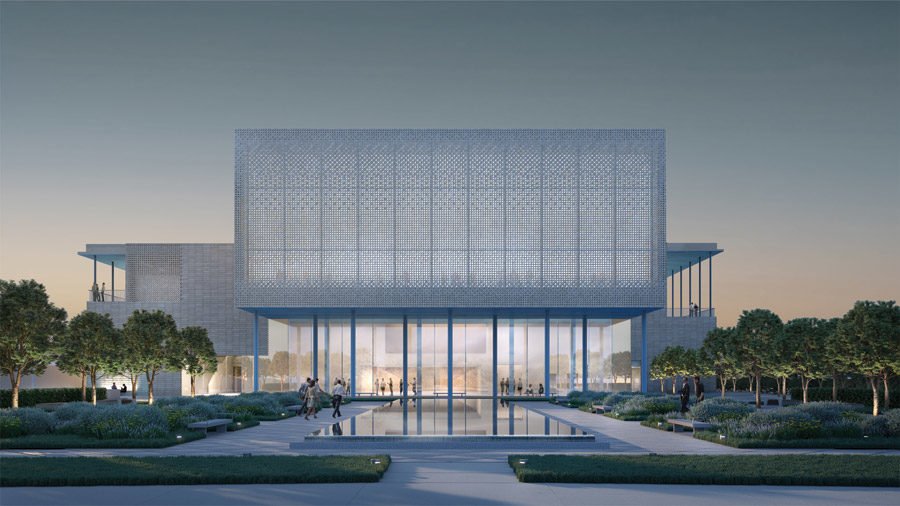
Located near lower Buffalo Bayou in Houston and featuring complex landscaping and extensive concrete work, the first Ismaili center in the US required an intense commitment to precision from its owner and design and construction team. Construction on the LEED Gold-targeted campus for the Shia Islam branch began in 2021 and will be completed in 2025.
On an 11-acre site, the 72-foot-tall cultural and religious center includes a 150,000-square-foot, five-story tripartite building that features elevated open terraces and numerous gardens and courtyards. Inside there is an atrium, a prayer space known as a “jamatkhana”, a library, social and exhibition rooms, a black box theatre, classrooms, administrative offices and catering event facilities. The complex also incorporates a two-storey underground garage with capacity for 600 cars.
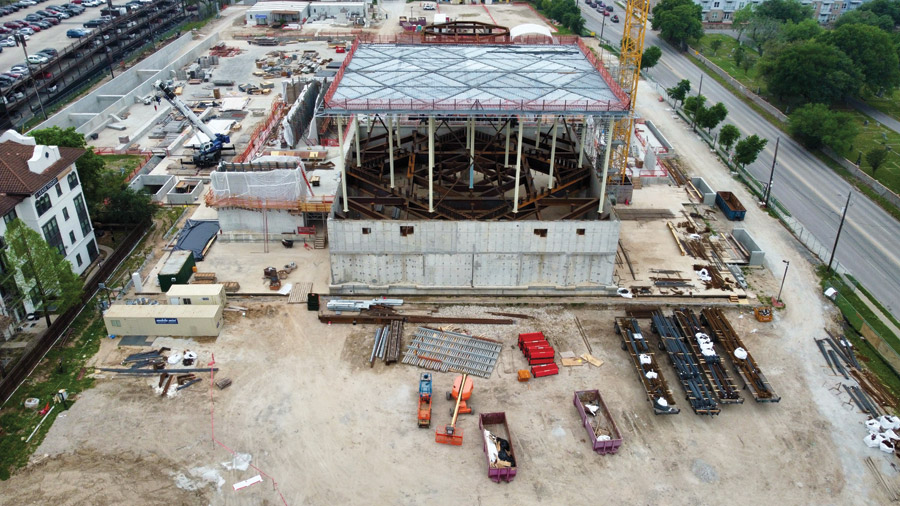
When completed in 2025, the five-story Ismaili Center in Houston will have 150,000 square feet.
Image courtesy of McCarthy Building Cos.
The Aga Khan Foundation USA, based in Washington, DC, is part of the Aga Khan Development Network which is chaired by the Aga Khan, the current global Ismaili Muslim leader. As an imam, he leads some 15 million Ismailis worldwide, and Texas has the largest American concentration of tens of thousands.
“The Ismaili Center will serve as a meeting place for all who call Houston home, with themed programs in cultural exchange, the arts, interfaith dialogue, international relations, and knowledge creation and sharing,” says Al -Karim Alidina, president of the Ismaili Council. for the USA, the social governing body of the American community. It will also serve as a place for “prayers, spiritual pursuits and contemplation,” he says.
“The center offers unique construction challenges due to its location on Buffalo Bayou, intricate design details and extremely high-end finishes.”
—Winston Hesch, Senior Superintendent, McCarthy Building Cos.
“We are thrilled to build the Ismaili Center, which we hope will be a future Houston landmark and icon of cultural connection,” says Winston Hesch, senior project superintendent at McCarthy Building Cos., who is leading the construction team. from Houston. London-based Farshid Moussavi Architecture designed the building, AKT II is the structural engineer, Nelson Byrd Woltz is the landscape architect and DLR Group is the architect and engineer of record. All follow the 100-year design protocols requested by the owner.
“The center offers unique construction challenges due to its Bayou location, intricate design details and extremely high-end finishes,” adds Hesch. With these demanding aspects, McCarthy’s team includes him and senior project managers Chris Vlasak and Randi Fronczek. The peak workforce for the project should be around 250 to 275 workers in early 2024.
“There’s nothing like this center in the city and nothing of this scale and significance in Texas,” Hesch says. Project officials declined to release a cost estimate for the center.
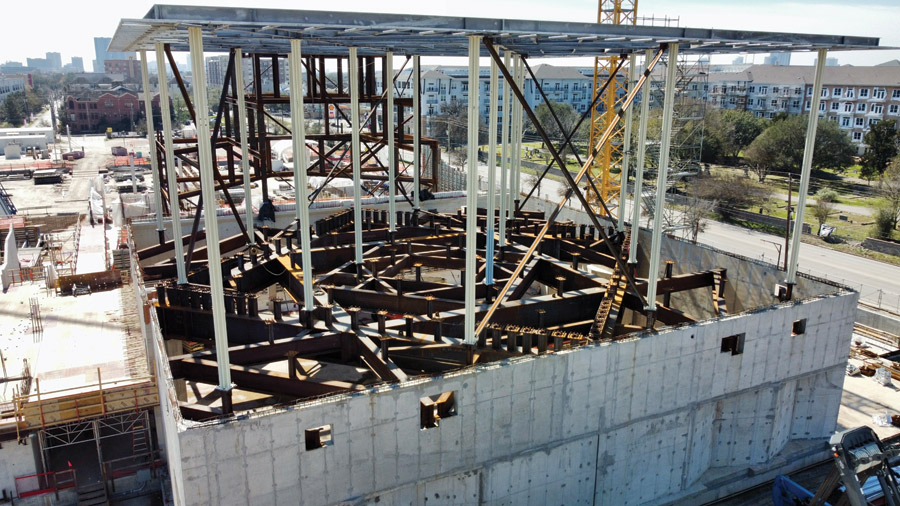
The project owner Aga Khan Foundation USA requested 100-year design protocols.
Image courtesy of McCarthy Building Cos.
Specific issues
Concrete is the most prominent material in the Ismaili Centre, both structurally and aesthetically. Ultra-performance concrete panels from Monterrey, Mexico make up the atrium, while light-colored stone from Turkey is used for the facade.
The success of the project depends on the high quality of the concrete pours, so McCarthy is doing the work himself. Varying concrete PSI levels, pour lengths, seasonal adjustments, as well as the difficulty of finishes, have required close collaboration from the pre-construction stage to achieve design intent, says Vlasak.
That’s why the owner chose CM’s project-at-risk delivery for the project,” explains Abdul Javery, owner’s representative and project manager. “This way, we have a pre-construction partner…who fully understands complexity and intricacy rather than a contractor after the design is complete.”
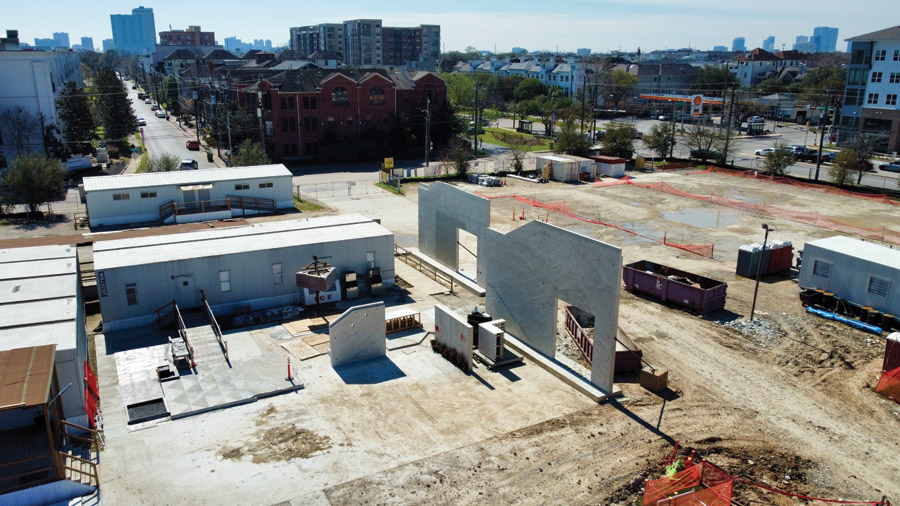
Concrete was the main construction material used to build the Ismaili Centre.
Image courtesy of McCarthy Building Cos.
Hesch adds that the varieties of concrete use in the project include concrete floors, prestressed concrete, concrete-clad steel and architectural concrete walls, as well as custom architectural concrete slabs. There are various colors, textures and designs within concrete work. Early on, the team had to make adjustments for availability due to national shortages at the time with many large Texas projects underway, but those weren’t disruptive, he says.
All concrete, including sidewalks, has custom finishes. Perforated stone panels with glass behind allow natural light in while keeping the building cool and bright at night, lit from within.
Hesch notes that the project’s expected 100-year design life required significant wall reinforcement, causing rebar congestion and cleanup issues. Also, because the owner didn’t want exposed construction joints and reveals, the team had to coordinate four large pours instead of many. One was over 115 linear feet and 30 feet tall.
For the architectural concrete panel formwork walls, the formwork was built like a fishbowl as the concrete mix composition had to be very thick to fit around the extensive rebar. Fronczek explains that the team used formwork vibrators instead of internal vibrators to consolidate the concrete.

When completed, the center will occupy 11 acres and stand 72 feet tall.
Image courtesy of McCarthy Building Cos.
Down by the Bayou
The north end of the campus is 300 feet from Buffalo Bayou, which is about 100 feet above sea level. The building is 20 feet higher than where the land drops to the bayou. As it is located in a flood zone, the site is subject to potential water events.
Steve Done, the owner’s project manager, explains that the downtown bayfront includes a retention pond. The area will also be planted with native flora designed to retain stormwater when Buffalo Bayou overflows its banks, as it is prone to do during storms. A protective wall surrounding the site for acoustic insulation allows water to reduce the impact of flooding in the area.
“Old Houston is becoming the new Houston.”
—Abdul Javery, project manager
More than 700 trees will be planted across the campus. Advance planning has been essential here, says Jeffrey Aten, principal of landscape architect Nelson Byrd Woltz: “Selected plants were acquired early and preserved at a local nursery,” he notes.
The underground two-level garage is located south of the water retention area outside the flood zone. To build it, McCarthy’s team installed dewatering wells to lower the water table, then excavated up to 35 feet while also installing earth-keyed retaining walls at both levels. There is a sump pump and a drainage system.
Both along the bayou and at the main entrance at the southern end, the site is laid out in a 5-foot grid, affirming the traditions of the Islamic mathematical order, which express the perfection of the divine. “This repetition and symmetry pays homage to that,” says Aten. “The building is immersed in the spirit of God, like a cathedral.”
The center’s Islamic architectural heritage is combined with Western design elements suited to Houston’s climate. The exterior of the building is made of matte sand-colored marble, designed for a clean mosaic of Islamic-inspired tessellated patterns that can withstand intense coastal heat and humidity and 70 inches of annual rainfall.

The design and geometry of the center reflect the influence of Muslim culture.
Image courtesy of McCarthy Building Cos.
Islamic Heritage
In the design of the campus, geometry asserts its importance in Islamic culture. Inside, the Jamatkhana worship area features a metal roof with octagonal designs and perforations.
Wooden panels with calligraphy adorn the wall of the prayer hall, and artisans are finishing the panels using computer numerical control machines. The complexity of the panel and the intricate patterns required very tight tolerances.
Plaster ceilings in most common areas are custom made with a plaster product that has triangular perforations. The lightweight plasterboard is made in Germany and trimmed with specific templates for light fixtures, fire alarms, sprinklers and safety devices, Fronczek explains, noting that the center’s most prominent light fixtures are also triangular.
Many interior areas feature silk laminated glass panels with a layer of colored silk organza fabric between two glass panels, creating a sense of movement.
The oversized glass panels, which exceed 10 feet by 5 feet, challenged the team to find a textile factory that could produce bolts of silk organza fabric large enough so that the fabric joints within each panel would not were visible
The center is a transformative project, both for the staff and for the city. It’s the culmination of a 40-year engineering career for owner-manager Javery, and sends “a message of peace, collaboration, friendship, reflection and intellectual engagement,” he says. “Our aspiration is that the Ismaili Center will be a monumental part of Houston’s civic assets for centuries to come.”
Director Done adds that the project “is changing the landscape of the city and the perception of the people of Houston. The old Houston is becoming the new Houston.”
