

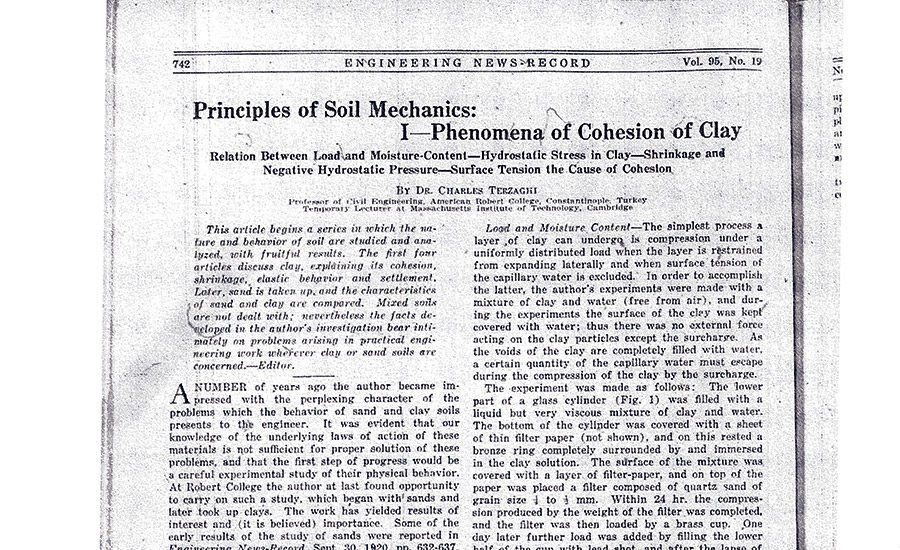

More art than science, earthmoving engineering was largely based on local customs in 1904, when Karl Terzaghi (1883-1963) earned his engineering degree in Austria. After overseeing a dam project in Croatia and studying dam construction projects in the US, he concluded that the study of soil mechanics had stagnated. As he later wrote: “The reason for this lack of progress lies mainly in the great difficulty of investigating soil phenomena.” He devoted the rest of his career to rigorously researching the physical study of soils and soil behavior.
While teaching at the Royal Ottoman College of Engineering in Istanbul in 1919, he began publishing his findings. His first book, The Mechanics of Earth Construction Based on Soil Physics, was published in 1924.
ENR first published a paper by Terzaghi in 1920. At the time, ENR associate editor Fred Schmitt found Terzaghi’s ideas so significant that he suggested Terzaghi submit reports of his studies and subsequent findings. They were published as a series of eight articles in 1925 (as Charles instead of Karl).
As Schmitt explained in the series, “The author [Terzaghi] he was able to trace the many physical properties of soils to four underlying factors: 1. Friction between grain surfaces; 2. Viscosity of capillary water; 3. Surface tension of capillary water; and 4. The influence of the width of the voids on the physical properties of the water itself”. The series constituted the first comprehensive treatment of the principles of soil mechanics read by English-speaking engineers.
Practical application of the theories proposed by Terzaghi began early in the U.S. In the early 1930s, the Los Angeles Bureau of Water and Supply began to apply the factors to soil compaction in large earthworks . The result was the development of a completely new procedure for the engineering control of this work. Simple tests were included to determine the suitability of materials for earthworks and to check compaction.
“Terzaghi not only laid the technical foundation for analyzing soil behavior responses in built facilities, he set the gold standard for the role played by geotechnical engineers that endures today,” says David P Sauls, president of GeoEngineers Inc. “Terzaghi saw the whole problem. , starting with the geology of the site and ending with the measured behavior of the soil during and after construction.
After teaching for several years in the 1920s at MIT, Terzaghi returned to Vienna, before settling permanently in the US in 1938 and teaching at Harvard. He published prolifically and consulted widely on projects such as the Aswan High Dam, the Mexico City sinking, the Chicago subway tunnels, and the 10-in. settlement of Charity Hospital in New Orleans. “His consulting engineering reports read like compelling stories that design and explain the solutions to the world’s most complex construction projects over the next 30 years,” notes Sauls.
Many of the analytical approaches that Terzaghi developed are still valid. “We have refined numerical analysis techniques and improved design input with superior soil sampling methods and laboratory testing,” says Sauls. “His work established our understanding of topics such as: the mathematical formulation of soil mechanics to analyze soil performance; foundation soil settlement under applied load; ground pressures; and tunnels and slopes (landslides, dams, slope stability)”, he adds. “Terzaghi is easily the greatest contributor to geotechnical engineering over the past century.”
