

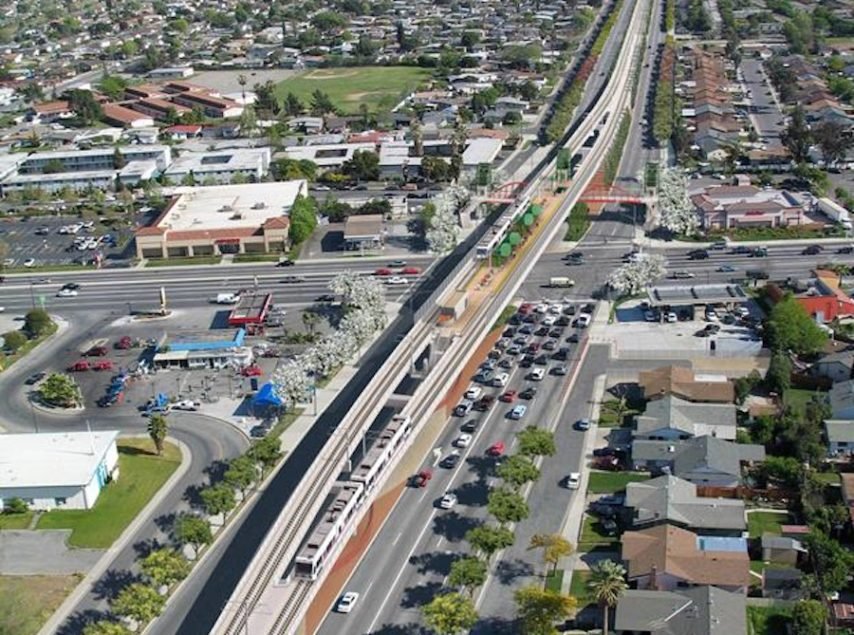
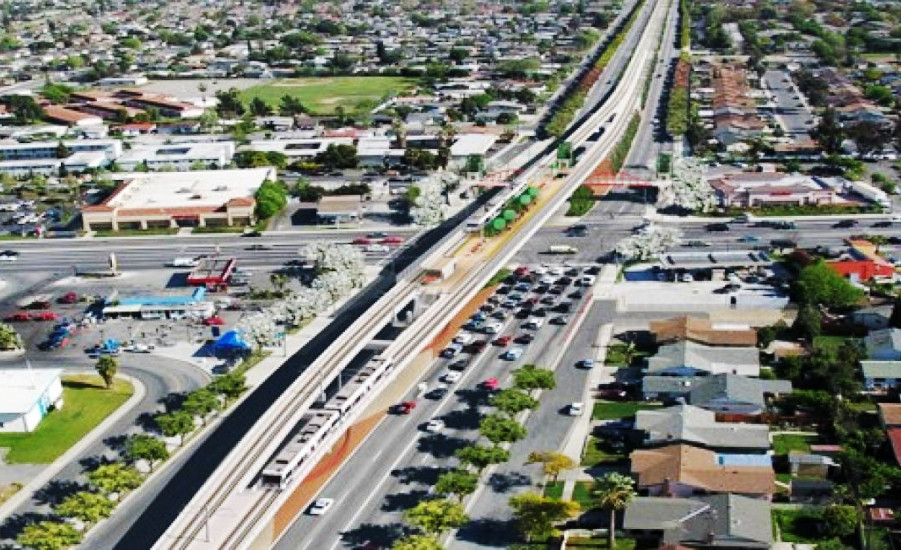
On March 7, the Santa Clara Valley Transportation Authority (VTA) voted to approve construction of the $653 million Eastridge Regional Connector project to BART in San Jose, California. A joint venture between Sacramento-based MCM Construction and New York City-based RailWorks Corp. . was selected to build the project, with a winning bid of $437,161,464.
The 2.4-mile Eastridge to BART Regional Connector Project (formerly the Capitol Expressway Light Rail Project) extends light rail from the Alum Rock Light Rail Station to the Transit Center in Eastridge, with an elevated guide primarily in the center of Capitol Expressway. The expansion will include an elevated light rail station accessed by a pedestrian crossing and an at-grade station located at the Eastridge Transit Center.
When the design, bidding and construction project is complete, VTA riders will be able to board light rail at the Eastridge Transit Center and connect directly to BART at the Milpitas station.
There were two other bidders for the job. DMZ Builders came in with a bid of $460,756,931 and Flatiron West Inc. bid $494,206,438. All bidders were prequalified, and MCM-Railworks was selected based on being the “lowest responsible and responsive bidder,” says Ken Ronsse, VTA project manager, deputy director of rail transit engineering and facilities.
While MCM-Railwork’s bid was the lowest, it still came in about $120 million above VTA’s estimates. Ronsse says this is mainly because there are more than 500 bid items included in the construction contract. “As major construction contracts have experienced across the country, there is volatility in construction bids given the need for contractors to commit to labor, material and equipment costs over several years or the construction duration,” he says. “For many items, the upward trend in material and labor costs is constant. However, for some items, such as concrete and electricity, the construction industry is still affected by supply chain constraints and inflation rate fluctuations. These fluctuations resulted in the difference between the VTA estimate and the bids.”
Although MCM-Railworks’ bid was higher than expected, it managed to cut the schedule significantly. Ronsse says part of the competitive bidding process for the project included bidding for the duration of the schedule, with VTA allowing no more than 1600 days to complete construction. “MCM-Railworks committed to finish the job in 1,250 days, which means it can be built 350 days earlier than VTA would have allowed in the bid,” he says. “The contractor is able to shorten the duration given their experience with large bridge projects and the efficiency they bring to the job.”
The Eastridge Regional Connector to BART project is the final phase of the larger Capitol Expressway transit improvement project that transforms the Capitol Expressway into a multimodal expressway, providing bus rapid transit (BRT), transit light rail and safe connections to the regional transit system. .
Phase 1 of the project, completed in 2012, improved safety measures along the Capitol Expressway and included new sidewalks, street lighting and a landscape buffer. It also included the reconstruction of the Eastridge Transit Center, which was completed in 2015.
The project is currently in final design, with VTA securing the right-of-way along the corridor to relocate the underground utilities and PG&E towers along the freeway. Once public services are relocated this summer, construction on the light rail extension can begin. Construction is expected to last until 2028, with revenue service expected in 2029.
