

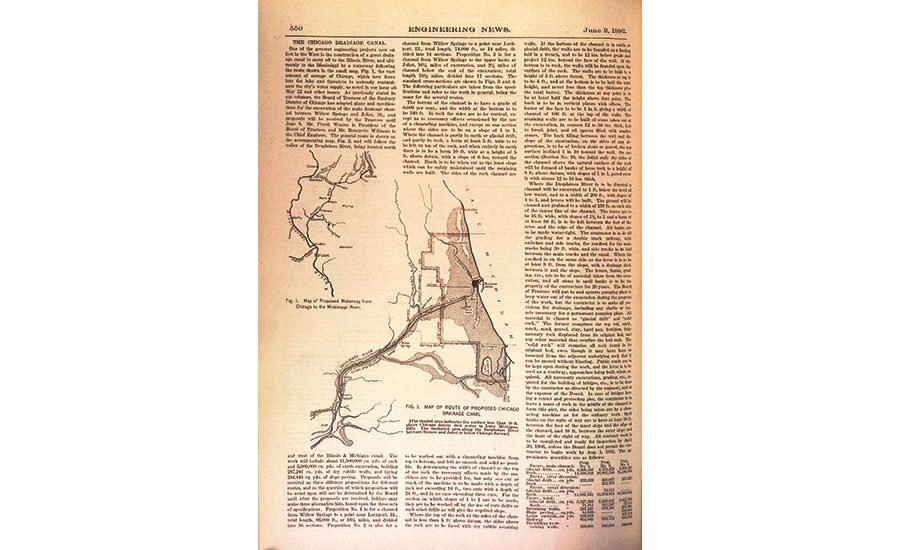

During the 19th century, Chicago’s sewage was discharged into the Chicago River and flowed into Lake Michigan. Because the city’s drinking water was, and still is, drawn from the lake through two-mile-long tunnels, officials feared that sewage could endanger the water supply.
The solution was the construction of the Chicago Sanitary and Ship Canal, which would send large amounts of water from the lake into the Chicago River, reversing its flow and sending the water to the Des Plaines River, which is part of the Mississippi River system. The 28-mile-long canal would be 202 feet wide and 24 feet deep.
ENR’s predecessor magazine Engineering News detailed the project in its June 2, 1892 edition.
The Chicago Drainage Board divided the work into 29 contracts and divided the material to be excavated into two classes, rock and “glacial drift,” defined as “top soil, earth, mud, sand, gravel, clay, tactile, boulders, fragmentary rock. displaced from its original bed and any other material overlying the bed rock.” Construction began in 1892.
Problems arose the following year when a contractor disputed the designation of material in his section and stopped work. “The McArthur brothers have now struck a hard, solid substance, and apparently consisting of conglomerate pebbles, gravel, sand, and clay. It requires drilling and blasting, and the contractors are asking for ‘rock price,’ which was much higher. After deliberation , the chief engineer refused to change the classification or allow the contractors to withdraw.
Another contractor, Streeter & Kenefick, also left the job, “declaring that to excavate this hard conglomerate at the price they had offered meant financial ruin.” The board declared its contract lost, retendered it, and the winning bidder’s price was slightly less than the original sum. The magazine account said: “It appears that the hard conglomerate which has caused so much trouble in this work is not as hard as has been claimed; or at least seems to have no terrors for these new contractors.”
In June 1893, 2,000 workers, mostly Polish Americans at quarries in Lemont and Romeo, Ill., near the canal, went on strike and were fired. The Poles looked for work, and the channel seemed to offer them. Many of the canal workers were black. “Dismissed by bad whiskey and what they considered an infringement of their rights, the dismissed employees of Lemont and Romeo undertook to drive out the men working on the canal, with the result that several men of the attacking party were killed.”
A wide variety of machines were used, depending on the material found. “In the two eastern sections of the canal, the material to be dredged was a stiff brick clay, sometimes mixed with loam and sand.” Dipper dredges were used in these sections. In other sections steam shovels were used to remove hard clay, cemented gravel and rock, which was then transported by conveyor belts to the waste bank. Where drilling and blasting took place, the broken rock was loaded by hand into carts and transported by stationary inclined cables, Lidgerwood ropeways and Brown cantilever hoists.
The workforce reached a maximum of 8,500. The excavation involved a total of 40 million cubic feet of earth and rock, the largest earthmoving project undertaken in North America to date. He trained a generation of American engineers, many of whom later worked on the Panama Canal. The Chicago River Project opened in 1900.
During the 1920s, the dilution method of sewage treatment provided by the canal proved inadequate for the growing Chicago metropolitan area, and treatment plants were built. The Chicago Sanitary District was renamed the Metropolitan Water Reclamation District of Greater Chicago in 1989. Operation of the canal was turned over to the US Army Corps of Engineers in 1930.
