

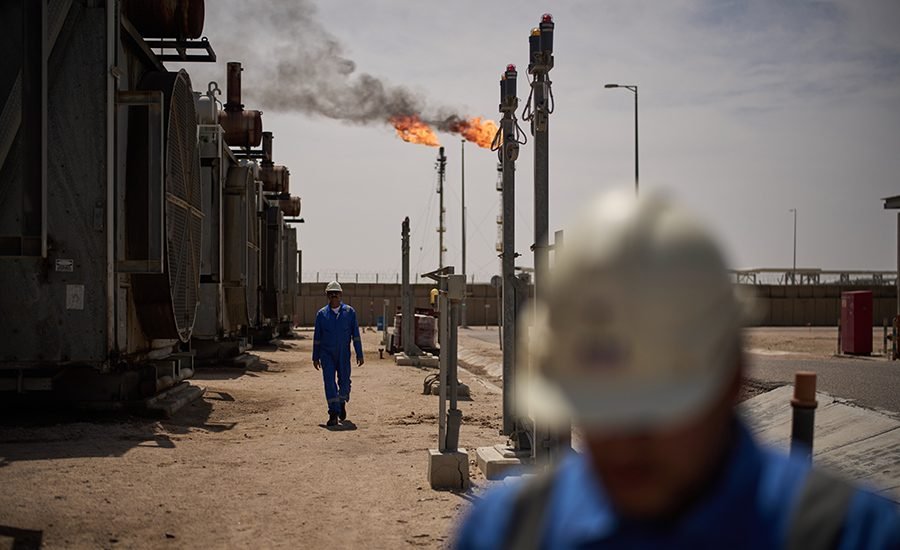
The cost to repair and rebuild Middle East infrastructure related to energy production damaged in the US-Israel-Iran conflict is at least $25 billion and could rise further, with engineering and construction making up about half the price, according to a detailed research assessment released March 23 by industry consultancy Rystad Energy.
The report points to drone and missile attacks that have heavily damaged facilities such as Iran’s South Pars offshore gas field and Qatar’s Ras Laffan gas production complex, considered the world’s largest supplier of liquefied natural gas, “as particularly worrying cases”. Rystad says the latter lost two LNG trains, equivalent to a 17% capacity reduction totaling about 12.8 million metric tons a year, prompting state energy company QatarEnergy to declare force majeure.
Significant damage was also reported to several other LNG facilities, as well as the Pearl gas-to-liquids plant at the Ras Laffan complex, which is jointly owned by QatarEnergy and Shell. The damaged LNG trains at the Ras Laffan facility operate in a joint venture with US energy giant ExxonMobil, which owns about a third of each.

Credit: Rystad Energy
“The Gulf region’s recovery will be defined less by financial capital and more by structural constraints. While some assets can be restored in months, others could remain offline for years,” said Audun Martinsen, head of supply chain research at Rystad, who led the Norway-based consultant’s research team. “Beyond the Strait of Hormuz state, each day of damaged or closed infrastructure puts pre-war production capacity further out of reach.”
At least 40 energy-producing assets in nine Middle Eastern countries have been “severely or very severely” damaged, and oil and gas fields, refineries and pipelines are expected to take some time to repair, said Fatih Birol, head of the International Energy Agency. He described the conflict “as worse than the two oil shocks of the 1970s, as well as the impact of the gas war between Russia and Ukraine, combined.” The agency noted that with several international energy companies and service providers evacuating staff from the region, rebuilding and restarting production assets await enough stability from the conflict for workers and managers to return.
The Rystad report notes that “capital alone will not be sufficient to restore the facility, with full recovery taking up to five years.” That’s because the large-frame gas turbines needed to power LNG’s main refrigeration compressors are supplied by only three original equipment manufacturers worldwide, he said, with all suppliers starting the year with production delays of about two to four years, driven by demand from data center electrification and the retirement of coal plants. These include US-based GE Vernova and Germany’s Siemens, Rystad analysts noted.
“The scale of damage and long delivery times for critical equipment could lead to a slow recovery” of the Ras Laffan complex, the consultant said. Also, “Iran’s legal exclusion from Western supply chains means it will have to rely on Chinese and domestic contractors, which is a technically feasible approach that could be slower and more expensive,” Rystad noted. “Urgent repairs will have to take priority over the planned expansion.”
Looking for quick answers on construction and engineering topics?
Try Ask ENR, our new intelligent AI search tool.
Ask ENR →
QatarEnergy operates 14 liquefaction trains at Ras Laffan, processing gas from the giant offshore North Field. Damage to the complex and the closure of the Strait of Hormuz could now slow its expansion that was announced last year. The energy owner has also halted all offshore contracting activities in the country to protect personnel and infrastructure from future airstrikes. QatarEnergy had awarded Italian-based contractor Saipem and China Offshore Oil Engineering Co. Ltd. a contract valued at more than $4 billion to develop the North Field area.
In Bahrain, the BAPCO Sitra refinery was hit twice, causing confirmed damage to two crude stills and a tank farm, according to Rystad, with cases of force majeure have also been declared in the group’s operations. The report noted that the facility had just reached mechanical completion in December under a $7 billion modernization program. The main contractors are a consortium led by TechnipEnergies together with Samsung Engineering i Gathered techniques, which held a $4.2 billion contract to increase capacity from 267,000 to 400,000 barrels per day.
“The destruction of the new order [crude distillation units] “A few months after first production has wiped out new processing capacity, delaying revenues intended to support recent investment,” Rystad said. “Restoring the units will likely require international contractors to be mobilized again at conflict-inflated costs and with uncertain war risk insurance, as damaged assets were recently brought online.”
There were also moderate to minor disruptions to energy infrastructure in other countries, including the United Arab Emirates, Kuwait, Iraq and Saudi Arabia. Across all affected facilities, Rystad said “the density and proximity of the domestic EPC ecosystem surrounding each asset” is what “most consistently modifies the recovery trajectories.” According to their research, this is “an often underestimated variable in conventional damage assessments.” The consultant credited Saudi Aramco’s quick restart of its 550,000-barrel-per-day Ras Tanura oil refinery to maintenance crews already on site for a planned turnaround when debris from the attack fell inside the facility’s perimeter.
In Iraq, damaging attacks on facilities at its southern oil production hub near Basra pushed authorities to cut output at the Zubair field, operated by Italy-based energy developer Eni, by 70,000 barrels per day from its normal level of 330,000 barrels per day. The region accounts for the majority of Iraq’s export earnings, the US Energy Information Administration said.

Chart: Rystad Energy
“Political affiliations will likely play a role in choosing the final winners, and both the Iranian and American governments are expected to have strong views on how the contracts are divided,” Reuters global energy transition opinion columnist Gavin Maguire said. “Still, after several weeks of constant bombardment there should be plenty of work to do.”
Meanwhile, Syria intends to build a new 150,000 bpd refinery next to one that has been operating since 1959 at 100,000 bpd, Energy Minister Mohammad Al Bashir announced on March 26. much of the country’s other oil and energy infrastructure. Syria’s second refinery in the Mediterranean port city of Banias, which operates at 90,000 bpd, will undergo a major overhaul starting in June that will restore capacity to 140,000 bpd, according to S&P Global.
The government also plans to rebuild much of the country’s pipeline network, which covers more than 2,500 kilometers. There are also talks to rebuild a line to transport Iraqi crude to the eastern Mediterranean port of Banias. Syria expects to take daily oil production to 200,000 bpd by the end of 2026 from the current 100,000 bpd and up to 800,000 bpd by 2029, according to S&P Global.
Key infrastructure for metals production in the Persian Gulf nations has also faced more recent attacks, following earlier attacks on Iran’s steel mills. The region produces about 9% of the world’s aluminum supply, S&P Global said, with damage to smelters in the United Arab Emirates and Bahrain from a March 28 Iranian attack still being assessed and disruption to raw alumina imports due to the Hormuz closure. Several manufacturers have already declared force majeure.
