


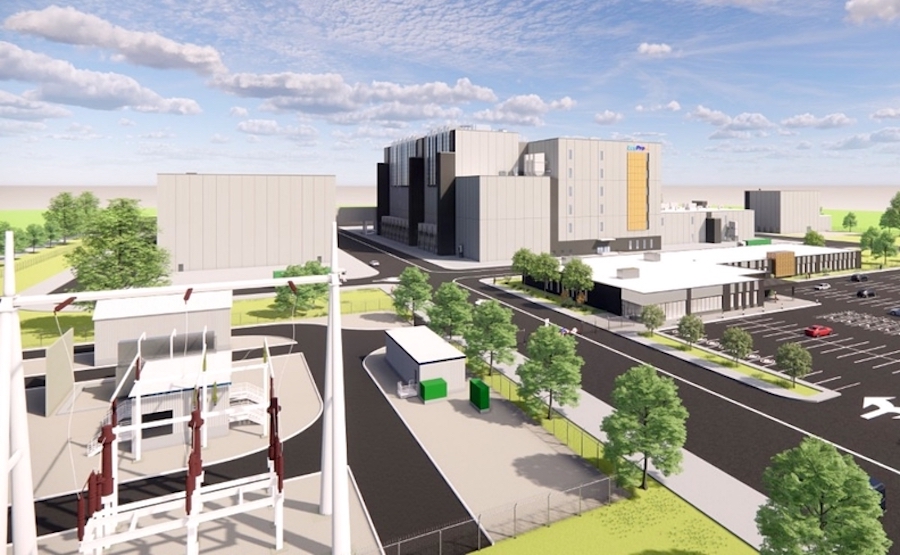
The developer of the $3 billion Mauricie project, which will be one of Canada’s largest green hydrogen projects, has awarded its first key engineering contract to AtkinsRéalis Inc.
The Quebec project, intended to produce 70,000 metric tons per year of green hydrogen at the province’s emerging industrial decarbonization hub, will include the construction of a purpose-built electrolyser, 1,000 MW of wind and solar power facilities and a network of transmission lines and substations, developer TES. Canada said.
The green hydrogen produced by the project, announced last year, will be used to decarbonise long-distance transport and industrial sectors, and produce renewable natural gas.
The owner said the Mauricie Project will start construction in 2026 for a targeted operation in 2028. “It could be multiple contractors, it could be one contractor, so that’s what we’re trying to determine at this point,” Andrew said Romano, who heads the renewable energy portfolio at AtkinsRéalis, formerly SNC Lavalin Inc.
“This is largely new infrastructure strategically located near existing Hydro Quebec service corridors,” he said. That includes the company’s “existing, very robust power grid that uses a lot of hydropower to generate clean power,” Romano added.
The project is located in the so-called Vallée de la Transition Energétique between Montreal and Quebec, in an industrial corridor near the St. Lawrence River, which was designated last year by the governments of Quebec and Canada as an innovation center in the energy transition.
Two large American car plants to produce materials for electric vehicles that were announced over the past two years are expected to be completed in Becancoeur, Quebec, within the center.
One is a $443 million factory, built by General Motors and South Korean industrial materials maker POSCO Future M, that will manufacture key active cathode components for EV lithium-ion batteries. It will open in 2025. The federal and provincial governments announced last year that they will provide $221 million in funding for the plant.
An $887 million Ford Motor Corp. cathode production facility is set to open in mid-2026. and two South Korean energy companies, SK On and EcoProBM, with capacity to manufacture 45,000 metric tons. Its area of 3 million square meters will include a six-story building.
Powers of design
For the facility’s green energy design, AtkinsRéalis and consulting engineer BBA, both based in Montreal, will develop the Project Mauricie plans, execution schedule, cost estimates and evaluations of environmental impact, they will also assist in geotechnical investigations, permitting and stakeholder and community engagement.
“This is an amazing project, the largest project in Quebec for decarbonization,” said Jean-Benoît Courchesnes, vice-president of business development at TES Canada. He called Project Mauricie “well structured”, with each component “well defined”.
The project will incorporate an existing 150 MW transmission line to provide baseload power to the new electrolyser, with new production and storage facilities, as well as wind turbines, collector network and access roads. “Real, tangible infrastructure is envisioned here,” Romano said.
Pierre-Olivier Pineau, research chair in energy sector management at the public business school, HEC Montreal, says securing a 150 MW base of renewable energy from Quebec Hydro is “smart,” but TES Canada he must make sure that there is a business model that can sustain this project”.
Projet Mauricie has already contracted all of its renewable natural gas production to Montreal-based energy distributor Énergir Inc. on a long-term, fixed-price contract, Courchesnes said.
“TThe rest of the green hydrogen production, up to 30,000 tonnes per year, will be sold under short-term agreements to the local heavy transport sector,” he said. TES Canada also works with three of Quebec’s largest logistics and fleet operators, “which have already placed tanks in hydrogen fuel cell trucks,” he added.
