

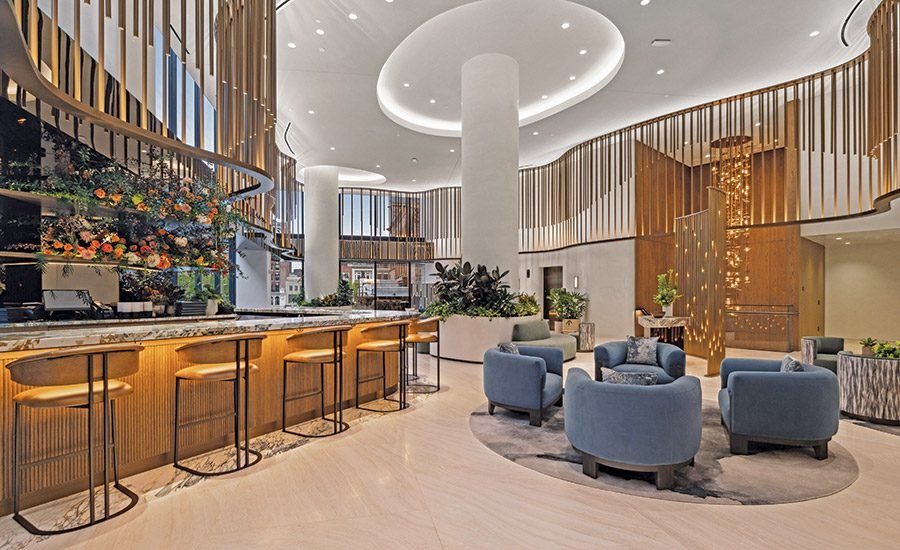
200 Club
Boston
BEST PROJECT
Presented by Commodore Builders
Owner: BXP
Main design company: Rockwell Group
Construction Manager: Commodore Builders
Structural Engineer: LeMessuier
MEP Engineer: Jaros, Baum & Bolles Consulting Engineers LLP
Architect of record: Finegold Alexander Architects
Named for its address, 200 Clarendon St., this conventional second-floor office space is now a 300,000-square-foot hospitality and wellness club. The transformation added a fully equipped wellness center, multipurpose fitness studios, showers, changing rooms and several flexible meeting rooms, as well as dedicated event and lounge spaces. Additional amenities include quiet work pods, collaborative living areas, a wellness/mom room and hotel-style concierge service, all designed to create a high-end, customer-focused environment.
The design takes advantage of the building’s elevation with full-height windows overlooking a bustling plaza, flooding the space with natural light and enhancing visual connectivity to one of Boston’s most iconic pedestrian areas. The lobby was also reimagined to better serve both customers and guests, improving flow and enhancing the overall brand experience.

Photo by Will Gaddis, Flylisted, courtesy of Commodore Buildings
Adapting the existing building infrastructure to accommodate the new programming required close collaboration with engineers and business partners to redesign mechanical and plumbing strategies within low floor-to-floor heights. Systems were routed through extremely tight interstitial spaces maintaining system integrity for adjacent clients. The complex curved walls, ceilings and columns were constructed from custom fiberglass reinforced plaster components, carefully coordinated with the routing of the building’s infrastructure. For the fiber-optic “starlight” ceilings, the team devised a new installation method by individually leveling each acoustic panel and threading the fiber-optic strands by hand.
To manage noise and minimize disruption to the building’s commercial customers and residential occupiers, all high-decibel work, including demolition and core drilling, was carried out during after-hours and weekends. This approach required detailed phase plans, coordination with property management and proactive communication to ensure smooth daily operations for building occupants.
Despite supply chain challenges, materials were sourced precisely and any substitutions were carefully approved to preserve the luxury aesthetic of the space.
